In brief
- ARTEMIS-008 randomised 461 patients in China with small cell lung cancer (SCLC) that had relapsed after first-line platinum-based chemotherapy to risvutatug rezetecan (Ris-Rez), a B7-H3-directed antibody-drug conjugate, or to topotecan.
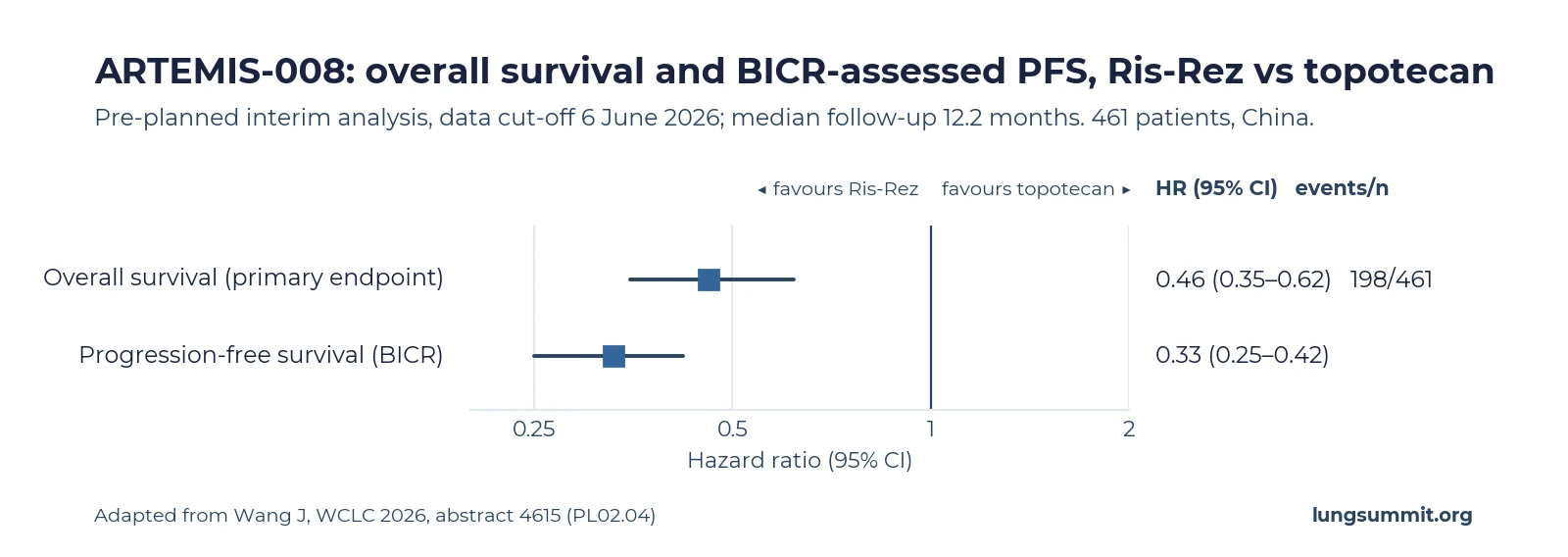
- At a pre-planned interim analysis, median overall survival, the primary endpoint, was 18.5 months with Ris-Rez versus 10.3 months with topotecan (HR 0.46; 95% CI 0.35–0.62; P<0.0001).
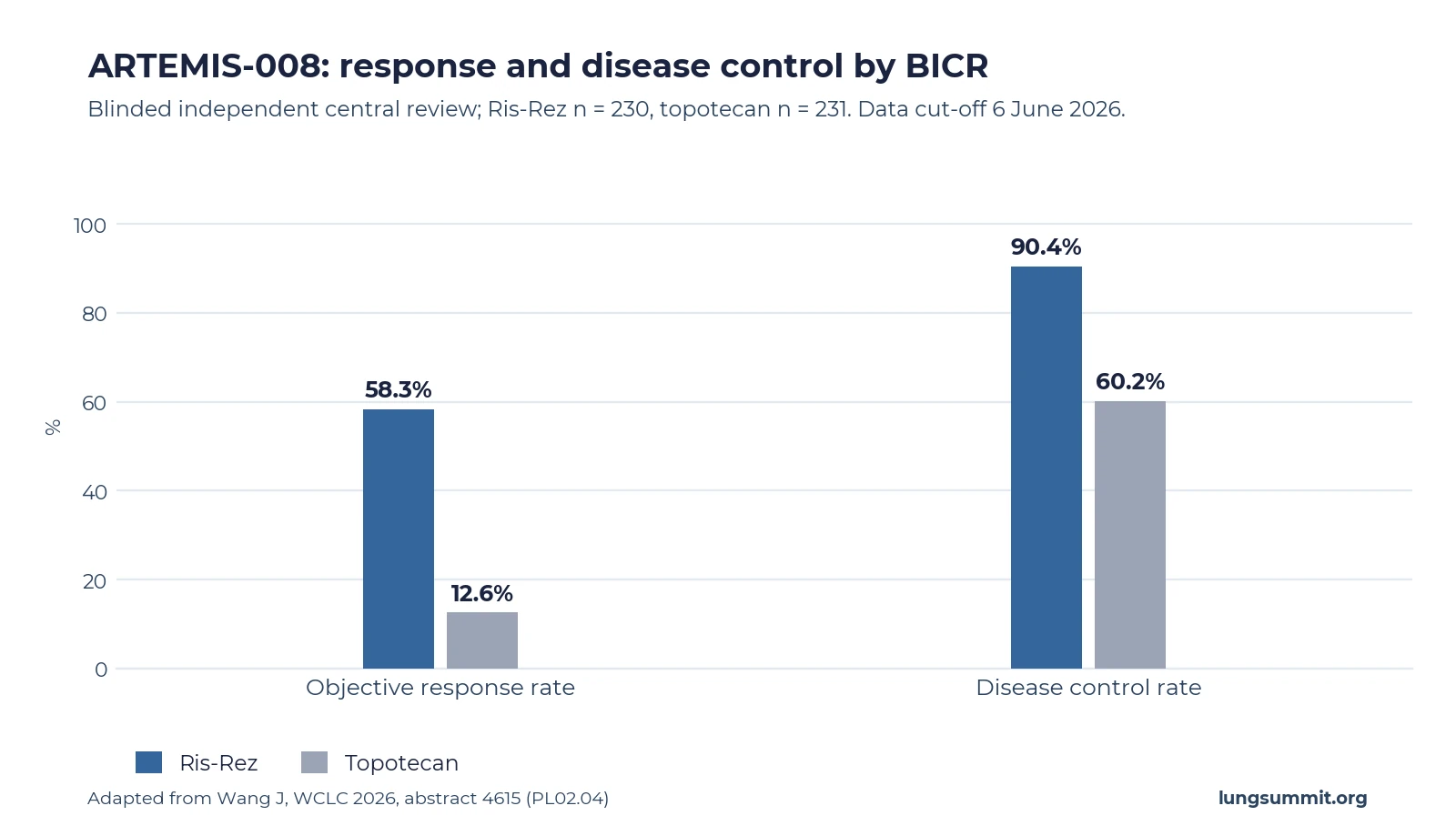
- Median progression-free survival by blinded independent central review was 7.2 versus 3.0 months (HR 0.33; 95% CI 0.25–0.42); the objective response rate was 58.3% versus 12.6%.
- Grade 3 or higher treatment-related adverse events were less frequent with Ris-Rez (60.9% versus 78.2%). Interstitial lung disease occurred in 11.7% of Ris-Rez patients versus 1.9% with topotecan, with no grade 4 or 5 events.
Study at a glance
- Trial: ARTEMIS-008 (NCT06498479), sponsored by Shanghai Hansoh BioMedical
- Design: multi-centre, open-label, randomised, controlled phase 3 conducted in China; the abstract describes the population as Chinese patients and every participating centre listed is in China
- Population: 461 adults with SCLC relapsed after first-line platinum-based therapy, ECOG performance status 0–1, measurable disease; stable brain metastases allowed. 87% had extensive-stage disease at entry and 80.9% had received a PD-(L)1 inhibitor
- Arms: Ris-Rez 8.0 mg/kg intravenously every 3 weeks (n = 230) versus topotecan 1.2 mg/m² intravenously on days 1–5 every 3 weeks (n = 231); randomised 1:1, stratified by chemotherapy-free interval, baseline brain metastases and disease stage
- Primary endpoint: overall survival, met at the pre-planned interim analysis. Secondary endpoints: progression-free survival, objective response rate, disease control rate and duration of response by blinded independent central review and by investigator; safety
- Data cut-off 6 June 2026; median follow-up 12.2 months; 198 deaths (77 with Ris-Rez, 121 with topotecan) against 192 planned for the interim analysis
An interim analysis powered for survival, in a population that had mostly seen a PD-(L)1 inhibitor
Risvutatug rezetecan, formerly HS-20093 and also known as GSK5764227, is an antibody-drug conjugate that couples a human anti-B7-H3 IgG1 antibody to a topoisomerase I inhibitor payload (rezetecan) through a cleavable linker, with a drug-to-antibody ratio of about 4. B7-H3 is expressed at high levels on SCLC, and in the presentation Prof. Wang cited the earlier phase 1 ARTEMIS-001 study, in which heavily pretreated patients with extensive-stage SCLC had a confirmed objective response rate of 52.3% and a median overall survival of 13.0 months.
ARTEMIS-008 enrolled patients aged 18 years or older with SCLC that had relapsed after first-line platinum-based therapy, measurable disease by RECIST 1.1 and an ECOG performance status of 0 or 1. Stable brain metastases were permitted. Randomisation was 1:1 and stratified by chemotherapy-free interval (less than 90 days or 90 days and more), baseline brain metastases and disease stage at study entry. Treatment continued until progression or another discontinuation criterion was met. The primary endpoint was overall survival; the interim analysis was pre-planned at 192 deaths, corresponding to a 75% information fraction of the 256 events required for the final analysis.
The two arms were well matched. Median age was 61.5 years in the Ris-Rez group and 63.0 years in the topotecan group, and about 83% of patients in each arm were men. All patients were Asian. Extensive-stage disease was recorded at study entry in 87.0% and 87.9% of patients, brain metastases in 19.1% and 19.9%, and liver metastases in 21.3% and 27.7%. A chemotherapy-free interval shorter than 90 days, the platinum-resistant setting, applied to 36.1% and 36.8% of patients. Every patient had received exactly one prior line of therapy, and 82.6% and 79.2% had received a PD-(L)1 inhibitor, so for most patients the immune checkpoint inhibitor had been part of that first-line regimen.
Median overall survival of 18.5 versus 10.3 months, with a hazard ratio of 0.46
At the data cut-off of 6 June 2026, after a median follow-up of 12.2 months, 77 patients (33.5%) in the Ris-Rez arm and 121 (52.4%) in the topotecan arm had died. Median overall survival was 18.5 months with Ris-Rez and 10.3 months with topotecan. The stratified hazard ratio was 0.46 (95% CI 0.35–0.62; P<0.0001). The presentation reported that the benefit was consistent across the pre-defined subgroups; the subgroup estimates were shown graphically and were not given as numbers in the abstract. Patients were censored at their last known survival time, and the 15 patients in the topotecan arm who withdrew consent before receiving treatment were censored at withdrawal.
The IASLC news release expresses the same hazard ratio as a 54% reduction in the risk of death. Prof. Wang summarised the primary result in the release.
“Ris-Rez demonstrated a statistically significant and clinically meaningful overall survival benefit over topotecan in patients with SCLC that progressed after platinum-based therapy, with a favorable safety profile.”
Prof. Jie Wang, National Cancer Center/National Clinical Research Center for Cancer/Cancer Hospital, Chinese Academy of Medical Sciences Peking Union Medical College, Beijing, China
Progression-free survival more than doubled and a 58% response rate by central review
Progression-free survival by blinded independent central review (BICR) was a median of 7.2 months with Ris-Rez and 3.0 months with topotecan (HR 0.33; 95% CI 0.25–0.42). Investigator assessment gave the same direction of effect, with medians of 7.8 and 4.0 months (HR 0.35; 95% CI 0.28–0.45).
By BICR, the objective response rate was 58.3% (95% CI 51.6–64.7) with Ris-Rez and 12.6% (95% CI 8.6–17.5) with topotecan. Four Ris-Rez patients (1.7%) had a complete response; the remainder of the responses in both arms were partial. The disease control rate was 90.4% (95% CI 85.9–93.9) versus 60.2% (95% CI 53.5–66.5). Median duration of response was 6.9 months (95% CI 5.6–8.2) with Ris-Rez and 5.6 months (95% CI 3.0–8.3) with topotecan; the difference between the arms lies more in the proportion of patients who respond than in the duration of response.
Less high-grade toxicity than topotecan, but interstitial lung disease in 11.7%
The safety population comprised 230 patients treated with Ris-Rez and 216 treated with topotecan, the 15 patients who withdrew before dosing being excluded. Median exposure was 6.9 months with Ris-Rez and 2.8 months with topotecan. Every treated patient in both arms had a treatment-related adverse event (TRAE). Grade 3 or higher TRAEs occurred in 60.9% of Ris-Rez patients and 78.2% of topotecan patients, and serious TRAEs in 34.3% and 37.5%. TRAEs led to dose reduction in 20.4% versus 38.0% of patients, to dose interruption in 11.3% versus 0.5%, and to treatment discontinuation in 9.1% versus 4.2%. Three deaths (1.3%) in the Ris-Rez arm were attributed to treatment: one each from pneumonia, septic shock and Pneumocystis jirovecii pneumonia. Two treatment-related deaths (0.9%) occurred with topotecan, one from septic shock with respiratory failure and one from myelosuppression.
The most common grade 3 or higher TRAEs in both arms were haematological. According to the abstract, grade 3 or higher decreased neutrophil count occurred in 27.0% of Ris-Rez patients versus 40.7% with topotecan, decreased white blood cell count in 24.3% versus 32.4%, anaemia in 17.4% versus 25.0% and decreased platelet count in 13.9% versus 59.7%. Grade 3 or higher decreased lymphocyte count was the one haematological event more frequent with the ADC, at 16.1% versus 10.2%.
Interstitial lung disease (ILD), searched with the narrow standardised MedDRA query, was recorded in 27 Ris-Rez patients (11.7%) and 4 topotecan patients (1.9%); grade 3 or higher ILD occurred in 9 (3.9%) and 2 (0.9%) respectively. No grade 4 or 5 ILD event was reported in either arm. The presenters characterised the overall profile as favourable with no new safety signals.
A China-only trial, with a global phase 3 already under way
ARTEMIS-008 was run entirely in China, in a population that was 100% Asian and predominantly male, and the interim analysis was reached at a median follow-up of a little over a year. Whether the same effect holds in other populations remains to be shown; the presentation described a global phase 3 study of Ris-Rez in relapsed SCLC, EMBOLD-SCLC-301 (NCT07099898), as ongoing. The presenters also referred to previously reported results of ARTEMIS-101 in previously treated non-squamous NSCLC as evidence for the drug across lung cancer settings, a claim that belongs to the sponsor and the investigators rather than to this trial.
In the abstract, the authors conclude that the results “suggest the potential of Ris-Rez to define a new standard of care in relapsed SCLC.” On the numbers reported in Seoul, the trial delivered a median overall survival gain of 8.2 months over topotecan at its first pre-planned look, with a lower rate of high-grade toxicity but a higher rate of interstitial lung disease. No journal publication accompanying the presentation was named in the press material.
Sources
- Wang J, Wang L, Duan J, et al. Risvutatug rezetecan (a B7-H3-directed ADC) versus topotecan in relapsed SCLC: primary results of phase 3 ARTEMIS-008. IASLC 2026 World Conference on Lung Cancer, Seoul, 12–15 September 2026; abstract 4615 (session PL02.04).
- IASLC news release, Seoul, 13 September 2026: “Phase III ARTEMIS-008 Trial Shows Risvutatug Rezetecan Significantly Improves Overall Survival in Relapsed Small-Cell Lung Cancer”.
- ARTEMIS-001 phase 1 results in extensive-stage SCLC, as cited in the presentation: Cancer Cell 2026;44(4):846–857.
ILCS 2026
The International Lung Cancer Summit (ILCS 2026) takes place on Friday 13 November 2026 in Lausanne and live online. Faculty will discuss the WCLC 2026 data in the context of daily practice. Register for ILCS 2026 →
Written by the Lung Summit editorial team.
This article was produced independently by the Lung Summit editorial team, without industry funding or input.