In brief
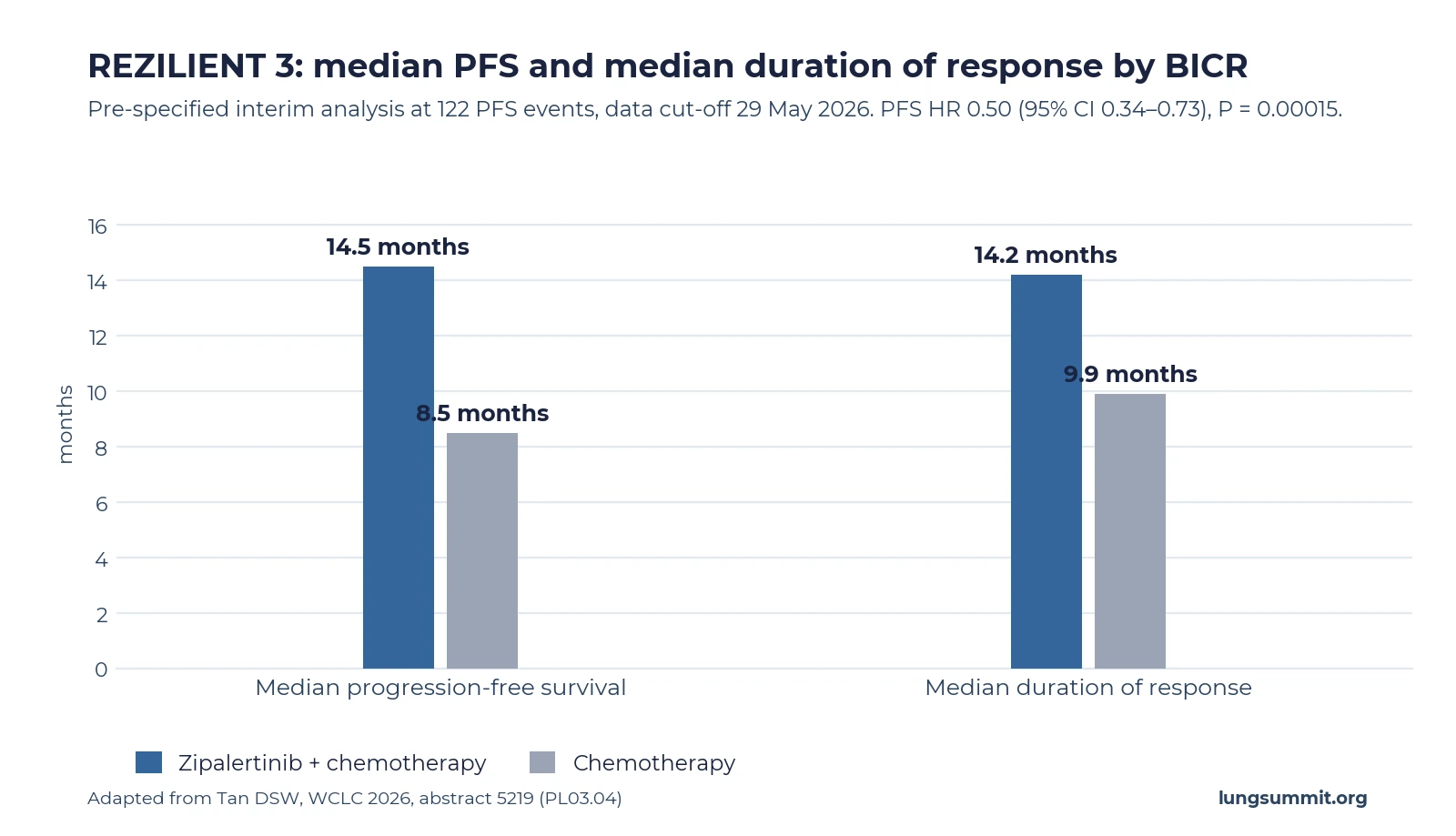
- REZILIENT 3 met its primary endpoint at a pre-specified interim analysis: median progression-free survival by blinded independent central review was 14.5 months with zipalertinib plus platinum–pemetrexed versus 8.5 months with chemotherapy alone (HR 0.50; 95% CI 0.34–0.73; P = 0.00015).
- Objective response rate was 65.0% versus 40.3% (P < 0.0001), with a median duration of response of 14.2 versus 9.9 months.
- Overall survival is immature: HR 0.72 (95% CI 0.42–1.23) after a median follow-up of 10.9 months, with 24.5% of the chemotherapy arm crossed over to zipalertinib.
- Grade 3 or higher treatment-related adverse events occurred in 80.7% versus 40.4%, driven by anaemia, thrombocytopenia and neutropenia; three treatment-related deaths were recorded on the combination and none on chemotherapy alone.
Study at a glance
- Trial: REZILIENT 3 (NCT05973773)
- Randomised phase 3 with a safety lead-in of 6–12 patients; international (188 sites planned; stratified by ECOG status, brain metastases and region, Asia versus non-Asia); open-label according to the IASLC release; optional crossover to zipalertinib on progression
- Population: 279 patients with untreated metastatic NSCLC and a locally tested EGFR exon 20 insertion, ECOG performance status 0–1; stable brain metastases permitted
- Arms: zipalertinib 100 mg twice daily plus pemetrexed and carboplatin or cisplatin (n = 140) versus the same chemotherapy alone (n = 139)
- Primary endpoint: progression-free survival by blinded independent central review; met at the pre-specified interim analysis (HR 0.50; 95% CI 0.34–0.73; P = 0.00015 against an interim boundary of P < 0.0196)
- Data cut-off 29 May 2026 at 122 PFS events; median follow-up 10.9 months for the overall survival interim
A selective inhibitor enters the first line after amivantamab and sunvozertinib
EGFR exon 20 insertions make up 5–10% of EGFR mutations in NSCLC and form a heterogeneous group with variable sensitivity to EGFR-directed therapy, according to the background slides. Two randomised trials have already reported a progression-free survival gain over chemotherapy in this population, one with amivantamab plus platinum-based chemotherapy and one with sunvozertinib. Zipalertinib (TAS6417, CLN-081) is a tyrosine kinase inhibitor built on a pyrrolopyrimidine scaffold. It forms an irreversible covalent bond with C797 and was designed for selectivity toward exon 20 insertion mutants over wild-type EGFR. Phase 1 and 2 studies reported activity, including in the central nervous system and after prior amivantamab.
REZILIENT 3 (NCT05973773) randomised 279 patients with untreated metastatic NSCLC, a locally confirmed EGFR exon 20 insertion and an ECOG performance status of 0 or 1 to zipalertinib 100 mg twice daily plus pemetrexed with carboplatin or cisplatin (n = 140), or to the same chemotherapy alone (n = 139). Stable brain metastases were permitted, and archival tissue was required. Randomisation was stratified by ECOG status, brain metastases and region (Asia versus non-Asia). Patients in the chemotherapy arm could cross over to zipalertinib on progression. The IASLC release describes the trial as international, randomised and open-label; 188 sites were planned. A safety lead-in of 6 to 12 patients preceded the randomised phase, and an independent data monitoring committee judged the combination safe to proceed.
The primary endpoint was progression-free survival by blinded independent central review (BICR). The final analysis was planned at 162 events to detect a hazard ratio of 0.60 with 90% power at a two-sided alpha of 0.05. A pre-specified interim analysis at 122 events, with a data cut-off of 29 May 2026, could claim superiority at a two-sided P below 0.0196. Secondary endpoints were overall survival, investigator-assessed PFS, objective response rate, duration of response, safety and patient-reported outcomes.
The two arms were balanced. Median age was 66.5 years (range 30–89) in the combination arm and 64.0 years (27–82) with chemotherapy; 65.7% and 63.3% of patients were women, 40.0% and 40.3% were enrolled in Asia, 97.1% in each arm had adenocarcinoma, and 31.4% and 31.7% had brain metastases at baseline. About six in ten patients in each arm had never smoked.
Median progression-free survival of 14.5 versus 8.5 months
At the interim cut-off, 50 of 140 patients on the combination and 72 of 139 on chemotherapy had progressed or died, the 122 events the analysis was designed around. Median PFS by BICR was 14.5 months (95% CI 12.9–21.4) with zipalertinib plus chemotherapy and 8.5 months (95% CI 7.0–10.9) with chemotherapy alone, a hazard ratio of 0.50 (95% CI 0.34–0.73; P = 0.00015), inside the interim boundary. The slides label the difference a six-month gain. At the cut-off, 64.3% of patients on the combination were censored, compared with 48.2% on chemotherapy.
The IASLC release states that the PFS benefit was consistent across subgroups, including patients with brain metastases. Subgroup hazard ratios were presented graphically and are not reproduced here. Prof. Tan summarised the primary result in the release:
“REZILIENT 3 demonstrated that adding zipalertinib to platinum-based chemotherapy produced a statistically significant and clinically meaningful six-month improvement in progression-free survival for patients with advanced NSCLC and EGFR exon 20 insertion mutations,”
Prof. Daniel Tan, National Cancer Centre Singapore and Duke-NUS Medical School, Singapore
Responses in two thirds of patients; overall survival not yet readable
The objective response rate by BICR (RECIST 1.1) was 65.0% (95% CI 56.49–72.86) with zipalertinib plus chemotherapy and 40.3% (95% CI 32.06–48.94) with chemotherapy alone (P < 0.0001). The response table counts 136 evaluable patients in the chemotherapy arm. Complete responses were recorded in 9 patients (6.4%) and 3 patients (2.2%), and disease control in 89.3% versus 81.3%. Responses appeared sooner with the combination, at a median of 1.4 months versus 2.6 months, and lasted longer: median duration of response was 14.2 months (95% CI 10.51–not estimable) among 91 responders, compared with 9.9 months (95% CI 6.80–not estimable) among 56.
Overall survival is immature. After a median follow-up of 10.9 months, 24 of 140 patients in the combination arm and 31 of 139 in the chemotherapy arm had died. The median was not reached in either arm; the lower bound of the 95% confidence interval was 18.4 months for chemotherapy. The hazard ratio was 0.72 (95% CI 0.42–1.23; P = 0.11), and 24.5% of the chemotherapy arm had crossed over to zipalertinib by the cut-off.

Grade 3 cytopenias in most patients on the combination
In the safety population (140 and 136 patients), treatment-related adverse events of grade 3 or higher were reported in 113 patients (80.7%) on the combination and 55 (40.4%) on chemotherapy alone. Serious adverse events occurred in 50.7% versus 33.1%, and treatment-related serious events in 37.9% versus 12.5%. The excess was mainly haematological. Anaemia of any grade affected 80.7% of the combination arm (grade 3 or higher, 48.6%) against 50.0% (12.5%) with chemotherapy; thrombocytopenia 56.4% (30.0%) versus 19.9% (8.1%); and neutropenia 50.7% (33.6%) versus 40.4% (22.1%).
EGFR-related events were mostly low grade. Rash of any grade occurred in 45.7% of the combination arm (grade 3 or higher, 10.7%), paronychia in 31.4% (1.4%), stomatitis in 28.6% (5.0%) and diarrhoea in 27.1% (1.4%); no grade 3 or higher rash or diarrhoea was recorded on chemotherapy alone. Pneumonitis was reported in 5.7% versus 2.2% (grade 3 or higher, 2.1% versus 1.5%).
Adverse events led to interruption of zipalertinib in 82.9% of patients, to dose reduction in 43.6% and to discontinuation in 17.1%. Pemetrexed was discontinued for an adverse event in 31.4% of the combination arm versus 11.8% with chemotherapy alone. The median relative dose intensity of zipalertinib was 87.1%; for the chemotherapy components it was 98.5% or higher in both arms. Adverse events with a fatal outcome were recorded in 13 patients (9.3%) on the combination and 4 (2.9%) on chemotherapy. Three deaths (2.1%) in the combination arm were judged treatment related, and sepsis or septic shock with a fatal outcome was recorded in 3 patients (2.1%) in that arm; neither occurred on chemotherapy alone.
On the conclusion slide, the investigators characterised the grade 3 excess as largely cytopenias and their sequelae, concentrated in the first four cycles and manageable with dose reductions. The IASLC release states that no new safety signals were observed.
Crossover, continuing follow-up and REZILIENT 4
The overall survival estimate rests on 55 deaths, with a quarter of the chemotherapy arm already crossed over to zipalertinib. The slides list further analysis of both overall survival and the adverse-event profile as ongoing, and the release says follow-up continues for overall survival and exploratory endpoints. REZILIENT 3 compared the combination with chemotherapy alone; a comparison with amivantamab plus chemotherapy or with sunvozertinib, the regimens with existing randomised PFS data in this population, was not part of the trial. The investigators concluded that zipalertinib with platinum-based chemotherapy is a new option for first-line treatment of metastatic EGFR exon 20 insertion NSCLC. The closing slide also lists REZILIENT 4 (NCT07128199), a trial of adjuvant zipalertinib in uncommon EGFR mutations.
Sources
- Tan DSW, et al. Zipalertinib plus chemotherapy for 1st line NSCLC with EGFR exon 20 insertions: results from the phase 3 trial (REZILIENT 3). IASLC 2026 World Conference on Lung Cancer, Seoul, 12–15 September 2026; abstract 5219 (session PL03.04).
- IASLC news release, Seoul, 14 September 2026: “Zipalertinib Plus Chemotherapy Significantly Extends Progression-Free Survival in First-Line EGFR Exon 20 Insertion-Positive NSCLC”.
ILCS 2026
The International Lung Cancer Summit (ILCS 2026) takes place on Friday 13 November 2026 in Lausanne and live online. Faculty will discuss the WCLC 2026 data in the context of daily practice. Register for ILCS 2026 →
Written by the Lung Summit editorial team.
This article was produced independently by the Lung Summit editorial team, without industry funding or input.