In brief
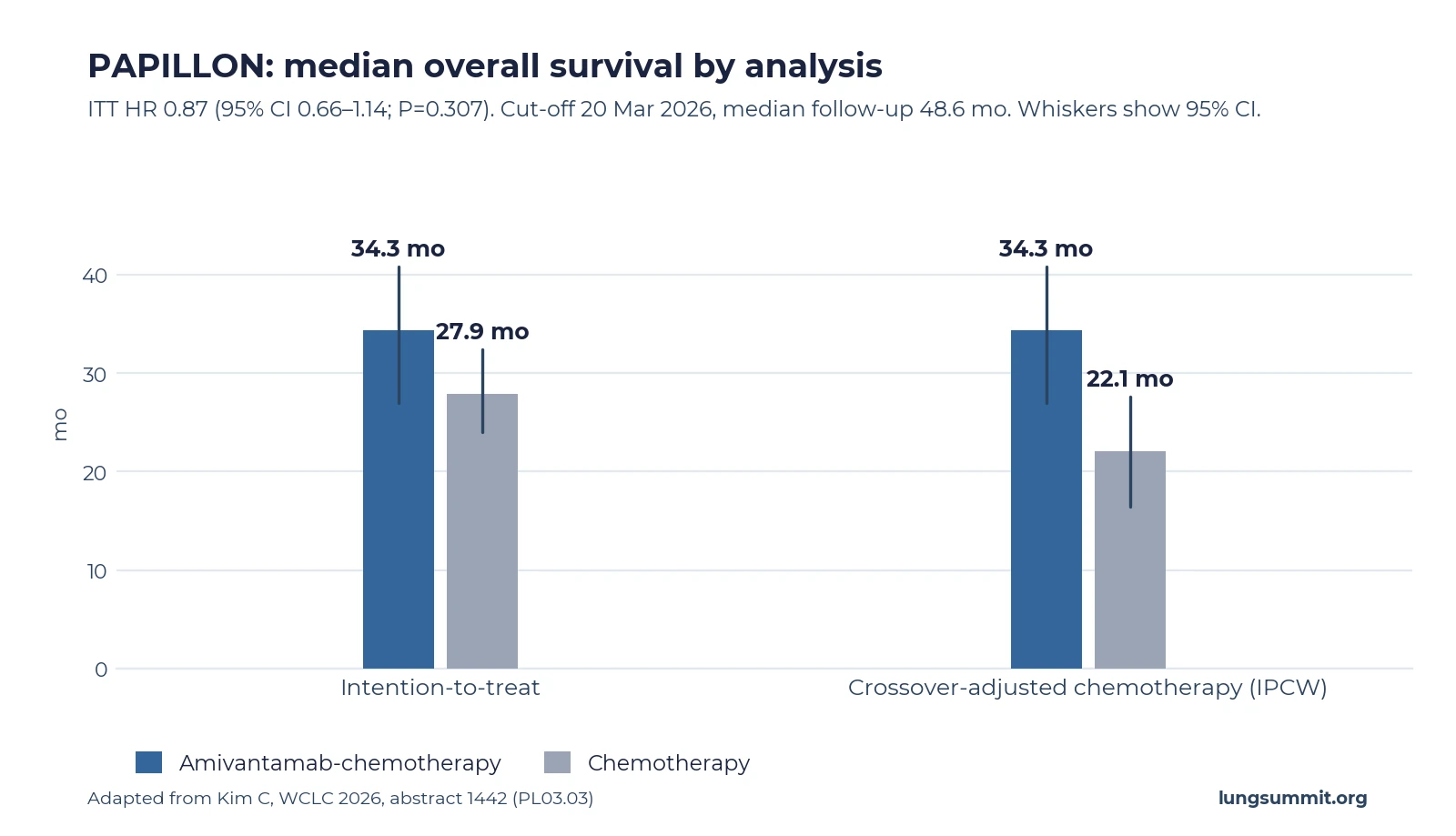
- Final overall survival in PAPILLON: median 34.3 months with first-line amivantamab plus carboplatin-pemetrexed versus 27.9 months with chemotherapy alone (HR 0.87, 95% CI 0.66–1.14; P=0.307) after a median follow-up of 48.6 months. The difference was not statistically significant.
- Of the 128 chemotherapy-arm patients who progressed, 97 (76%) went on to second-line amivantamab. The prespecified crossover-adjusted analysis (IPCW) re-estimated the chemotherapy median at 22.1 months, HR 0.57 (nominal P below 0.01).
- Time to second progression (PFS2) was 28.3 versus 17.5 months (HR 0.59, 95% CI 0.45–0.77), and time to worsening favoured the combination on five of eight EORTC QLQ-C30 symptom scales.
- No new safety signals; grade ≥3 neutropenia occurred in 34% versus 23%. The trial predates prophylactic measures for EGFR-related toxicity and subcutaneous amivantamab.
Study at a glance
- Trial: PAPILLON (NCT04538664)
- Phase 3, randomised 1:1; 308 participants from 24 countries, enrolled December 2020 to November 2022
- Population: treatment-naïve locally advanced or metastatic NSCLC with a documented EGFR exon 20 insertion, ECOG PS 0–1; n=308 (153 amivantamab-chemotherapy, 155 chemotherapy)
- Arms: amivantamab plus carboplatin-pemetrexed versus carboplatin-pemetrexed; on-protocol crossover to amivantamab monotherapy permitted after BICR-confirmed progression
- Primary endpoint: PFS by BICR, met at the primary analysis (11.4 vs 6.7 months; HR 0.40, 95% CI 0.30–0.53; P<0.001). Overall survival was a key secondary endpoint with approximately 56% power; HR 0.87, P=0.307, not significant
- Data cut-off 20 March 2026; median follow-up 48.6 months (range 0.3–59.4)
A 6.4-month difference in median survival, with a hazard ratio short of significance
At the clinical cut-off of 20 March 2026, median overall survival was 34.3 months (95% CI 27.0–40.8) in the amivantamab-chemotherapy arm and 27.9 months (95% CI 24.0–32.4) in the chemotherapy arm. The hazard ratio for death was 0.87 (95% CI 0.66–1.14; P=0.307), a 13% reduction in risk that did not reach statistical significance. Overall survival was tested after PFS and objective response rate in the hierarchy. According to the abstract, the final analysis was conducted after approximately 210 deaths across both arms and was estimated to provide approximately 56% power to detect a significant difference; the presentation adds that crossover attenuated that power further.
At the cut-off, 18 participants (12%) in the amivantamab-chemotherapy arm remained on treatment and none remained on chemotherapy. Median treatment duration was 13.4 months with the combination and 6.9 months with chemotherapy alone. Two participants randomised to the combination withdrew consent before receiving study drug, so the safety population in that arm is 151.
Both the abstract and the presentation describe 34.3 months as the longest median overall survival reported to date in EGFR Ex20ins advanced NSCLC. The reference point is external: the abstract cites historical real-world medians of 16.2 to 24.3 months for this population, which the presentation rounds to about 16 to 24 months.
Three in four chemotherapy patients who progressed went on to amivantamab
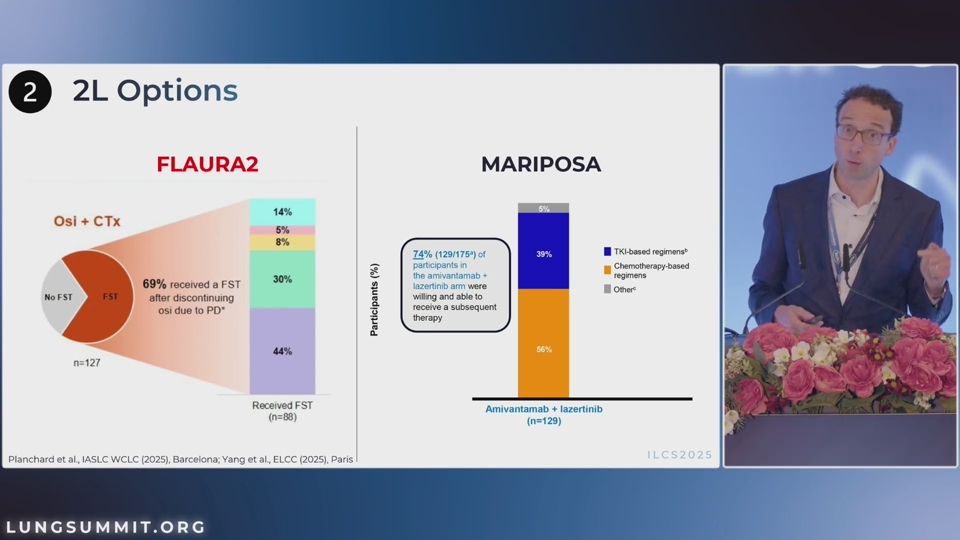
The trial allowed chemotherapy-arm participants to cross over to amivantamab monotherapy once progression had been confirmed by blinded independent central review. Of the 155 randomised to chemotherapy, 128 discontinued for progressive disease, and 97 of them (76%) received second-line amivantamab: 87 within the study and 10 off protocol. Overall, 129 chemotherapy-arm participants received a subsequent therapy compared with 83 in the combination arm; in the presentation the investigators attribute this asymmetry to the crossover design and to the absence of active second-line options at the time the trial was run. In the combination arm, the most frequent next treatments were chemotherapy or immune checkpoint inhibitor regimens (39 participants) and other EGFR-targeted or TKI-based regimens (31).
Because most control-arm patients eventually received the study drug, the protocol prespecified crossover-adjusted analyses, with inverse probability of censoring weighting (IPCW) as the primary model. Under IPCW, the estimated median for the chemotherapy arm falls to 22.1 months (95% CI 16.4–27.6) and the hazard ratio for amivantamab-chemotherapy versus adjusted chemotherapy is 0.57. The abstract gives the interval as 0.39–0.82 with a nominal P of 0.003; the presentation slide gives 0.35–0.77 and a nominal P of 0.002. The two sources disagree on the interval, so it is not quoted here as a single figure; both put the nominal P below 0.01. The presentation also reports two further models recommended in the EMA guidance on crossover adjustment: two-stage estimation gave an HR of 0.54 (95% CI 0.38–0.77) and rank-preserving structural failure time an HR of 0.71 (95% CI 0.37–1.36). None of these adjusted results formed part of the hierarchical testing.
The release quotes Dr. Kim on how the crossover should be read.
“While crossover likely attenuated the hazard-ratio-based overall survival estimate, the adjusted analysis showed a substantially longer estimated survival benefit, supporting amivantamab-chemotherapy as a foundational first-line regimen for patients with Ex20ins advanced NSCLC.”
Dr. Chul Kim, Georgetown Cancer Institute, Washington, DC, USA
Sex and smoking history split the subgroups; second progression came ten months later
Across the predefined subgroups, the presentation reports that overall survival generally favoured amivantamab-chemotherapy, with the caveat that subgroup analyses were not part of the hypothesis testing. Two splits stand out in the forest plot. Among women the HR was 0.58 (95% CI 0.40–0.84; n=178), among men 1.33 (95% CI 0.88–2.01; n=130). Among never-smokers the HR was 0.63 (95% CI 0.44–0.91; n=179), among participants with a smoking history 1.22 (95% CI 0.81–1.85; n=129). Age below 75 years gave an HR of 0.81 (95% CI 0.61–1.08); the 27 participants aged 75 or older gave 1.33 (95% CI 0.55–3.25). Participants with a history of brain metastases had an HR of 0.97 (95% CI 0.57–1.62) versus 0.82 (95% CI 0.60–1.13) without. The abstract does not report subgroup figures.
PFS2, the time from randomisation to a second progression event, was 28.3 months (95% CI 21.8–36.2) with the combination and 17.5 months (95% CI 15.2–21.0) with chemotherapy (HR 0.59, 95% CI 0.45–0.77; P<0.0001). Time to treatment discontinuation was 14.1 versus 7.6 months (HR 0.36, 95% CI 0.28–0.46) and time to subsequent therapy 16.9 versus 9.9 months (HR 0.37, 95% CI 0.29–0.48). These endpoints appear in the presentation only.
Toxicity from an era before prophylaxis, and symptom scales that favoured the combination
In the safety population of 151 combination-arm and 155 chemotherapy-arm participants, the investigators report a profile consistent with the primary publication and no new signals. The adverse events associated with EGFR inhibition were common with amivantamab: paronychia in 60% (grade ≥3 in 10%), rash in 58% (grade ≥3 in 15%) and acneiform dermatitis in 31%. Events associated with MET inhibition were hypoalbuminaemia in 46% and peripheral oedema in 34%. Infusion-related reactions occurred in 44%, almost all grade 1–2. Haematological toxicity was higher with the combination for neutropenia (60% versus 46% any grade; 34% versus 23% grade ≥3), similar for anaemia (53% versus 56%) and modestly higher for thrombocytopenia (38% versus 30%). Discontinuation for an adverse event occurred in 17 participants in each arm (11%).
The presentation makes a point about timing: PAPILLON was conducted before prophylactic strategies for these adverse events had been evaluated and before subcutaneous amivantamab became available, so the profile reported here is that of intravenous dosing without the measures now in use.
Patient-reported outcomes were measured with the EORTC QLQ-C30, with time to worsening defined as the first clinically meaningful deterioration of at least 10 points, or death. Five of the eight symptom scales favoured the combination at P<0.05: dyspnoea (median 12.4 versus 7.8 months; HR 0.68, 95% CI 0.51–0.90), pain (9.5 versus 6.0 months; HR 0.73, 95% CI 0.56–0.96), insomnia (13.8 versus 8.5 months; HR 0.69, 95% CI 0.52–0.93), nausea and vomiting (6.9 versus 4.3 months; HR 0.75, 95% CI 0.58–0.98) and diarrhoea (16.9 versus 11.7 months; HR 0.72, 95% CI 0.54–0.96). Fatigue, appetite loss and constipation did not differ. Time to symptomatic progression, an investigator-assessed endpoint, was 28.8 versus 22.4 months (HR 0.77, 95% CI 0.59–1.01; P=0.055).
The investigators’ conclusion, in the abstract and on the closing slide, is that the intention-to-treat result was attenuated by crossover, that the adjusted analysis shows a longer estimated survival benefit, and that the data support amivantamab-chemotherapy as a foundational first-line regimen in this population. The protocol-defined overall survival test itself was not met, and the adjusted hazard ratios carry nominal P values only.
Sources
- Kim C, Tang K-J, Cho BC, et al. First-line amivantamab-chemotherapy vs chemotherapy in NSCLC with EGFR exon 20 insertions: overall survival from PAPILLON. IASLC 2026 World Conference on Lung Cancer, Seoul, 12–15 September 2026; abstract 1442 (session PL03.03).
- IASLC news release, Seoul, 14 September 2026: “In the PAPILLON Study, First-Line Amivantamab-Chemotherapy Demonstrates the Longest Overall Survival Reported for EGFR Exon 20 Insertion-Positive Advanced NSCLC”.
- Zhou C, et al. N Engl J Med. 2023;389(22):2039–2051 (primary PFS analysis of PAPILLON, cited in the abstract and presentation).
ILCS 2026
The International Lung Cancer Summit (ILCS 2026) takes place on Friday 13 November 2026 in Lausanne and live online. Faculty will discuss the WCLC 2026 data in the context of daily practice. Register for ILCS 2026 →
Written by the Lung Summit editorial team.
This article was produced independently by the Lung Summit editorial team, without industry funding or input.