In brief
- TAISHAN-302 randomised 451 patients with SCLC relapsed after one platinum-based line, at 85 sites in China, to the anti-B7-H3 antibody-drug conjugate Tam-Peli or topotecan.
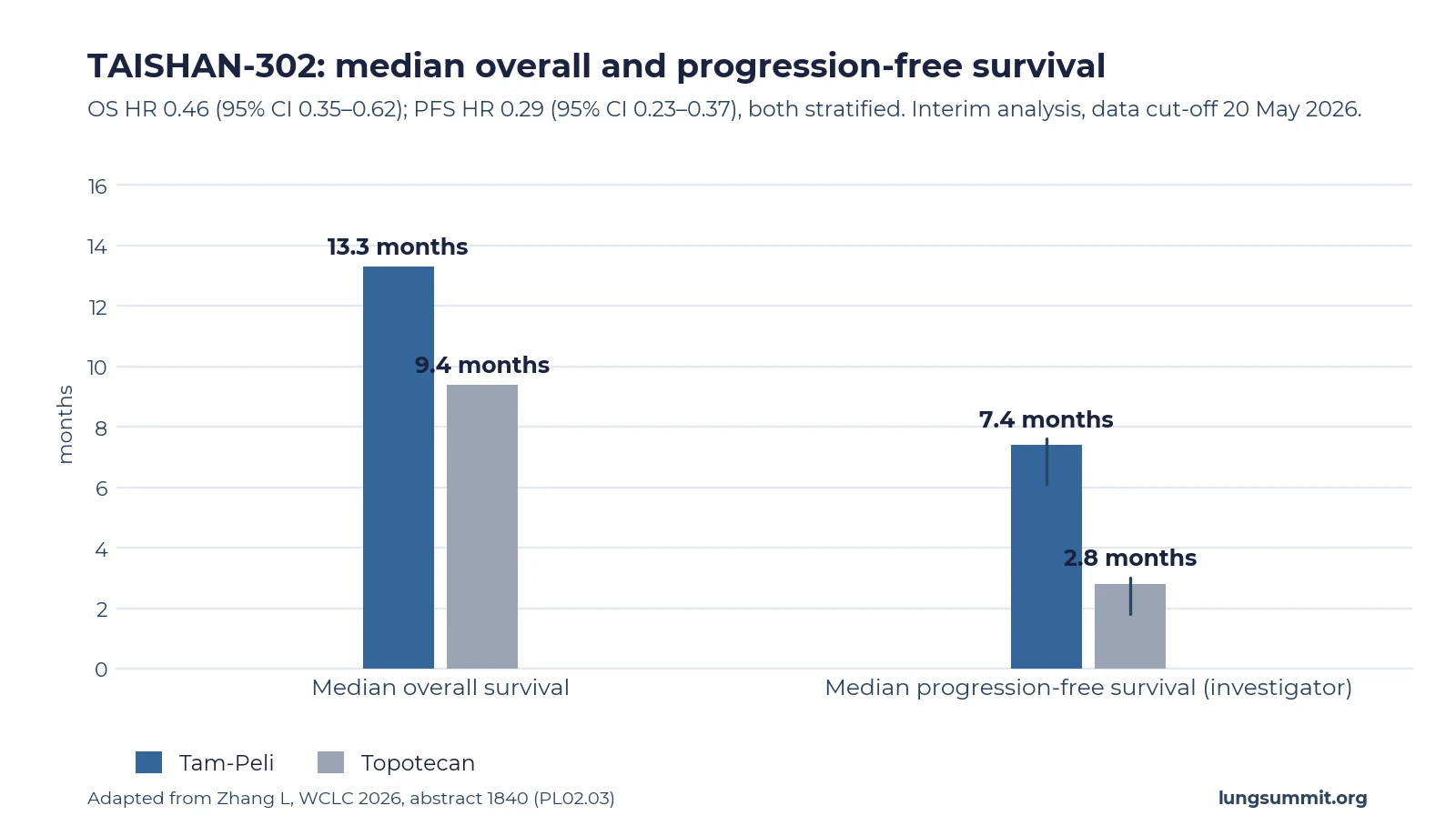
- At the interim analysis, median overall survival was 13.3 versus 9.4 months (stratified HR 0.46, 95% CI 0.35–0.62; p<0.0001), and median progression-free survival 7.4 versus 2.8 months (HR 0.29, 95% CI 0.23–0.37).
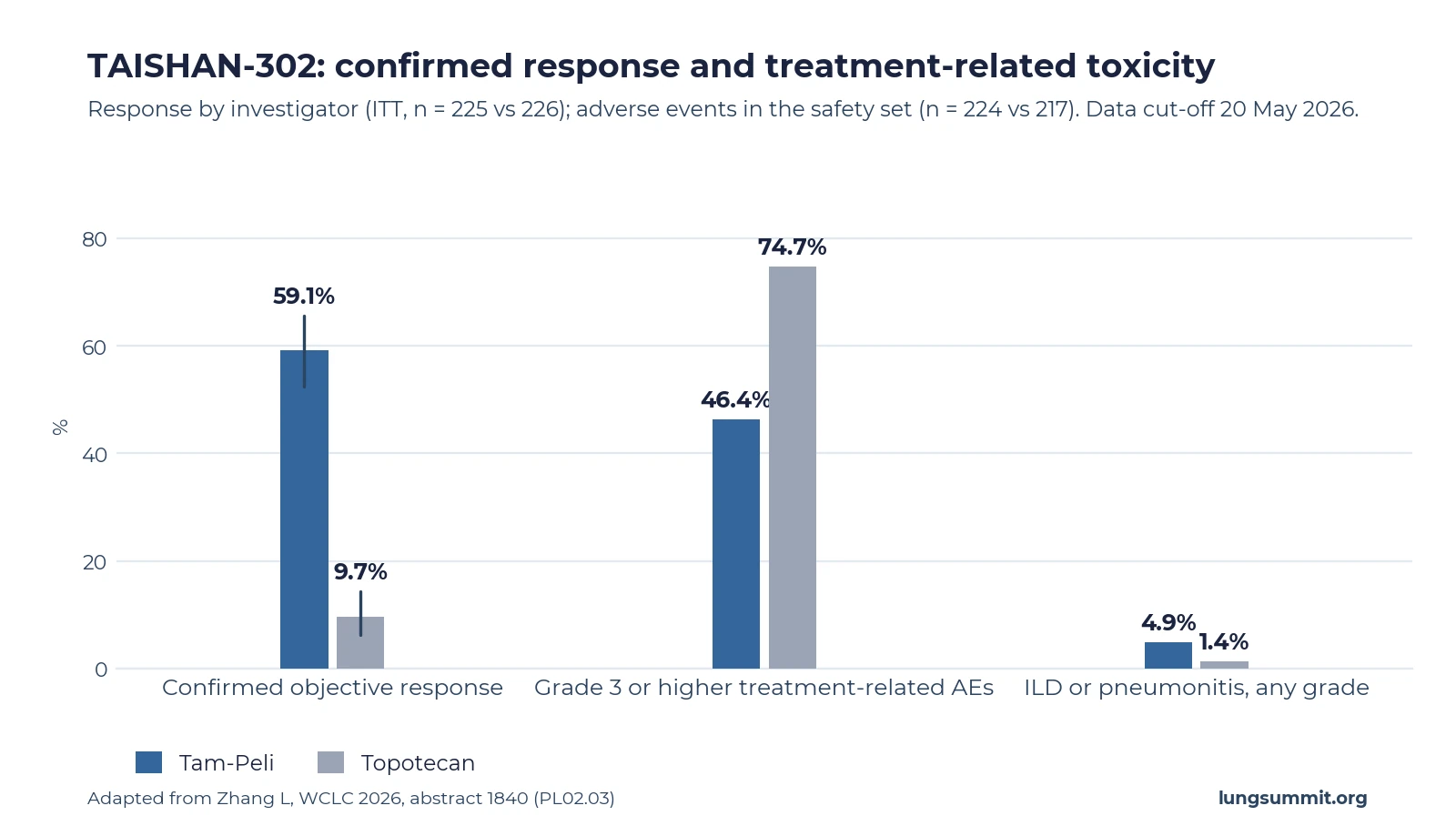
- Confirmed objective response was 59.1% with Tam-Peli and 9.7% with topotecan; no complete responses occurred in either arm.
- Grade 3 or higher treatment-related adverse events were less frequent with Tam-Peli (46.4% versus 74.7%); interstitial lung disease or pneumonitis occurred in 4.9% versus 1.4%, with no grade 4 or 5 events.
Study at a glance
- Trial: TAISHAN-302 (NCT06612151), sponsored by MediLink Therapeutics (Suzhou)
- Multicentre, randomised, open-label phase 3; 85 sites, all in China
- 451 patients with SCLC that had progressed after one prior line of platinum-based therapy, ECOG PS 0–1, measurable disease
- Tam-Peli 2.0 mg/kg IV day 1 every 3 weeks (maximum 200 mg), n = 225, versus topotecan 1.2 mg/m² days 1–5 every 3 weeks, n = 226; no crossover
- Primary endpoint overall survival: met at the interim analysis (HR 0.46, 95% CI 0.35–0.62; p<0.0001). Key secondary endpoints PFS and ORR by investigator: both met
- Data cut-off 20 May 2026; median follow-up 9.4 months (9.2 months with Tam-Peli, 9.5 with topotecan); 200 of a planned 285 OS events at the final analysis
A B7-H3 conjugate against topotecan, with survival as the primary endpoint
Tam-Peli is a fully human IgG1 antibody against B7-H3 carrying a topoisomerase 1 inhibitor payload (YL0010014) at a drug-to-antibody ratio of 8. The deck describes the linker as cleavable and activated in the tumour microenvironment, and the payload as 5 to 10 times more potent than deruxtecan. The investigators cite preclinical and phase 1/2 data in relapsed SCLC as the basis for the phase 3 comparison.
TAISHAN-302 enrolled adults with histologically or cytologically confirmed SCLC that had progressed after one prior line of platinum-based therapy, with at least one measurable lesion per RECIST version 1.1 and an ECOG performance status of 0 or 1. Patients were randomised 1:1 to Tam-Peli 2.0 mg/kg intravenously on day 1 of each 3-week cycle, capped at 200 mg, or to topotecan 1.2 mg/m² on days 1 to 5 of each 3-week cycle, the dose in the Chinese prescribing information. Treatment continued until progression or intolerable toxicity, and crossover between arms was not permitted. Randomisation was stratified by disease stage at enrolment (the deck labels the strata local versus systemic disease, the abstract limited versus extensive), by the presence of brain metastasis, and by a chemotherapy-free interval of under or at least 90 days.
Overall survival was the primary endpoint. Investigator-assessed progression-free survival and objective response rate were the key secondary endpoints, tested in a fixed sequence after overall survival. The design assumed a median overall survival of 8.0 months with topotecan and a hazard ratio of 0.7, and called for 285 deaths to give at least 85% power at a one-sided alpha of 0.025. One interim analysis was planned at 190 deaths. By the data cut-off of 20 May 2026 there had been 200, and the one-sided boundary recalculated for that number of events was 0.0075.
Between 17 December 2024 and 26 October 2025, 451 patients were randomised, 225 to Tam-Peli and 226 to topotecan. Median age was 62 years in both arms; 81.3% and 84.5% were men, and 82.7% and 88.1% had a performance status of 1. Almost all had received immunotherapy in the first line (86.2% and 88.1%). Brain metastases were present in 34.7% and 34.1%, liver metastases in 32.0% and 35.4%, and the chemotherapy-free interval was under 90 days in 48.9% and 48.7%. Only 3.1% and 4.4% had local disease at enrolment.
Median overall survival of 13.3 versus 9.4 months at the interim analysis
At the cut-off, median follow-up was 9.4 months (9.2 months in the Tam-Peli arm and 9.5 months in the topotecan arm), and 76 patients (33.8%) on Tam-Peli and 124 (54.9%) on topotecan had died. Median overall survival was 13.3 months (95% CI 12.1 to not estimable) with Tam-Peli and 9.4 months (95% CI 7.7–10.5) with topotecan. The stratified hazard ratio was 0.46 (95% CI 0.35–0.62; p<0.0001), which the investigators describe as a 54% reduction in the rate of death. The p-value cleared the interim boundary of 0.0075.
The abstract reports the effect as consistent across prespecified subgroups, with hazard ratios of 0.43 in patients with brain metastasis, 0.34 in those with liver metastasis and 0.44 in those with a chemotherapy-free interval under 90 days. The deck’s forest plot also stratified by baseline B7-H3 expression (H-score low, intermediate or high) among patients with expression data, but the per-subgroup estimates were not given in the text of either source.
Progression-free survival by investigator followed the same direction. With 134 events (59.6%) on Tam-Peli and 179 (79.2%) on topotecan, median progression-free survival was 7.4 months (95% CI 6.1–7.6) against 2.8 months (95% CI 1.8–3.0); the stratified hazard ratio was 0.29 (95% CI 0.23–0.37; p<0.0001). The deck reports the benefit as consistent across all subgroups for this endpoint as well.
Six in ten confirmed responses, all of them partial
The confirmed objective response rate by investigator was 59.1% (95% CI 52.4–65.6) with Tam-Peli and 9.7% (95% CI 6.2–14.4) with topotecan (p<0.0001). Every response was partial; there were no complete responses in either arm. Stable disease was the best response in 32.0% and 41.2%, progressive disease in 6.7% and 35.4%, and 2.2% and 13.7% were not evaluable. Disease control was reached in 91.1% (95% CI 86.6–94.5) of the Tam-Peli arm and 50.9% (95% CI 44.2–57.6) of the topotecan arm.
Responses came sooner with the conjugate, at a median of 1.5 months from randomisation compared with 2.6 months. Median duration of response was 6.3 months (95% CI 6.0–8.0) with Tam-Peli and 7.8 months (95% CI 3.3–9.9) among the 22 responders to topotecan. At the cut-off, 71 patients in the Tam-Peli arm were still on treatment against 8 in the topotecan arm, and median exposure was 31.1 weeks versus 10.1 weeks. Disease progression by RECIST was the leading reason for stopping in both arms (104 and 153 patients); 16 and 6 patients stopped for an adverse event.
Intracranial control in the third of patients with brain metastases
Intracranial efficacy was an exploratory endpoint, assessed by investigators using a modified RECIST 1.1 in 74 patients on Tam-Peli and 69 on topotecan who had brain metastases. Median intracranial progression-free survival was 6.1 months (95% CI 5.7–7.8) with Tam-Peli and 4.2 months (95% CI 2.8–5.6) with topotecan, a hazard ratio of 0.43 (95% CI 0.27–0.68; nominal p = 0.0002). The confirmed intracranial response rate was 32.4% (95% CI 22.0–44.3) against 2.9% (95% CI 0.4–10.1), and intracranial disease control 90.5% against 59.4%, both with nominal p-values below 0.0001. These figures come from the deck only; the abstract carries no intracranial data other than the overall survival hazard ratio in the brain metastasis subgroup.
Fewer grade 3 or higher toxicities than topotecan, and more lung inflammation
The safety set comprised 224 patients treated with Tam-Peli and 217 with topotecan. Treatment-related adverse events of any grade were near universal in both arms (98.7% and 99.5%), but grade 3 or higher events were less common with Tam-Peli, 46.4% against 74.7%, over a median exposure three times as long (31.1 versus 10.1 weeks). Serious treatment-related events occurred in 25.9% and 36.4%, dose reductions in 25.9% and 36.9%, and dose interruptions in 34.8% and 36.9%. Discontinuation for a treatment-related event was more frequent with Tam-Peli (5.8% versus 2.8%). One death on topotecan was attributed to treatment; none on Tam-Peli.
The most common grade 3 or higher events were haematological in both arms, at lower rates with Tam-Peli; the per-term incidences were shown as a chart and are not in the text of either source. Treatment-emergent interstitial lung disease or pneumonitis was reported in 4.9% of patients on Tam-Peli and 1.4% on topotecan. Grade 3 events occurred in 0.9% of each arm, and there were no grade 4 or 5 events.
In the IASLC news release, Prof. Zhang placed the trial among the first of its kind for the drug class.
“TAISHAN-302 is among the first phase III studies of an antibody-drug conjugate to demonstrate statistically significant and clinically meaningful improvements in overall survival, progression-free survival and objective response rate compared with topotecan in relapsed small-cell lung cancer.”
Prof. Li Zhang, Sun Yat-sen University Cancer Center, Guangzhou, China
The investigators conclude that Tam-Peli is a potential new standard of care for relapsed SCLC, and describe its safety profile as generally favourable and manageable, with no new or unexpected signals. The abstract goes further than the release, calling TAISHAN-302 the first phase 3 trial of an antibody-drug conjugate to improve overall survival, progression-free survival and response rate over topotecan in this setting. The comparison was with topotecan at the Chinese label dose, in a population with systemic disease in about 96% and prior immunotherapy in 86% to 88%, and the final overall survival analysis at 285 deaths is still to come. No journal publication was named in the press materials.
Sources
- Zhang L, Zhao Y, Liu H, et al. Tam-Peli, an anti-B7-H3 antibody-drug conjugate, versus topotecan in relapsed SCLC: A randomized, open-label, phase 3 study (TAISHAN-302). IASLC 2026 World Conference on Lung Cancer, Seoul, 12–15 September 2026; late-breaking abstract 1840 (session PL02.03, Presidential Symposium).
- IASLC news release, Seoul, 13 September 2026: “Phase III TAISHAN-302 Trial Shows Tam-Peli Significantly Improves Survival in Relapsed Small-Cell Lung Cancer”.
ILCS 2026
The International Lung Cancer Summit (ILCS 2026) takes place on Friday 13 November 2026 in Lausanne and live online. Faculty will discuss the WCLC 2026 data in the context of daily practice. Register for ILCS 2026 →
Written by the Lung Summit editorial team.
This article was produced independently by the Lung Summit editorial team, without industry funding or input.