In brief
- SWOG S1827 MAVERICK randomised 304 patients with small-cell lung cancer and no brain metastases after initial therapy to brain MRI surveillance alone or MRI surveillance plus prophylactic cranial irradiation (PCI).
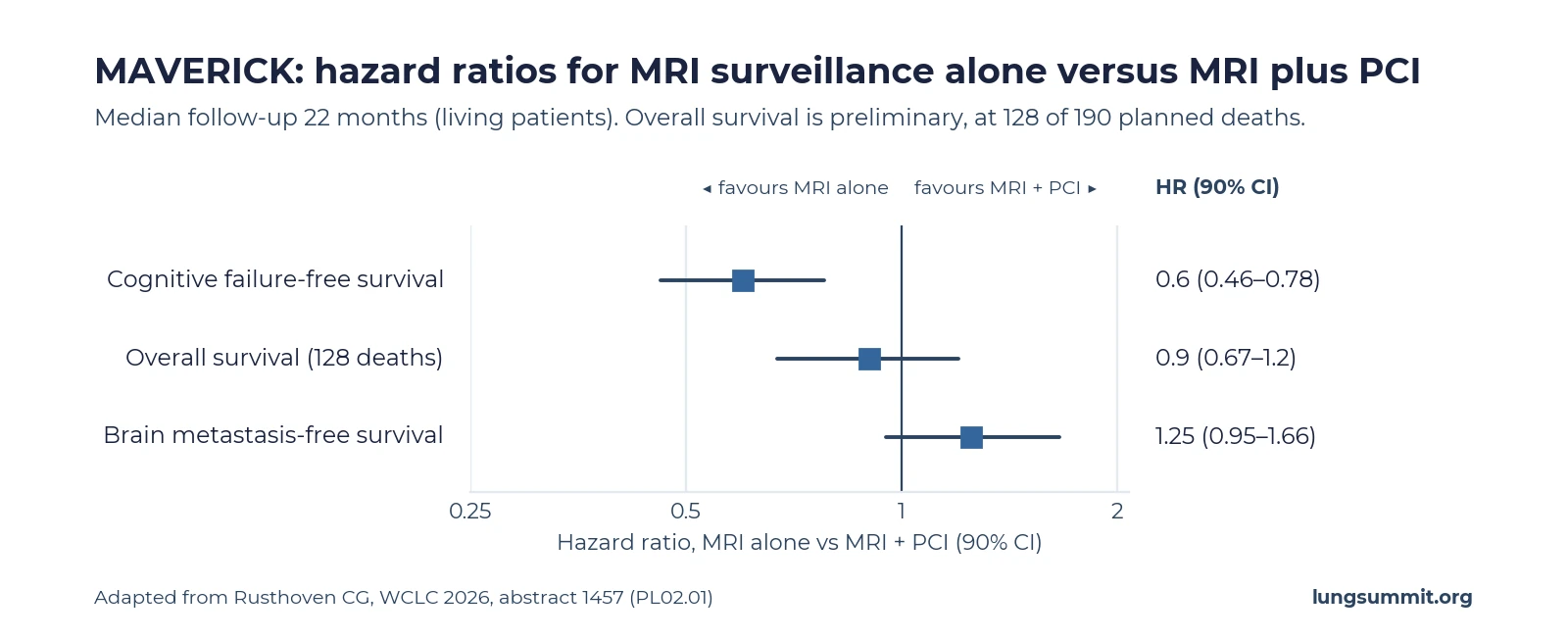
- MRI alone improved cognitive failure-free survival, the primary endpoint (HR 0.60, 90% CI 0.46–0.78), with a similar effect in limited-stage and extensive-stage disease.
- A preliminary overall survival analysis at 128 deaths found no significant difference (HR 0.90, 90% CI 0.67–1.20); the final analysis is planned at 190 deaths.
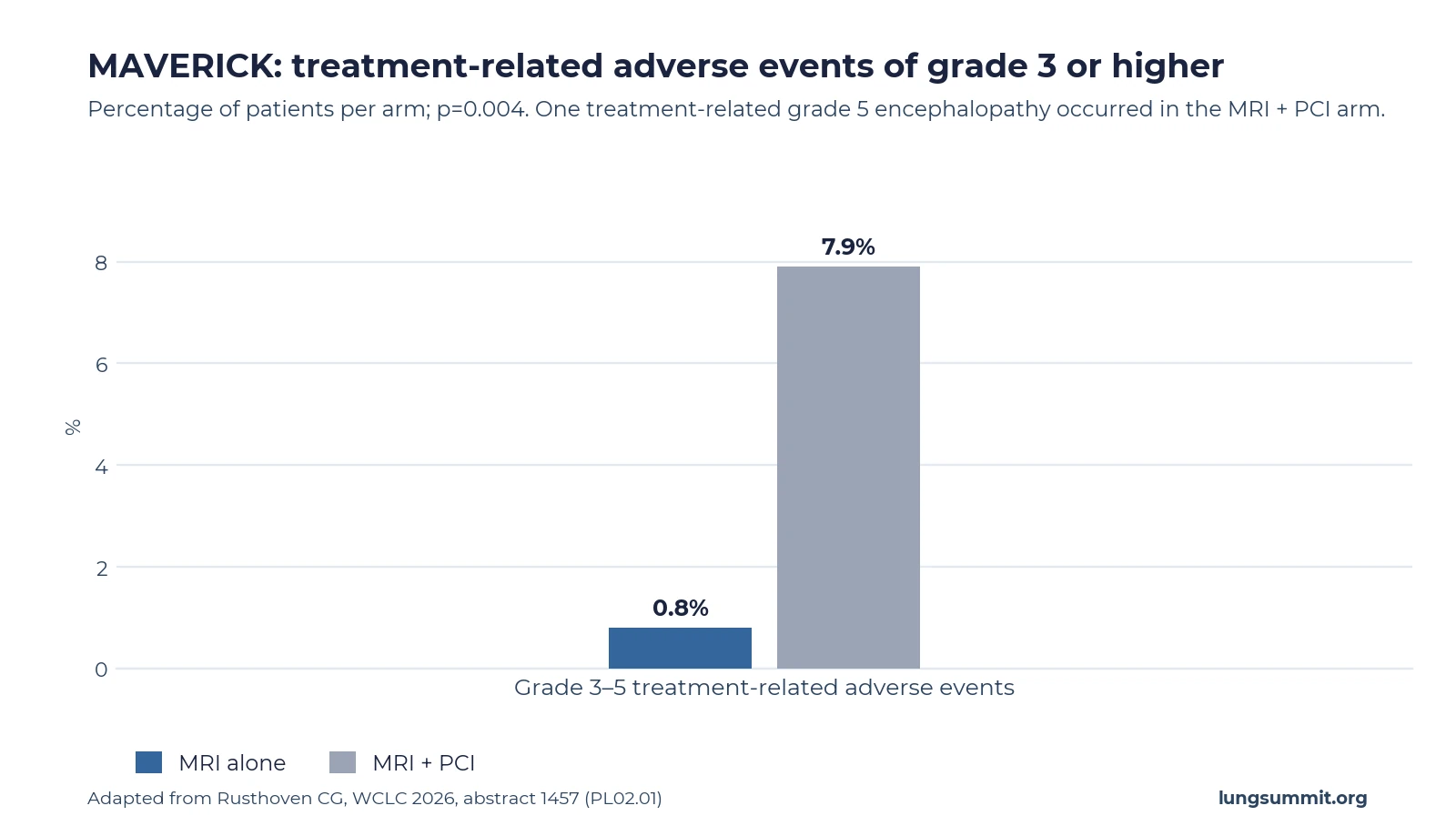
- Treatment-related adverse events of grade 3 or higher occurred in 0.8% of patients with MRI alone and 7.9% with MRI plus PCI (p=0.004), including one grade 5 encephalopathy in the PCI arm.
Study at a glance
- Trial: SWOG S1827 / MAVERICK (no registry identifier given in the press materials)
- Randomised phase III, international: 139 institutions in the United States, Canada, Mexico, Korea, Chile and Colombia; stratified by stage, upfront immunotherapy and performance status
- 304 patients with limited-stage (68%) or extensive-stage SCLC, initial therapy completed, no brain metastases on MRI; enrolled January 2020 to December 2025
- MRI surveillance alone versus MRI surveillance plus PCI (25 Gy in 10 fractions, hippocampal avoidance at physician discretion); MRI and cognitive testing at 3, 6, 9, 12, 18 and 24 months in both arms
- Primary endpoint: cognitive failure-free survival, met (HR 0.60, 90% CI 0.46–0.78). Key secondary endpoint: overall survival non-inferiority, upper bound of the 90% CI below 1.25
- Median follow-up 22 months among living patients; overall survival preliminary at 128 deaths, final analysis at 190 deaths. No data cut-off date was stated
The survival case for PCI rests on trials from before routine MRI
Brain metastases develop in approximately 40–60% of patients with SCLC over the course of the disease if no prophylaxis is given, and PCI reduces that rate by roughly half. As Dr. Rusthoven summarised in the presentation, PCI became standard of care on the strength of studies from the pre-MRI era: the 1999 Aupérin meta-analysis, in which 86% of patients had limited-stage disease, reported a 5.4% overall survival benefit at three years with PCI versus observation, and the 2007 EORTC phase III trial in extensive-stage disease reported one-year overall survival of 27% with PCI versus 13% with observation.
Two things have changed since. Brain MRI is now used routinely for staging and surveillance, so metastases can be detected earlier and treated with salvage therapy, which may remove the survival advantage that PCI once conferred. There are also concerns that PCI causes cognitive decline, although the presentation noted that prospective evidence on this point is limited. A Japanese phase III trial in extensive-stage SCLC (Takahashi et al., Lancet Oncology 2017) found no significant overall survival difference between MRI surveillance alone and MRI plus PCI. No published randomised data existed for limited-stage disease, where NCCN, ASCO and ASTRO guidelines list PCI as standard, and PCI has remained an option in extensive-stage disease because of the conflicting survival outcomes in earlier trials.
MAVERICK tested the hypothesis that, compared with MRI plus PCI, MRI surveillance alone would produce superior cognitive failure-free survival without a decline in overall survival.
Accrual pressure made cognition, not survival, the primary endpoint
The trial enrolled patients with limited-stage or extensive-stage SCLC who had completed first-line therapy, had no prior brain metastases and had none on MRI after that therapy. Immunotherapy as part of upfront treatment was allowed in both stage groups. Patients were randomised to MRI surveillance alone or MRI surveillance plus PCI, stratified by stage, receipt of immunotherapy and performance status (0–1 versus 2). PCI was delivered as 25 Gy in 10 fractions, with hippocampal-avoidance PCI permitted at the treating physician’s discretion; 77% of patients who received PCI were treated with the hippocampal-avoidance technique. Radiotherapy, either whole-brain or stereotactic, was recommended at the time brain metastases appeared.
Brain MRI was performed every three months in the first year and every six months in the second, with cognitive testing on the same schedule using the Hopkins Verbal Learning Test-Revised, the Controlled Oral Word Association test and the Trail Making Test. Cognitive failure was defined as a decline on one or more tests meeting the Reliable Change Index criterion, and a cognitive failure-free survival (CFFS) event was either cognitive failure or death.
The primary endpoint was originally overall survival in a non-inferiority design. Because of the accrual rate, the protocol was amended to make CFFS, previously the key secondary endpoint, the primary endpoint. With a target of 300 participants, the trial had 90% power to detect a hazard ratio of 0.66 in favour of MRI alone at a one-sided 5% significance level. Overall survival became the key secondary endpoint, tested for non-inferiority with a margin of 1.25 for the upper bound of the 90% confidence interval; the final survival analysis is scheduled after 190 deaths. Other secondary endpoints were brain metastasis-free survival, progression-free survival, the cumulative incidence of brain metastases, cognitive failure and toxicity.
Between January 2020 and December 2025, 304 patients were accrued at 139 institutions in six countries. The arms were well balanced: 68% of patients had limited-stage disease and 41% had received immunotherapy with upfront treatment. The presentation noted that the ADRIATIC trial, which established adjuvant durvalumab as standard of care for limited-stage SCLC, was published during the enrolment period. Compliance was imperfect in both arms. In the MRI plus PCI arm, 29 patients did not receive PCI, 25 of them because they refused it after random assignment; in the MRI alone arm, 11 patients did not undergo MRI surveillance. Median follow-up for living patients was 22 months.
Cognitive failure or death: hazard ratio 0.60 with MRI alone
MRI surveillance alone improved CFFS, with a hazard ratio of 0.60 (90% CI 0.46–0.78) versus MRI plus PCI. The presentation reported CFFS of 37.8% (90% CI 30.0–45.5) at six months and 17.3% (90% CI 11.6–24.0) at twelve months with MRI alone, compared with 16.5% (90% CI 10.7–23.4) and 5.9% (90% CI 2.6–11.0) with MRI plus PCI. Because death counts as an event, these rates reflect mortality as well as cognitive decline.
Subgroup analyses showed no significant interaction between the treatment effect and either disease stage or receipt of immunotherapy. One-year CFFS with MRI alone versus MRI plus PCI was 19.8% versus 7.5% in limited-stage disease and 11.0% versus 0% in extensive-stage disease, according to the presentation. Detailed analyses of cognitive function are to be presented at a later meeting.
More brain metastases without PCI, no survival difference at 128 deaths
Omitting PCI had the expected effect on intracranial control. In the presentation, the cumulative incidence of brain metastases, with death as a competing risk, was 21% at six months and 30% at twelve months with MRI alone, compared with 6.9% and 15% with MRI plus PCI (subdistribution HR 2.19, 95% CI 1.31–3.64). The brain was the first site of progression in 18% of patients with MRI alone and 5.3% with MRI plus PCI, whereas extracranial first progression was recorded in 31% and 45%, respectively.
Brain metastasis-free survival numerically favoured MRI plus PCI, but the difference was not statistically significant (HR 1.25 for MRI alone, 90% CI 0.95–1.66). Progression-free survival did not differ between the arms (HR 0.96, 90% CI 0.75–1.23).
The preliminary overall survival analysis, conducted at 128 deaths, suggested no significant difference between the strategies, with a hazard ratio of 0.90 for MRI alone (90% CI 0.67–1.20). The upper bound of that interval, 1.20, currently lies below the pre-specified non-inferiority margin of 1.25. The final overall survival analysis will be reported after 190 deaths.
Grade 3 or higher toxicity in 7.9% with PCI and 0.8% without
Treatment-related adverse events of grade 3 or higher occurred in 7.9% of patients in the MRI plus PCI arm and 0.8% in the MRI alone arm (p=0.004). Events of grade 2 or higher were reported in 41.3% and 1.7%, respectively, according to the presentation. One treatment-related grade 5 encephalopathy occurred in the MRI plus PCI arm. The most common treatment-related adverse events with PCI were fatigue, alopecia, nausea and poor appetite.
In the IASLC news release, Dr. Rusthoven summarised the primary result and its consistency across disease stages:
“MRI surveillance alone was associated with improved cognitive failure-free survival compared to a strategy of MRI surveillance plus PCI. The benefit of MRI surveillance alone also appears to be consistent across patients with both limited-stage and extensive-stage small-cell lung cancer.”
Dr. Chad Rusthoven, University of Colorado School of Medicine, Aurora, USA
The investigators’ conclusion is that MRI surveillance alone should be the standard of care for patients with SCLC, on the grounds that it produced superior CFFS in both limited-stage and extensive-stage disease, that preliminary survival analyses show no significant difference, and that the higher rate of brain metastases without PCI did not translate into a difference in progression-free survival. Two parts of the picture remain incomplete: the final overall survival analysis at 190 deaths, which will decide the formal non-inferiority test, and the detailed cognitive function data that the presentation deferred to a later meeting.
Sources
- Rusthoven CG, Redman MW, Brown PD, et al. SWOG S1827 MAVERICK: Phase III Trial of Brain MRI Surveillance +/- Prophylactic Cranial Irradiation for Small-Cell Lung Cancer. IASLC 2026 World Conference on Lung Cancer, Seoul, 12–15 September 2026; abstract 1457 (session PL02.01).
- IASLC news release, Seoul, 13 September 2026: “Phase III MAVERICK Trial Supports Brain MRI Surveillance Alone as Standard of Care for Small-Cell Lung Cancer”.
ILCS 2026
The International Lung Cancer Summit (ILCS 2026) takes place on Friday 13 November 2026 in Lausanne and live online. Faculty will discuss the WCLC 2026 data in the context of daily practice. Register for ILCS 2026 →
Written by the Lung Summit editorial team.
This article was produced independently by the Lung Summit editorial team, without industry funding or input.