In brief
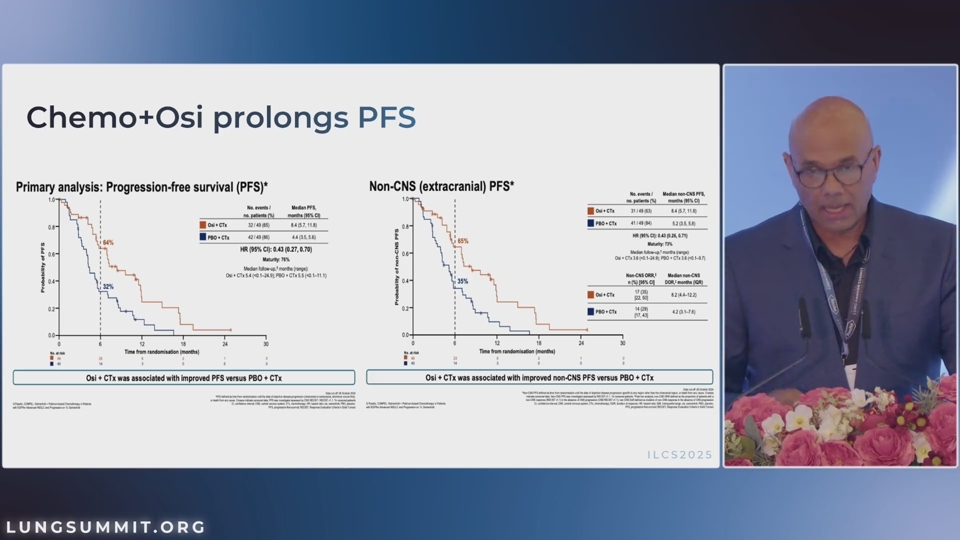
- ADAURA at eight years: overall survival 79% with adjuvant osimertinib versus 64% with placebo in resected stage IB–IIIA EGFR-mutated NSCLC (HR 0.52).
- PAPILLON final survival: median 34.3 versus 27.9 months for first-line amivantamab–chemotherapy in EGFR exon 20 insertion disease (HR 0.87, p=0.307), after 76% of the chemotherapy arm crossed over.
- REZILIENT 3: zipalertinib plus platinum–pemetrexed reached a median PFS of 14.5 versus 8.5 months in the same mutation group (HR 0.50).
- ARROS-1: zidesamtinib produced responses in 93% of TKI-naive ROS1-positive patients by the abstract (94% on the slides), and in all ten with measurable brain disease.
- DESTINY-Lung04: first-line T-DXd extended median PFS to 14.3 months versus 8.3 with pembrolizumab–chemotherapy in HER2-mutant NSCLC (HR 0.63); the interim OS hazard ratio was 1.15.
ADAURA at eight years: 79% of osimertinib patients alive, against 64% on placebo
Dr. Roy S. Herbst (Dartmouth Cancer Center, Lebanon, USA) presented an exploratory eight-year overall survival (OS) landmark from ADAURA, the global, double-blind phase III trial in which 682 patients with completely resected EGFR-mutated stage IB–IIIA NSCLC received three years of adjuvant osimertinib 80 mg daily (n=339) or placebo (n=343), with or without adjuvant chemotherapy. Follow-up was extended to 4 May 2026 for patients who gave further consent or had accessible records; 127 of the 558 alive at the planned final analysis (23%) had no new data and stayed censored.
In the primary stage II–IIIA population the OS hazard ratio (HR) was 0.53 (95% CI 0.38–0.75); eight-year OS was 74% with osimertinib versus 58% with placebo, a 16-point difference, at a median follow-up of 92.0 versus 68.5 months. In the whole stage IB–IIIA population the HR was 0.52 (95% CI 0.39–0.71) and eight-year OS was 79% versus 64%, with benefit across predefined subgroups. The analysis was post hoc: no p-values were given for the updated HRs, median OS was not stated, and disease-free survival has not been collected since April 2022. Dr. Herbst said: “These additional long-term findings further characterize the established survival benefit of adjuvant osimertinib for patients with resected EGFR-mutated stage IB-IIIA NSCLC, with or without adjuvant chemotherapy.”
PAPILLON final survival: 34.3 versus 27.9 months, not significant after 76% crossover
Dr. Chul Kim (Georgetown Cancer Institute, Washington, USA) reported the protocol-specified final OS analysis of PAPILLON, the phase 3 trial that randomised 308 patients with untreated advanced NSCLC and EGFR exon 20 insertions to amivantamab plus carboplatin–pemetrexed (n=153) or chemotherapy alone (n=155), with crossover to second-line amivantamab allowed after confirmed progression. OS was a secondary endpoint, and the analysis had an estimated 56% power.
At the 20 March 2026 cut-off, after a median follow-up of 48.6 months, median OS was 34.3 months (95% CI 27.0–40.8) versus 27.9 months (95% CI 24.0–32.4), HR 0.87 (95% CI 0.66–1.14; p=0.307). Of the 128 chemotherapy-arm patients who discontinued for progression, 97 (76%) went on to amivantamab. In the prespecified crossover-adjusted analysis (inverse probability of censoring weighting), median OS for the chemotherapy arm was 22.1 months and the HR 0.57; its confidence interval and nominal p-value differ between the abstract and the slides, so neither is quoted here. Safety was described as consistent with earlier reports of intravenous amivantamab before prophylactic measures, and patient-reported outcomes favoured the combination. No updated progression-free survival was presented. Dr. Kim said: “PAPILLON demonstrated the longest reported median overall survival to date in EGFR exon 20 insertion-positive advanced NSCLC with first-line amivantamab-chemotherapy.”
REZILIENT 3: zipalertinib plus chemotherapy adds six months of PFS in EGFR exon 20 disease
Prof. Daniel Tan (National Cancer Centre Singapore) presented the first results of REZILIENT 3, an international, randomised, open-label phase 3 trial of zipalertinib, a selective EGFR exon 20 insertion inhibitor. In total 279 patients with untreated advanced NSCLC and EGFR exon 20 insertions received zipalertinib 100 mg twice daily plus platinum–pemetrexed (n=140) or chemotherapy alone (n=139); crossover to zipalertinib was permitted.
At the prespecified interim analysis (cut-off 29 May 2026), median PFS by blinded independent central review was 14.5 versus 8.5 months, HR 0.50 (95% CI 0.34–0.73; p=0.00015). Objective response was 65.0% versus 40.3% (p<0.0001) and median duration of response 14.2 versus 9.9 months. OS is immature: neither median was reached, and the interim HR was 0.72 (95% CI 0.42–1.23) at a median follow-up of 10.9 months. Grade 3 or higher adverse events were more frequent with the combination (87.1% versus 54.4% all-cause in the release; 80.7% versus 40.4% treatment-related on the slides), mainly cytopenias; grade 3 or higher rash (10.7%) and diarrhoea (1.4%) occurred only with zipalertinib. Prof. Tan said: “REZILIENT 3 demonstrated that adding zipalertinib to platinum-based chemotherapy produced a statistically significant and clinically meaningful six-month improvement in progression-free survival for patients with advanced NSCLC and EGFR exon 20 insertion mutations.”
ARROS-1: zidesamtinib responses in 93% of TKI-naive ROS1-positive patients, including all ten with brain disease
Dr. Alexander E. Drilon (Memorial Sloan Kettering Cancer Center, New York, USA) reported the TKI-naive cohort of ARROS-1, the global, single-arm phase 1/2 trial of zidesamtinib, a ROS1 inhibitor already approved for previously treated disease. Of 532 patients treated at 100 mg once daily across all lines, 183 were TKI-naive; efficacy was analysed in the 94 with measurable disease by central review.
Objective response by central review was 93% (87 of 94) in the abstract; the slides and release count 94% (88 of 94) by including one response awaiting confirmation. Median duration of response was not reached, with 86% of responses ongoing at 12 months. In ten patients with measurable CNS disease the intracranial response rate was 100%, complete in 70%. Treatment-related adverse events in at least 15% of the 532 patients were peripheral oedema (34%), weight gain (18%), raised creatine phosphokinase (18%), dysgeusia (17%) and raised AST (15%); 11% needed a dose reduction and 1% stopped. There is no comparator arm and no OS; the 12-month PFS rate of 90% rests on the slides alone. Dr. Drilon said: “Zidesamtinib demonstrated clinically meaningful activity in TKI-naive patients with ROS1-positive NSCLC, with a safety profile consistent with previous reports and low rates of dose reduction and discontinuation.”
DESTINY-Lung04: first-line T-DXd lifts median PFS to 14.3 months in HER2-mutant NSCLC, no survival advantage yet
Dr. Julia Rotow (Dana-Farber Cancer Institute, Boston, USA) presented the primary analysis of DESTINY-Lung04, a global, open-label phase 3 trial in which 454 treatment-naive patients with unresectable or metastatic HER2-mutant (exon 19 or 20) NSCLC received trastuzumab deruxtecan (T-DXd) 5.4 mg/kg every three weeks (n=227) or pembrolizumab plus platinum and pemetrexed (n=227), with no crossover.
At the 9 June 2026 cut-off, median PFS by blinded independent central review was 14.3 versus 8.3 months, HR 0.63 (95% CI 0.50–0.79; p<0.0001). Objective response was 70.0% versus 44.5%, and median duration of response 13.4 versus 9.7 months. Overall survival, at a first interim without formal testing, did not favour T-DXd: median 29.3 versus 33.1 months, HR 1.15 (95% CI 0.88–1.52). The investigators attributed this in part to subsequent therapy; the slides put later HER2-directed treatment at 48.0% of the control arm versus 22.9%. Grade 3 or higher drug-related adverse events were similar (34.1% versus 33.6%), but adjudicated drug-related interstitial lung disease or pneumonitis occurred in 20.8% of T-DXd patients (78.7% grade 1 or 2; four fatal cases on the slides) against 2.3%. Dr. Rotow said: “These results demonstrate substantial improvements in progression-free survival and response with first-line trastuzumab deruxtecan for patients with advanced or metastatic HER2-mutant NSCLC.”
Sources
- Herbst RS, et al. Adjuvant Osimertinib in Resected EGFR-Mutated Stage IB-IIIA NSCLC: ADAURA Exploratory 8-year Overall Survival Landmark Update. IASLC 2026 World Conference on Lung Cancer, Seoul, 12–15 September 2026; abstract 912 (session PL03.01).
- Kim C, et al. First-line Amivantamab-chemotherapy vs Chemotherapy in NSCLC with EGFR Exon 20 Insertions: Overall Survival from PAPILLON. IASLC 2026 World Conference on Lung Cancer, Seoul, 12–15 September 2026; abstract 1442 (session PL03.03).
- Tan DSW, et al. Zipalertinib Plus Chemotherapy for 1st Line NSCLC with EGFR Exon 20 Insertions: Results from the Phase 3 Trial (REZILIENT 3). IASLC 2026 World Conference on Lung Cancer, Seoul, 12–15 September 2026; abstract 5219 (session PL03.04).
- Drilon AE, et al. Zidesamtinib in TKI-naive Patients with Advanced/Metastatic ROS1+ NSCLC: ARROS-1 Efficacy and Safety Data. IASLC 2026 World Conference on Lung Cancer, Seoul, 12–15 September 2026; abstract 4707 (session PL03.06).
- Rotow J, et al. First-Line Trastuzumab Deruxtecan (T-DXd) in Patients With HER2-mutant NSCLC: DESTINY-Lung04 Primary Results. IASLC 2026 World Conference on Lung Cancer, Seoul, 12–15 September 2026; abstract 1052 (session PL03.08).
- IASLC news release, Seoul, 14 September 2026: “Eight-Year ADAURA Update Shows Sustained Overall Survival Benefit With Adjuvant Osimertinib in Resected EGFR-Mutated NSCLC”.
- IASLC news release, Seoul, 14 September 2026: “In the PAPILLON Study, First-Line Amivantamab-Chemotherapy Demonstrates the Longest Overall Survival Reported for EGFR Exon 20 Insertion-Positive Advanced NSCLC”.
- IASLC news release, Seoul, 14 September 2026: “Zipalertinib Plus Chemotherapy Significantly Extends Progression-Free Survival in First-Line EGFR Exon 20 Insertion-Positive NSCLC”.
- IASLC news release, Seoul, 14 September 2026: “Zidesamtinib Demonstrates 93% Response Rate in TKI-Naive Patients With Advanced ROS1-Positive NSCLC”.
- IASLC news release, Seoul, 14 September 2026: “Phase 3 DESTINY-Lung04 Trial Shows First-Line Trastuzumab Deruxtecan Significantly Improves Progression-Free Survival in HER2-Mutant NSCLC”.
- Herbst RS, et al. Journal of Thoracic Oncology, published 14 September 2026 (simultaneous publication of the ADAURA analysis, as stated in the IASLC release).
ILCS 2026
The International Lung Cancer Summit (ILCS 2026) takes place on Friday 13 November 2026 in Lausanne and live online. Faculty will discuss the WCLC 2026 data in the context of daily practice. Register for ILCS 2026 →
Written by the Lung Summit editorial team.
This article was produced independently by the Lung Summit editorial team, without industry funding or input.