In brief
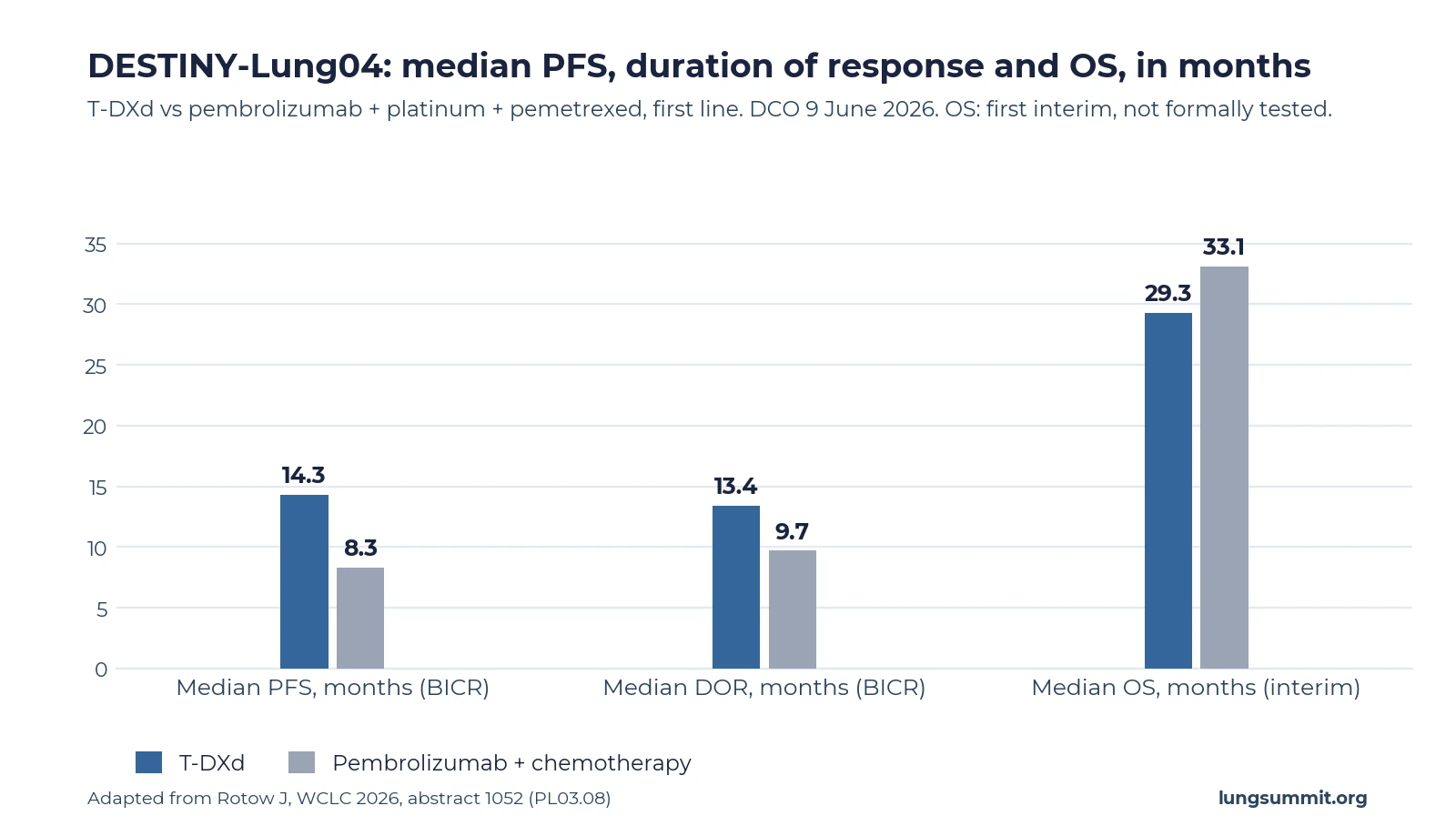
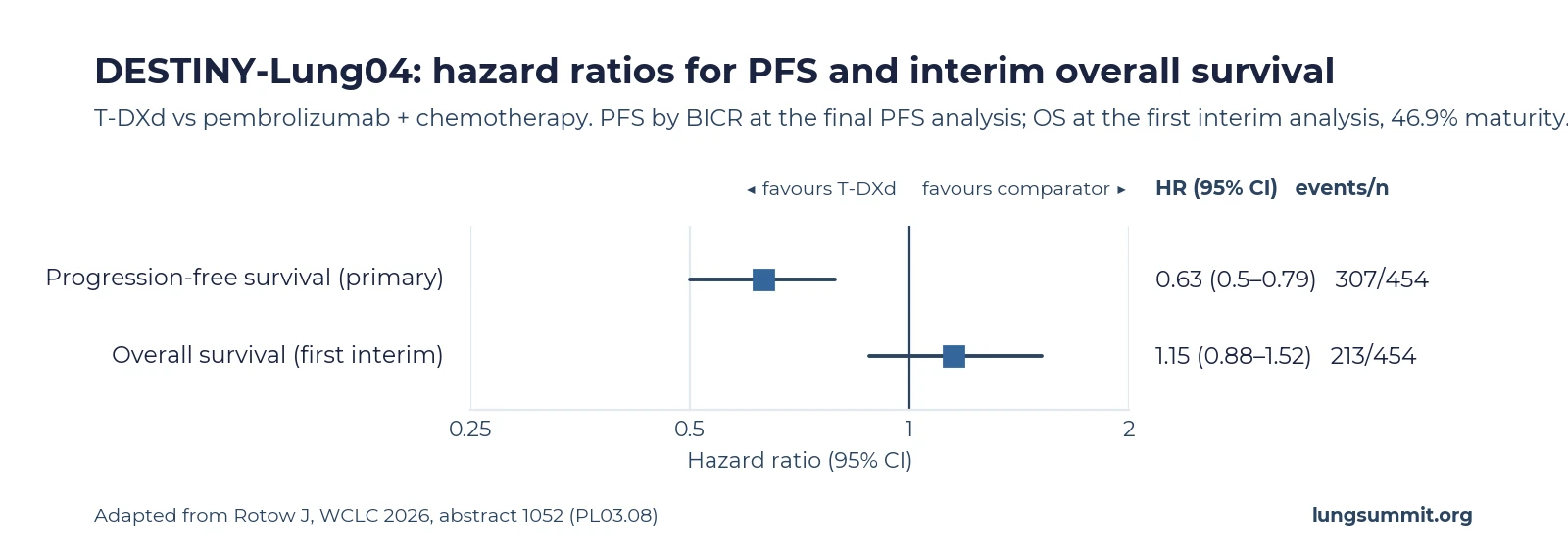
- In DESTINY-Lung04, first-line single-agent trastuzumab deruxtecan (T-DXd) extended median progression-free survival by blinded independent central review to 14.3 months, against 8.3 months with pembrolizumab plus platinum chemotherapy and pemetrexed (HR 0.63, 95% CI 0.50–0.79; P<0.0001), in 454 patients with HER2-mutant NSCLC.
- The objective response rate was 70.0% with T-DXd and 44.5% with pembrolizumab plus chemotherapy; median duration of response was 13.4 and 9.7 months.
- At a first interim analysis, median overall survival was 29.3 months with T-DXd and 33.1 months with the comparator (HR 1.15, 95% CI 0.88–1.52), with no formal test planned; the investigators point to an imbalance in later HER2-directed therapy (22.9% vs 48.0% of randomised patients).
- Adjudicated drug-related interstitial lung disease or pneumonitis occurred in 20.8% of T-DXd-treated patients, including four grade 5 events, against 2.3% with pembrolizumab plus chemotherapy; grade 3 or higher drug-related adverse events were 34.1% and 33.6%.
Study at a glance
- Trial: DESTINY-Lung04 (NCT05048797), sponsored by AstraZeneca
- Design: global, randomised, open-label, multicentre phase 3; stratified by brain metastases (presence or history) and smoking history; no crossover
- Population: 454 treatment-naive patients with unresectable locally advanced or metastatic nonsquamous NSCLC and a HER2 exon 19 or exon 20 mutation, ECOG PS 0–1, asymptomatic or stable brain metastases permitted
- Arms: T-DXd 5.4 mg/kg IV every 3 weeks (n=227) vs pembrolizumab 200 mg plus cisplatin or carboplatin for up to four cycles plus pemetrexed 500 mg/m², every 3 weeks (n=227)
- Primary endpoint: PFS by BICR per RECIST 1.1, met (HR 0.63, 95% CI 0.50–0.79; P<0.0001). Secondary: OS, ORR and DOR by BICR, investigator-assessed PFS2, safety
- Data cut-off 9 June 2026; median follow-up 21.6 months with T-DXd and 20.4 months with pembrolizumab plus chemotherapy
A HER2-directed ADC tested head to head against chemo-immunotherapy in the front line
HER2 (ERBB2) mutations are found in roughly 2–4% of nonsquamous NSCLC, and the investigators describe the resulting disease as aggressive, with a poor prognosis. The global first-line standard for these patients has been immunotherapy with a pemetrexed-platinum doublet; according to the presentation, response rates with that regimen are limited and many patients progress. T-DXd, an antibody-drug conjugate directed at HER2, is approved in multiple countries for previously treated HER2-mutant NSCLC. The abstract also records that zongertinib, a HER2 tyrosine kinase inhibitor, recently received accelerated approval in the United States in the first-line setting.
DESTINY-Lung04 is described by the investigators as the first global randomised phase 3 trial of a HER2-directed therapy against pembrolizumab plus pemetrexed and platinum chemotherapy as first-line treatment for HER2-mutant NSCLC. Patients were randomised 1:1 to T-DXd 5.4 mg/kg every three weeks, or to pembrolizumab 200 mg with investigator’s choice of cisplatin or carboplatin for up to four cycles and pemetrexed 500 mg/m², all continued until progression or unacceptable toxicity. The HER2 mutation could be confirmed by a local or a central test. Patients with radiological CNS progression could stay on their assigned treatment if the investigator judged they were still benefiting.
The two arms of 227 patients were well matched: median age 62 years, 58% women, 62% never-smokers, and 23–24% with treated brain metastases at baseline. Exon 20 mutations accounted for 93–94% of cases and exon 19 for 4–7%. About half of patients were enrolled in Asia (46.3% and 52.9%), with 30–38% in Europe and 12–13% in North America. The final PFS analysis was planned at around 306 events; at the cut-off there were 307.
Six months more progression-free time, and a higher response rate
Median PFS by blinded independent central review was 14.3 months (95% CI 12.4–16.5) with T-DXd and 8.3 months (95% CI 7.0–9.9) with pembrolizumab plus chemotherapy, a hazard ratio of 0.63 (95% CI 0.50–0.79; P<0.0001). The investigators characterise this as a statistically significant and clinically meaningful improvement of six months.
The point estimate favoured T-DXd in every prespecified stratum; in two small groups the confidence interval crossed 1. Hazard ratios were 0.62 (95% CI 0.41–0.93) in patients with a history of brain metastases and 0.65 (95% CI 0.50–0.85) without; 0.70 in ever-smokers and 0.61 in never-smokers; 0.65 in exon 20 disease and 0.46 (95% CI 0.16–1.19) in the 25 patients with an exon 19 mutation. Patients with de novo metastatic disease had a hazard ratio of 0.60 (95% CI 0.46–0.78), while the 83 patients enrolled at recurrence or relapse had a hazard ratio of 0.89 (95% CI 0.52–1.52). The largest effect was seen in the 76 patients with liver metastases at baseline (HR 0.41, 95% CI 0.24–0.70).
The objective response rate by central review, which included unconfirmed responses, was 70.0% (95% CI 63.6–75.9) with T-DXd and 44.5% (95% CI 37.9–51.2) with pembrolizumab plus chemotherapy, an odds ratio of 2.93 (95% CI 2.00–4.34). Complete responses were rare in both arms (1.8% each); the difference lay in partial responses, 68.3% against 42.7%. Median duration of response was 13.4 months (95% CI 10.4–17.2) with T-DXd and 9.7 months (95% CI 7.0–11.1) with the comparator. Investigator-assessed PFS2, the time to a second progression after the next line of therapy, was 22.7 months with T-DXd and 17.3 months with pembrolizumab plus chemotherapy (HR 0.80, 95% CI 0.62–1.02).
Dr. Rotow summarised the efficacy findings in the IASLC news release accompanying the presentation.
“These results demonstrate substantial improvements in progression-free survival and response with first-line trastuzumab deruxtecan for patients with advanced or metastatic HER2-mutant NSCLC,”
Dr. Julia Rotow, Dana-Farber Cancer Institute, Boston, USA
An interim overall survival hazard ratio above 1, and what patients received afterwards
Overall survival was 46.9% mature at the cut-off, with 115 deaths (50.7%) in the T-DXd arm and 98 (43.2%) in the comparator arm. Median overall survival was 29.3 months (95% CI 26.2–33.4) with T-DXd and 33.1 months (95% CI 27.7–40.7) with pembrolizumab plus chemotherapy, a hazard ratio of 1.15 (95% CI 0.88–1.52). This first interim analysis was timed to the final PFS analysis and carried no formal hypothesis test; testing is planned at the second interim and the final analysis. The presentation states plainly that no OS benefit was observed with T-DXd.
The investigators’ explanation rests on the treatments given after the trial drug, since crossover was not permitted. At the cut-off, 17.7% of T-DXd-treated patients were still on study treatment, against 4.5% in the comparator arm. Among patients who had discontinued, a similar share in each arm went on to further anti-cancer therapy (71.5% and 72.4%). The composition of that therapy differed. Of all randomised patients, 48.0% in the pembrolizumab plus chemotherapy arm later received a HER2-directed agent (33.0% a HER2 antibody-drug conjugate, 27.8% a HER2 tyrosine kinase inhibitor), compared with 22.9% in the T-DXd arm (5.3% and 18.1%). Subsequent immunotherapy plus chemotherapy in the T-DXd arm was limited, at 23.8%. The news release attributes to the investigators the view that these imbalances confounded the interpretation of overall survival; the presentation itself says the OS trend “in part may reflect” them.
Pneumonitis in one patient in five, and what the adjudication committee found
Median treatment duration was 12.3 months with T-DXd and 7.1 months with pembrolizumab plus chemotherapy. Drug-related adverse events of any grade were reported in 90.3% and 89.5% of treated patients, and grade 3 or higher events in 34.1% and 33.6%. Serious drug-related events were more frequent with T-DXd (15.5% vs 10.0%), while discontinuation for a drug-related event was identical at 15.9%. Five deaths were attributed to treatment: four from pneumonitis in the T-DXd arm (1.8%) and one from sepsis in the comparator arm (0.5%). Nausea was the most frequent drug-related event with T-DXd (any grade 50.0%, against 38.2% with the comparator); anaemia was more common with pembrolizumab plus chemotherapy (44.1% vs 27.9%), and alopecia with T-DXd (32.7% vs 6.8%).
An independent committee adjudicated every potential case of interstitial lung disease or pneumonitis. Drug-related ILD was confirmed in 47 T-DXd-treated patients (20.8%) and five comparator patients (2.3%). In the T-DXd arm, 3.1% of patients had grade 1 events, 13.3% grade 2, 2.2% grade 3, 0.4% grade 4 and 1.8% grade 5. One further fatal event, recorded as respiratory failure, was adjudicated as drug-related grade 5 ILD after the database lock. Most cases were grade 1 or 2 (78.7%) and 66.0% resolved. Sixteen of the 30 grade 2 events had been recorded as grade 1 by the investigator and were upgraded because steroids were used. Delayed initiation or suboptimal dosing of steroids was observed in 90% of grade 3 or higher cases, including all four grade 5 cases. Left ventricular dysfunction occurred in 3.1% of T-DXd-treated patients (0.5% in the comparator arm), with no grade 4 or 5 events. The investigators state that ILD remains an important risk of T-DXd requiring appropriate monitoring and management, and note that 64.1% of patients who stopped T-DXd for grade 3 or lower ILD went on to further therapy, in line with the arm as a whole.
The investigators’ conclusion, and the analyses still to come
The investigators conclude that first-line T-DXd monotherapy improved PFS, response rate and duration of response over pembrolizumab plus doublet chemotherapy, that safety was consistent with the known profiles of each treatment, and that the data support T-DXd as a new first-line option in HER2-mutant NSCLC. In the news release, Dr. Rotow said the findings support T-DXd as a new first-line treatment option for a population in which more effective HER2-directed approaches are needed.
Two elements of the data remain unsettled. Overall survival has been examined only at an interim look with a hazard ratio whose confidence interval spans 0.88 to 1.52, and the planned second interim and final analyses will carry the formal tests. The trial was open-label, and the share of patients given later HER2-directed therapy differed between arms by more than twofold.
Sources
- Rotow J, et al. First-Line Trastuzumab Deruxtecan (T-DXd) in Patients With HER2-mutant NSCLC: DESTINY-Lung04 Primary Results. IASLC 2026 World Conference on Lung Cancer, Seoul, 12–15 September 2026; abstract 1052 (session PL03.08).
- IASLC news release, Seoul, 14 September 2026: “Phase 3 DESTINY-Lung04 Trial Shows First-Line Trastuzumab Deruxtecan Significantly Improves Progression-Free Survival in HER2-Mutant NSCLC”.
ILCS 2026
The International Lung Cancer Summit (ILCS 2026) takes place on Friday 13 November 2026 in Lausanne and live online. Faculty will discuss the WCLC 2026 data in the context of daily practice. Register for ILCS 2026 →
Written by the Lung Summit editorial team.
This article was produced independently by the Lung Summit editorial team, without industry funding or input.