In brief
- EVOKE-03/KEYNOTE-D46 did not meet its primary endpoint: median PFS was 11.8 months with sacituzumab govitecan plus pembrolizumab versus 7.7 months with pembrolizumab alone (HR 0.81, 95% CI 0.66–1.00), but the one-sided P value of 0.0252 did not cross the boundary of 0.007.
- At the interim analysis, overall survival was not improved: median 21.5 versus 22.8 months (HR 1.07, 95% CI 0.85–1.35; P = 0.7155).
- Confirmed response rate was 55.6% versus 43.7% and disease control 83.3% versus 73.1%; median duration of response was 21.4 versus 21.3 months.
- Grade 3 or higher treatment-emergent adverse events occurred in 73.6% of the combination arm and 45.0% of the pembrolizumab arm; no new toxicities were reported.
Study at a glance
- Trial: EVOKE-03/KEYNOTE-D46 (NCT05609968)
- Design: open-label, multicentre, randomised phase 3; international (stratified by region: East Asia; Western Europe/North America/Australia; rest of world); funded by Gilead Sciences and Merck Sharp & Dohme
- Population: 620 patients with previously untreated stage IV NSCLC, PD-L1 TPS ≥50%, ECOG PS 0–1, no EGFR, ALK or ROS1 alteration
- Arms: sacituzumab govitecan 10 mg/kg on days 1 and 8 plus pembrolizumab 200 mg on day 1 of each 21-day cycle (n = 311) versus pembrolizumab 200 mg alone (n = 309), up to 35 cycles of pembrolizumab
- Dual primary endpoints: PFS by blinded independent central review (not met) and overall survival (not met at the interim analysis)
- Data cut-off 3 April 2026; median follow-up 14.7 months
Two primary endpoints, each with its own significance boundary
The rationale for the trial comes from the limits of first-line immunotherapy. According to the presentation, more than half of patients with metastatic NSCLC do not respond to first-line pembrolizumab monotherapy. Sacituzumab govitecan is a Trop-2-directed antibody-drug conjugate carrying the topoisomerase I inhibitor payload SN-38. The phase 2 EVOKE-02 study had tested it with pembrolizumab in the first-line setting and, as described by the investigators, showed encouraging preliminary activity across histologies and in the PD-L1 TPS ≥50% subgroup.
EVOKE-03/KEYNOTE-D46 randomised 620 patients 1:1 to the combination or to pembrolizumab alone, stratified by ECOG performance status, predominant histology and geographic region. The population was 70% to 73% male, with a median age of 67 to 68 years; about 31% had squamous histology and about 17% had never smoked. Brain metastases were present in 8.7% and 9.7% of patients in the two arms, and liver metastases in about 16% of each. One patient in the pembrolizumab arm had a PD-L1 TPS below 50%.
The trial used a dual primary endpoint design with alpha split between the two endpoints: 0.007 for PFS and 0.018 for OS, with objective response rate as a secondary endpoint alongside duration of response, patient-reported outcomes and safety. A one-sided P value below 0.05 for PFS was therefore not sufficient on its own.
Median PFS 4.1 months longer, but the boundary was not crossed
At the primary PFS analysis, with 367 events (59% maturity) and a median follow-up of 14.8 months in the combination arm and 14.4 months in the control arm, median PFS by blinded independent central review was 11.8 months (95% CI 8.9–14.5) with sacituzumab govitecan plus pembrolizumab and 7.7 months (95% CI 5.6–9.7) with pembrolizumab alone. The stratified hazard ratio was 0.81 (95% CI 0.66–1.00) and the one-sided P value 0.0252, above the prespecified boundary of 0.007. The 12-month PFS rate was 48.3% versus 36.9%, and the 18-month rate 36.0% versus 29.9%.
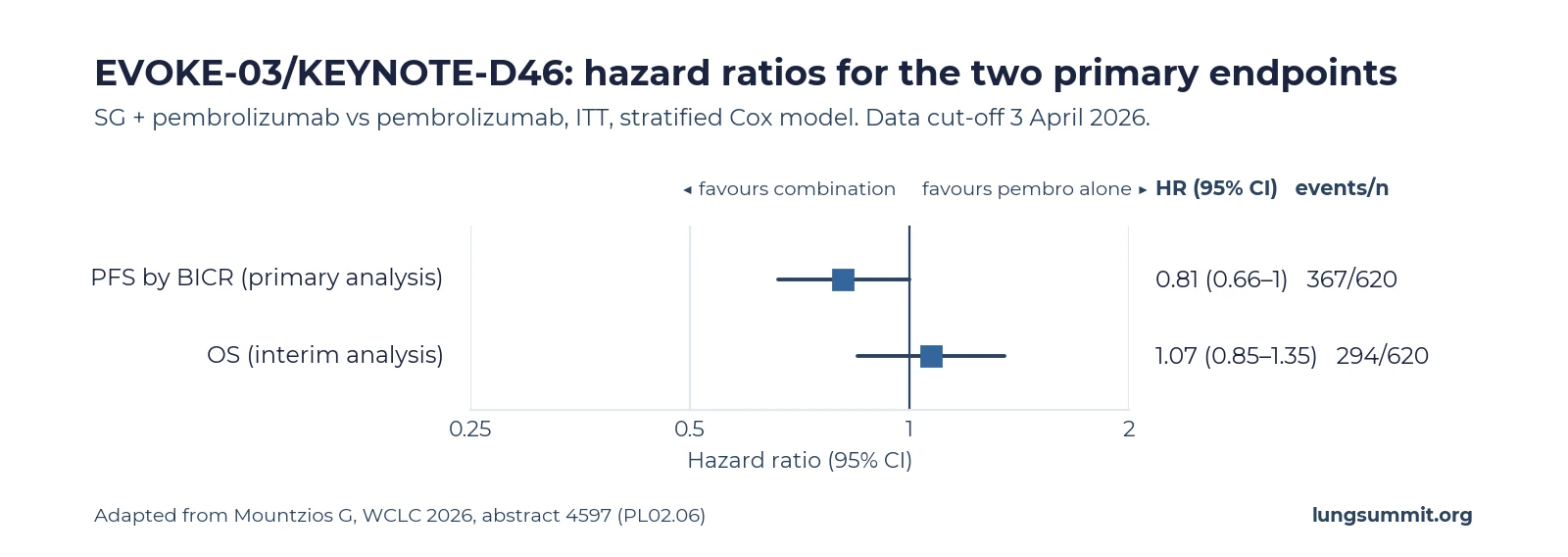
The interim overall survival analysis, with 294 events (47% maturity, 80% information fraction), showed no advantage for the combination. Median OS was 21.5 months (95% CI 18.5–26.7) with sacituzumab govitecan plus pembrolizumab and 22.8 months (95% CI 18.7–29.0) with pembrolizumab alone, a hazard ratio of 1.07 (95% CI 0.85–1.35; P = 0.7155 against a boundary of 0.008). PFS subgroup analyses were presented as unstratified hazard ratios; subgroups representing fewer than 10% of the intention-to-treat population were not analysed, and the values are not reproduced here.
In the IASLC news release, Dr. Mountzios summarised the result.
“While the combination of sacituzumab govitecan and pembrolizumab produced a numerically longer progression-free survival and a higher response rate, EVOKE-03/KEYNOTE-D46 did not meet statistical significance for its primary PFS endpoint, and overall survival was not significantly improved at this interim analysis,”
Dr. Giannis Mountzios, Henry Dunant Hospital Center, Athens, Greece
A post-hoc look at East Asian and Chinese patients
The investigators also presented a post-hoc analysis of overall survival by region, which they stated was neither pre-specified nor pre-stratified. In the East Asian cohort (114 versus 116 patients, median follow-up 18.1 months), median OS was not reached with the combination (95% CI 24.3 months to not evaluable) versus 27.9 months (95% CI 16.7 to not evaluable) with pembrolizumab alone, hazard ratio 0.73 (95% CI 0.48–1.10). In the Chinese subgroup (52 versus 55 patients, median follow-up 22.4 months), median OS was again not reached versus 27.9 months, hazard ratio 0.65 (95% CI 0.36–1.16). Both confidence intervals include 1, the analyses were unstratified, and the presentation drew no conclusion from them beyond reporting the figures.
Response rate 12 points higher, duration of response identical
The secondary endpoints separated more clearly than the primary ones. Confirmed objective response by blinded independent central review was 55.6% (95% CI 49.9–61.2) with sacituzumab govitecan plus pembrolizumab and 43.7% (95% CI 38.1–49.4) with pembrolizumab alone, a difference the investigators put at about 12 percentage points. Complete responses were recorded in 7.7% versus 3.9% of patients and partial responses in 47.9% versus 39.8%. Progressive disease as best response was less frequent with the combination, 7.1% versus 16.5%. Disease control was 83.3% (95% CI 78.7–87.3) versus 73.1% (95% CI 67.8–78.0).

Responses, once achieved, lasted about as long in both arms: median duration of response was 21.4 months (95% CI 14.9 to not estimable) with the combination and 21.3 months (95% CI 15.7 to not estimable) with pembrolizumab alone. No post-baseline assessment was available for 8.4% and 8.1% of patients, respectively.
Grade 3 or higher events in 73.6% versus 45.0%
The safety population comprised 307 patients in the combination arm and 309 in the pembrolizumab arm. Median exposure to study drug was 8.5 months with the combination and 6.2 months with pembrolizumab alone. Treatment-emergent adverse events of any grade occurred in 98.4% versus 95.1% of patients, and grade 3 or higher events in 73.6% versus 45.0%. Serious treatment-emergent events were reported in 53.4% versus 39.5%, and events leading to discontinuation of any study drug in 30.9% versus 20.1%.
Adverse events leading to death occurred in 35 patients (11.4%) in the combination arm and 30 (9.7%) in the control arm. Nine deaths were considered treatment-related: five with the combination (immune-mediated lung disease, pneumonia in two patients, interstitial lung disease and pneumonitis), of which the investigators noted not all were attributed to sacituzumab govitecan, and four with pembrolizumab alone (pneumonitis, pulmonary embolism, myocarditis and immune-mediated lung disease, one each).
The events reported in more than 15% of patients in the combination arm were, in order of frequency, anaemia (44% of patients, grade 3 or higher in 8%), alopecia (41%), neutropenia (40%, grade 3 or higher in 24%), diarrhoea (32%), nausea (30%), fatigue (30%), leukopenia (29%, grade 3 or higher in 8%), decreased appetite (21%), rash (16%), raised ALT (15%) and pruritus (15%). In the pembrolizumab arm none of these exceeded 10%. The investigators characterised the profile as consistent with each agent used alone, with no new or additional toxicities from the combination.
The investigators concluded that the combination produced a numerically longer PFS that did not reach statistical significance, a higher response and disease control rate, a similar duration of response, and no significant difference in overall survival at the interim analysis. The OS analysis was conducted at an 80% information fraction; the presentation gave no date for the final analysis.
Sources
- Mountzios G, et al. Primary results from phase 3 EVOKE-03/KEYNOTE D46: sacituzumab govitecan + pembrolizumab in PD-L1 TPS ≥50% metastatic NSCLC. IASLC 2026 World Conference on Lung Cancer, Seoul, 12–15 September 2026; abstract 4597 (session PL02.06).
- IASLC news release, Seoul, 13 September 2026: “Sacituzumab Govitecan Plus Pembrolizumab Does Not Meet Primary Endpoints in First-Line PD-L1-High Metastatic NSCLC”.
ILCS 2026
The International Lung Cancer Summit (ILCS 2026) takes place on Friday 13 November 2026 in Lausanne and live online. Faculty will discuss the WCLC 2026 data in the context of daily practice. Register for ILCS 2026 →
Written by the Lung Summit editorial team.
This article was produced independently by the Lung Summit editorial team, without industry funding or input.