In brief
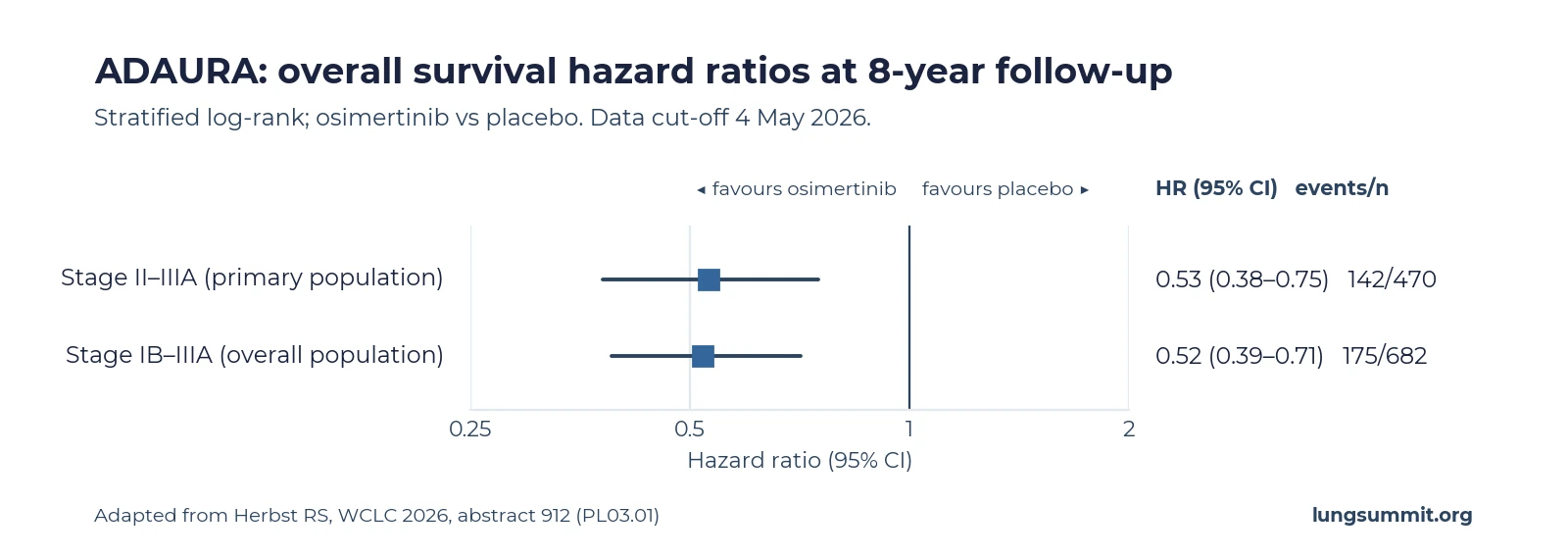
- At a data cut-off of 4 May 2026, eight-year overall survival (OS) in the full stage IB–IIIA population of ADAURA was 79% with adjuvant osimertinib versus 64% with placebo (HR 0.52, 95% CI 0.39–0.71).
- In the primary stage II–IIIA population the eight-year OS rates were 74% versus 58% (HR 0.53, 95% CI 0.38–0.75), a 16-point difference.
- The analysis is post hoc and exploratory: 127 of the 558 patients alive at the 2023 final analysis (23%) had no further survival data and stayed censored there.
- Every predefined subgroup on the slides favoured osimertinib, with hazard ratios between 0.45 and 0.74; the intervals for stage IB, male patients, L858R carriers and ever-smokers crossed 1.0.
Study at a glance
- Trial: ADAURA (NCT02511106), funded by AstraZeneca
- Global Phase III, double-blind, randomised, placebo-controlled; 682 patients randomised from 26 countries
- Completely resected EGFR-mutated (Ex19del or L858R) stage IB–IIIA NSCLC (AJCC 7th edition), adjuvant chemotherapy allowed; osimertinib n=339, placebo n=343
- Osimertinib 80 mg once daily versus placebo, 1:1, for up to 3 years
- Primary endpoint: investigator-assessed disease-free survival in stage II–IIIA, met (HR 0.20). OS was a secondary endpoint, met at the planned final analysis (HR 0.49). This update is a post hoc exploratory OS landmark analysis in all randomised patients
- Data cut-off 4 May 2026; median OS follow-up 93.3 months (osimertinib) versus 79.6 months (placebo) in the overall population
How the eight-year follow-up was assembled, and who is missing from it
ADAURA randomised 682 patients with completely resected stage IB–IIIA NSCLC carrying an EGFR mutation, 1:1, to osimertinib 80 mg once daily or placebo for up to three years, after adjuvant chemotherapy where it was given. The primary endpoint, investigator-assessed disease-free survival in stage II–IIIA disease, was reported in 2020 with a hazard ratio of 0.20. The planned final overall survival analysis, at a data cut-off of 27 January 2023, gave a hazard ratio of 0.49 and five-year OS of 88% versus 78% in the overall population. Follow-up was scheduled to end there.
A protocol amendment in August 2023 asked patients who were still alive to consent to yearly survival follow-up. Of the 558 patients alive at the January 2023 cut-off, 431 (77%) contributed further survival information, either through that yearly follow-up or from accessible records and the date of last contact. The remaining 127 (23%) contributed nothing new and remained censored at their last known alive date from the 2023 analysis. The split was uneven by arm: 237 of 297 osimertinib patients (80%) had additional data, against 194 of 261 placebo patients (74%). The two arms also entered the extension with different numbers of deaths already recorded, 42 of 339 (12%) on osimertinib and 82 of 343 (24%) on placebo. Disease progression was not collected after 11 April 2022, the date of the updated DFS analysis, so this update speaks to survival only.
The analysis population was all 682 randomised patients. Eight-year OS rates were estimated by the Kaplan–Meier method and hazard ratios by stratified log-rank statistics. Median follow-up for OS across all patients reached 93.3 months with osimertinib and 79.6 months with placebo in the overall population, and 92.0 versus 68.5 months in the stage II–IIIA population. No p-values were reported for the eight-year comparison; the slides show the 2023 value (HR 0.49, 95% CI 0.33–0.73; p=0.0004) beside each new estimate for reference.
Eight-year survival: 79% versus 64% overall, 74% versus 58% in stage II–IIIA
In the primary population of 470 patients with stage II–IIIA disease, 142 deaths had occurred by the cut-off (maturity 30%: 24% on osimertinib, 36% on placebo). The eight-year OS rate was 74% (95% CI 67–80) with osimertinib and 58% (95% CI 50–65) with placebo, a difference of 16 percentage points, with an OS hazard ratio of 0.53 (95% CI 0.38–0.75).
In the overall stage IB–IIIA population, 175 of 682 patients had died (26%; 20% versus 31%). Eight-year OS was 79% (95% CI 74–83) versus 64% (95% CI 58–70), a 15-point difference, with a hazard ratio of 0.52 (95% CI 0.39–0.71). The presentation’s forest plot also gives an unadjusted Cox proportional-hazards estimate for the whole population of 0.56 (95% CI 0.41–0.75), close to the stratified figure.
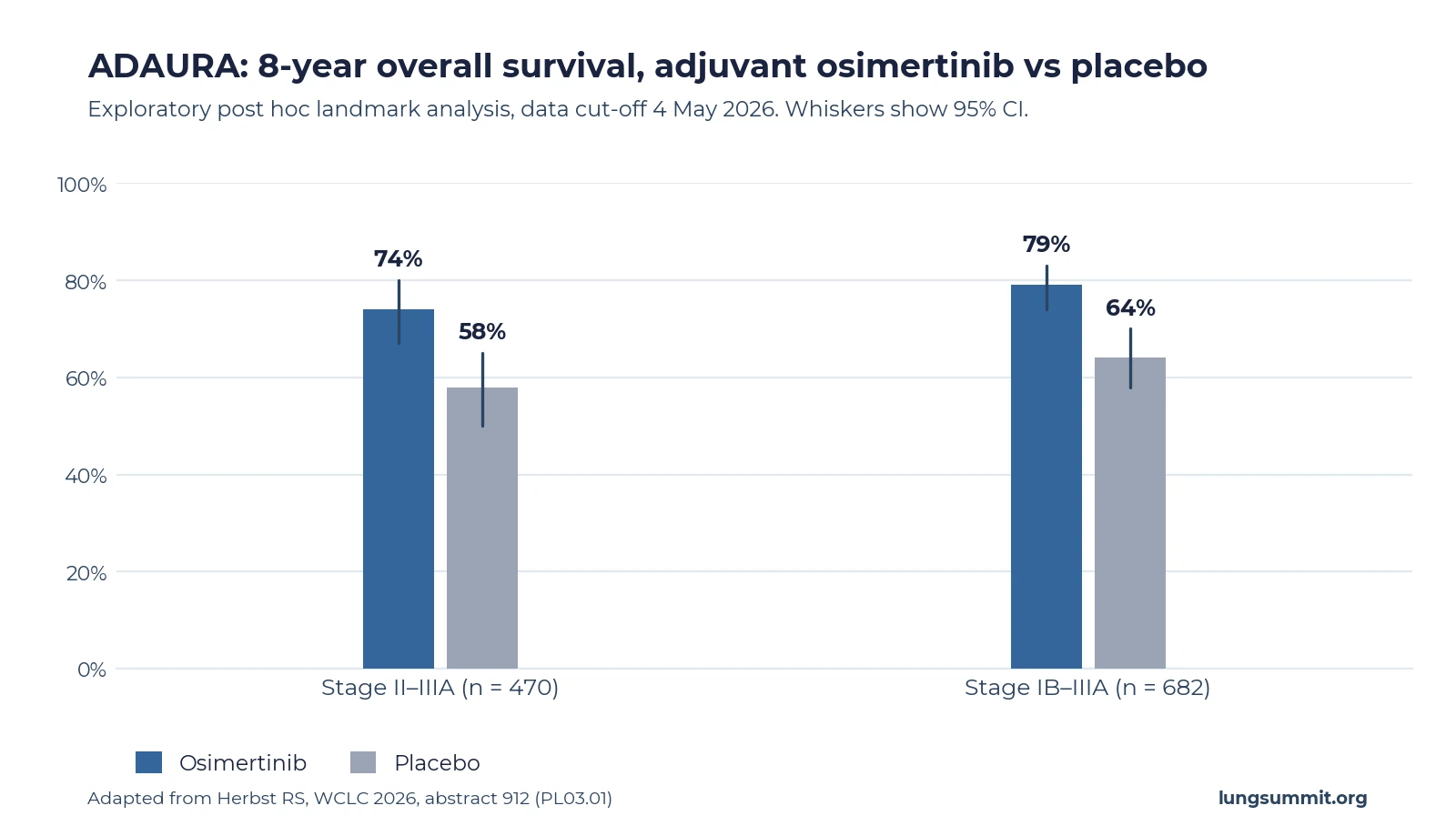
The Kaplan–Meier plots on the slides mark both landmarks. In the overall population the curves read 88% at five years and 79% at eight years for osimertinib, against 78% and 64% for placebo; in stage II–IIIA they read 85% and 74% against 73% and 58%. The gap between arms in the overall population was therefore 10 points at five years and 15 points at eight, and the authors describe continued separation of the curves rather than convergence after treatment stopped at three years.
Stage IB, II and IIIA each favoured osimertinib; four subgroup intervals crossed 1.0
By stage (AJCC 7th edition), eight-year OS with osimertinib versus placebo was 91% versus 77% in stage IB (HR 0.50, 95% CI 0.23–1.01), 78% versus 63% in stage II (HR 0.60, 95% CI 0.36–0.97) and 70% versus 52% in stage IIIA (HR 0.49, 95% CI 0.31–0.77). The stage IB interval touches 1.0, on 33 events among 212 patients; stage IA is the subject of the separate ADAURA2 trial and was not enrolled here.
Across the other predefined subgroups the point estimates ranged from 0.45 to 0.74. Female patients (HR 0.47, 95% CI 0.32–0.69), patients with exon 19 deletions (HR 0.45, 95% CI 0.29–0.68) and non-Asian patients (HR 0.45, 95% CI 0.27–0.74) had the lowest estimates. The intervals for male patients (HR 0.74, 95% CI 0.44–1.22; 60 events in 204 patients), L858R carriers (HR 0.72, 95% CI 0.46–1.11) and patients with a smoking history (HR 0.58, 95% CI 0.32–1.04) included 1.0. Age under or over 65 made little difference (HR 0.59 and 0.53), and neither did receipt of adjuvant chemotherapy (HR 0.54 with, 0.58 without). These subgroup figures appear on the presentation slides only; the abstract states that benefit was observed across predefined subgroups without giving the estimates.
Why the investigators call the eight-year difference a conservative estimate
A backup slide addresses what the missing 23% might do to the landmark rates. Within the placebo arm, patients who supplied additional survival data differed from those who did not: 56% versus 27% were disease-free at April 2022, and 37% versus 27% had stage IB disease. In the osimertinib arm the same comparisons were 81% versus 77% and 32% versus 38%. The investigators’ interpretation is that the eight-year rates may be overestimated in both arms, that the overestimate is likely larger for placebo, and that the observed difference between arms is therefore probably conservative. That is their reading of an imbalance they identified themselves; the analysis remains post hoc and exploratory, as the abstract describes it.
Two further limits sit on the slides. Disease status after April 2022 is unknown, so the update cannot say whether the survival difference tracks continued freedom from recurrence. And the presentation’s genomic analysis, limited to seven tissue and 17 plasma samples, found one patient whose disease progressed on treatment, with MET amplification; most progression occurred after osimertinib had stopped, with no clear resistance driver relative to placebo.
Dr. Herbst’s characterisation in the IASLC release follows the abstract’s conclusion closely.
“These additional long-term findings further characterize the established survival benefit of adjuvant osimertinib for patients with resected EGFR-mutated stage IB-IIIA NSCLC, with or without adjuvant chemotherapy.”
Dr. Roy S. Herbst, Dartmouth Cancer Center, Lebanon, NH, USA
The abstract and the release both state that three years of adjuvant osimertinib is the standard of care in this setting. The presentation names three ongoing osimertinib studies in the resectable setting: TARGET (NCT05526755), a Phase II study of five years of adjuvant osimertinib in stage II–IIIB disease; ADAURA2 (NCT05120349), a Phase III trial in stage IA; and NeoADAURA (NCT04351555), a Phase III neoadjuvant trial in stage II–IIIB N2 disease. It was dedicated to Prof. Masahiro Tsuboi of the National Cancer Center Hospital East, Kashiwa, Japan, a co-investigator on ADAURA who died in February 2026.
Sources
- Herbst RS, Majem M, John T, et al. Adjuvant Osimertinib in Resected EGFR-Mutated Stage IB-IIIA NSCLC: ADAURA Exploratory 8-year Overall Survival Landmark Update. IASLC 2026 World Conference on Lung Cancer, Seoul, 12–15 September 2026; abstract 912 (session PL03.01).
- IASLC news release, Seoul, 14 September 2026: “Eight-Year ADAURA Update Shows Sustained Overall Survival Benefit With Adjuvant Osimertinib in Resected EGFR-Mutated NSCLC”.
- Herbst RS, et al. Journal of Thoracic Oncology, published 14 September 2026, simultaneous with the WCLC presentation (as stated in the IASLC news release; no volume, page or DOI given).
ILCS 2026
The International Lung Cancer Summit (ILCS 2026) takes place on Friday 13 November 2026 in Lausanne and live online. Faculty will discuss the WCLC 2026 data in the context of daily practice. Register for ILCS 2026 →
Written by the Lung Summit editorial team.
This article was produced independently by the Lung Summit editorial team, without industry funding or input.