SELECT FROM MENU

Therapy Areas
Drug Classes

       Therapy Areas

All Sessions

All Sessions

Resectable NSCLC

Resectable NSCLC

Advanced NSCLC

Advanced NSCLC

SCLC

SCLC

Biomarkers

Biomarkers

       Drug Classes

Targeted Therapies

Targeted Therapies

Immunotherapies

Immunotherapies

ADCs

ADCs

Advanced NSCLCSeptember 15, 2026

HARMONi-2: ivonescimab extends overall survival over pembrolizumab in China

Presented by Prof. Caicun Zhou of Shanghai Pulmonary Hospital, Tongji University School of Medicine, in the Presidential Symposium of the IASLC 2026 World Conference on Lung Cancer (WCLC) in Seoul on 13 September, the second interim analysis of overall survival in the phase 3 HARMONi-2 trial found a median of 30.75 months with ivonescimab against 22.57 months with pembrolizumab as first-line monotherapy for PD-L1-positive advanced non-small cell lung cancer (NSCLC). The hazard ratio was 0.73 (95% CI 0.57–0.95, P=0.009). The trial randomised 398 patients, all at centres in China.
Share
HARMONi-2: ivonescimab extends overall survival over pembrolizumab in China

In brief

  • Median overall survival was 30.75 months with first-line ivonescimab versus 22.57 months with pembrolizumab (HR 0.73, 95% CI 0.57–0.95, P=0.009) at the second prespecified interim analysis of HARMONi-2, with 234 deaths at the 20 August 2026 cut-off.
  • The primary endpoint, progression-free survival, had already been met: 11.1 versus 5.8 months (HR 0.51, 95% CI 0.38–0.69, P<0.0001).
  • The overall survival hazard ratio was 0.65 in squamous disease and 0.58 at PD-L1 TPS 50% or higher; the intervals for non-squamous disease (HR 0.79) and TPS 1–49% (HR 0.85) include 1.
  • Any-grade treatment-related adverse events occurred in 93.4% versus 84.9% and serious ones in 29.9% versus 21.6%; discontinuations were 4.1% versus 5.0%. All 398 patients were enrolled at centres in China.

Study at a glance

  • Trial: HARMONi-2 (NCT05499390)
  • Phase 3, randomised 1:1; patients enrolled at centres in China between November 2022 and August 2023 (single-country trial)
  • 398 patients with treatment-naïve, locally advanced or metastatic NSCLC, PD-L1 TPS ≥1%, no EGFR or ALK alterations
  • Ivonescimab 20 mg/kg (n=198) versus pembrolizumab 200 mg (n=200), each alone, every 3 weeks
  • Primary endpoint: progression-free survival by independent radiology review (RECIST v1.1), met (HR 0.51). Key secondary endpoint: overall survival, met at the second of two planned interim analyses (HR 0.73, P=0.009, one-sided alpha 0.0141)
  • Data cut-off 20 August 2026; 234 overall survival events. Median follow-up not reported in the abstract

One bispecific antibody against pembrolizumab alone, no chemotherapy in either arm

Ivonescimab is a bispecific antibody that binds PD-1 and VEGF; the abstract describes it as first in class. HARMONi-2 set it against pembrolizumab, a PD-1 inhibitor, in a head-to-head design with no chemotherapy in either arm.

Eligible patients had treatment-naïve, locally advanced or metastatic NSCLC with a PD-L1 tumour proportion score (TPS) of 1% or higher and no EGFR or ALK alterations. Between November 2022 and August 2023, 398 patients were randomised 1:1 to ivonescimab 20 mg/kg (n=198) or pembrolizumab at a 200 mg flat dose (n=200), given every three weeks. The abstract states that enrolment took place at centres in China, and all fifteen affiliations in the author block are in China. The trial has no sites outside the country.

The primary endpoint was progression-free survival (PFS) assessed by an independent radiology review committee under RECIST v1.1, and it was met in the earlier analysis: median PFS was 11.1 months with ivonescimab and 5.8 months with pembrolizumab (HR 0.51, 95% CI 0.38–0.69, P<0.0001). Overall survival (OS) was the key secondary endpoint, to be tested at two planned interim analyses and one final analysis. The WCLC presentation covers the second interim analysis.
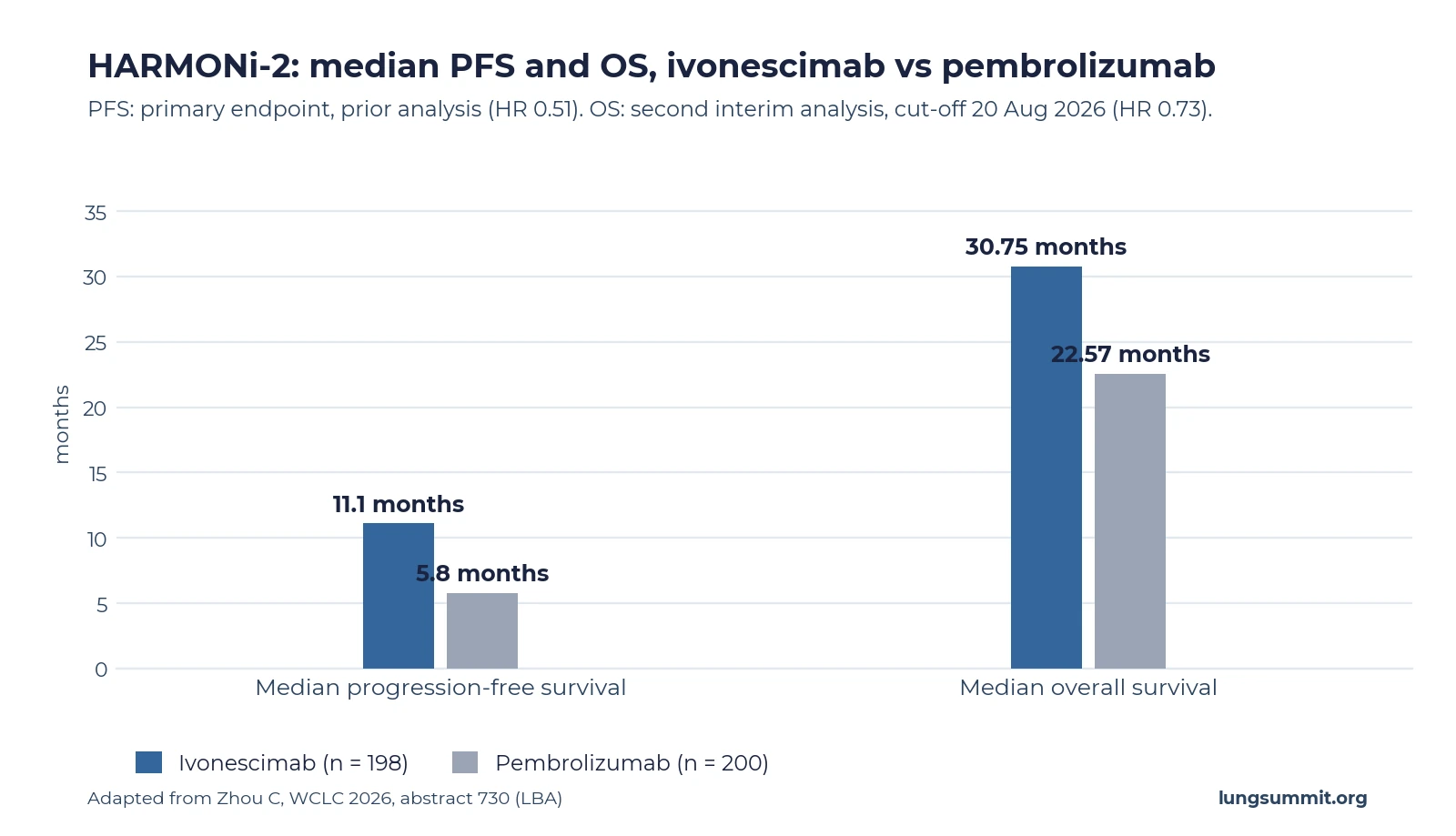
Bar chart of HARMONi-2 medians: progression-free survival 11.1 months with ivonescimab versus 5.8 months with pembrolizumab, and overall survival 30.75 months versus 22.57 months.
Figure 1. Median progression-free survival (primary endpoint, previously reported: 11.1 versus 5.8 months, HR 0.51, 95% CI 0.38–0.69, P<0.0001) and median overall survival at the second prespecified interim analysis (30.75 versus 22.57 months, HR 0.73, 95% CI 0.57–0.95, P=0.009) with first-line ivonescimab versus pembrolizumab in HARMONi-2. Data cut-off for overall survival 20 August 2026, 234 events. Adapted from Zhou C, WCLC 2026, abstract 730 (LBA).

Overall survival cleared its interim boundary at 234 deaths

The second interim analysis was planned for 232 OS events, with a one-sided alpha of 0.0139. By the data cut-off of 20 August 2026, 234 events had occurred, and the prespecified O’Brien-Fleming spending function set the alpha for this look at 0.0141.

Median OS was 30.75 months with ivonescimab and 22.57 months with pembrolizumab, a difference of just over eight months at the median. The hazard ratio was 0.73 (95% CI 0.57–0.95), and the reported P value of 0.009 falls inside the alpha allotted to the analysis. The authors describe the result as a statistically significant and clinically meaningful survival benefit; the second of those judgements is theirs.

Several figures a reader would want are not in the abstract. It gives no median follow-up, no landmark survival rates at fixed timepoints, and no information on what treatment patients in either arm received after progression. Because the analysis is an interim one, a final OS analysis remains to come.

Squamous histology and PD-L1 TPS of 50% or higher show the largest effect

The abstract reports OS hazard ratios for four prespecified subgroups and calls the benefit generally consistent across them. In squamous histology the hazard ratio was 0.65 (95% CI 0.45–0.95); in non-squamous histology it was 0.79 (95% CI 0.55–1.14). Split by PD-L1 expression, the hazard ratio was 0.85 (95% CI 0.61–1.18) at TPS 1–49% and 0.58 (95% CI 0.38–0.89) at TPS 50% or higher.

Two of the four intervals include 1, those for non-squamous disease and for TPS 1–49%, and the abstract gives no patient or event counts for any subgroup, so the width of each interval cannot be related to its size. The point estimates put the larger effect in squamous tumours and in tumours with high PD-L1 expression.
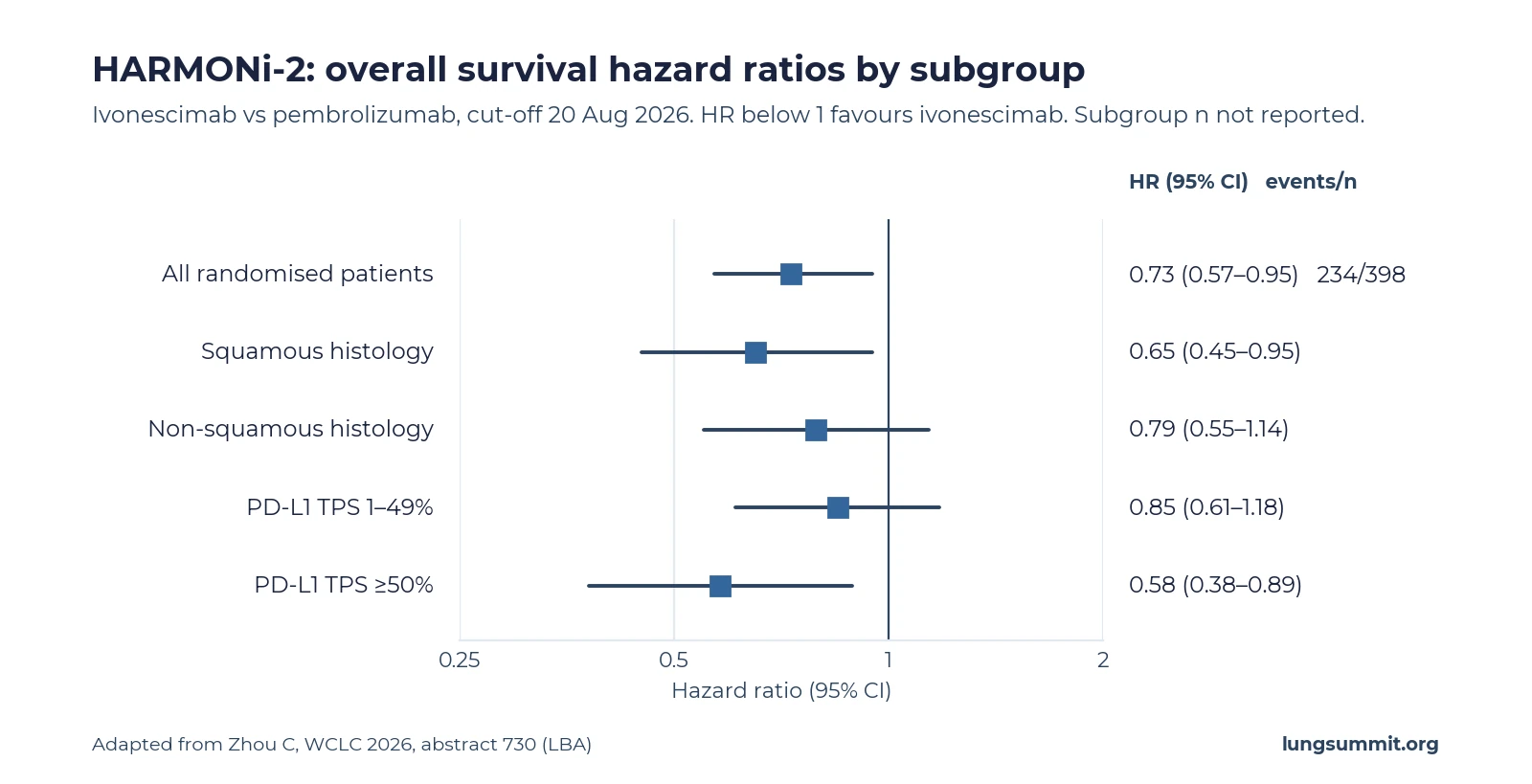
Forest plot of HARMONi-2 overall survival hazard ratios: 0.73 overall, 0.65 in squamous histology, 0.79 in non-squamous histology, 0.85 at PD-L1 TPS 1 to 49 percent, and 0.58 at TPS 50 percent or higher, with 95 percent confidence intervals.
Figure 2. Overall survival hazard ratios for ivonescimab versus pembrolizumab in HARMONi-2 at the second interim analysis: 0.73 (95% CI 0.57–0.95; 234 events in 398 patients) overall, 0.65 (0.45–0.95) in squamous and 0.79 (0.55–1.14) in non-squamous histology, 0.85 (0.61–1.18) at PD-L1 TPS 1–49% and 0.58 (0.38–0.89) at TPS 50% or higher. Subgroup event counts were not reported. Adapted from Zhou C, WCLC 2026, abstract 730 (LBA).

More treatment-related and serious adverse events with ivonescimab, similar discontinuation rates

Treatment-related adverse events (TRAEs) of any grade occurred in 93.4% of patients on ivonescimab and 84.9% on pembrolizumab. Serious TRAEs were reported in 29.9% versus 21.6%. TRAEs leading to permanent discontinuation were 4.1% with ivonescimab and 5.0% with pembrolizumab, and immune-related adverse events were 34.0% versus 33.7%.

The abstract characterises the two profiles as broadly comparable and states that no new safety signals were identified with ivonescimab relative to the established pembrolizumab profile. It does not break the events down by type or by grade 3 or higher, and it does not report treatment-related deaths, so the events behind the higher rate of serious TRAEs in the ivonescimab arm cannot be identified from it.

A single-country trial, and the claim the authors build on it

Every patient in HARMONi-2 was treated in China, and the abstract makes no claim about other populations. Four of the twenty authors list Akeso Biopharma, Zhongshan, as their affiliation. The conclusion of the abstract goes beyond the OS figures: the authors write that the findings support ivonescimab as a chemotherapy-free first-line treatment with the potential to redefine the standard of care and to serve as a cornerstone of treatment in this population. That is the authors’ framing.

In the IASLC news release accompanying the presentation, Prof. Zhou summarised the result in the same terms as the abstract.

“Ivonescimab significantly prolonged overall survival versus pembrolizumab in this patient population, with no new safety signals identified relative to the established pembrolizumab safety profile.”Prof. Caicun Zhou, Shanghai Pulmonary Hospital, Tongji University School of Medicine, Shanghai, China

What the abstract establishes is narrower than the conclusion drawn from it: in a Chinese population with PD-L1-positive, EGFR- and ALK-negative advanced NSCLC, ivonescimab monotherapy prolonged OS over pembrolizumab monotherapy at a prespecified interim analysis, at the cost of more serious treatment-related events and with no difference in discontinuations. The final OS analysis is still pending.

Sources

  1. Zhou C, Wang L, Xiong A, et al. Overall Survival Analysis From HARMONi-2: Ivonescimab vs Pembrolizumab as First-Line Treatment for PD-L1-Positive NSCLC. IASLC 2026 World Conference on Lung Cancer, Seoul, 12–15 September 2026; late-breaking abstract 730 (Presidential Symposium, session PL02).
  2. IASLC news release, Seoul, 13 September 2026: “Late-Breaking HARMONi-2 Analysis Shows Ivonescimab Significantly Improves Overall Survival Versus Pembrolizumab in PD-L1-Positive Advanced NSCLC”.

ILCS 2026

The International Lung Cancer Summit (ILCS 2026) takes place on Friday 13 November 2026 in Lausanne and live online. Faculty will discuss the WCLC 2026 data in the context of daily practice. Register for ILCS 2026 →

Written by the Lung Summit editorial team.

This article was produced independently by the Lung Summit editorial team, without industry funding or input.

i 3 On This Page

Share

       Continue With

Related Topics

Videos
Oliver Gautschi on EGFR+ NSCLC
Jul 20 2026
SPONSORED INTERVIEW
Advanced NSCLCTargeted Therapies

Advances in EGFR+ NSCLC: An Interview with Prof. Oliver Gautschi

Prof. Oliver Gautschi discusses recent advances in the treatment of EGFR-mutant non-small cell lung cancer in this on-demand expert interview.

O. Gautschi
Prof. Alessandra Curioni-Fontecedro discussing approaches in metastatic PD-L1 negative NSCLC
May 04 2026
SPONSORED INTERVIEW
Advanced NSCLCImmunotherapies

Approaches in Metastatic PD-L1 Negative NSCLC: An Interview with Prof. Alessandra Curioni-Fontecedro

Prof. Alessandra Curioni-Fontecedro discusses treatment approaches in metastatic PD-L1 negative non-small cell lung cancer in this on-demand expert interview.

A. Curioni-Fontecedro
Lung Cancer Review by Solange Peters, Martin Reck, Charles Rudin
Dec 18 2025
VIRTUAL ROUNDTABLE
Advanced NSCLCSCLCADCs

2025 Approvals & Highlights

} 1 h 49 min

S. PetersC. RudinM. Reck
Sep 26 2025
ILCS 2025
Advanced NSCLC

Latest Options for Non-Oncogene Addicted Advanced NSCLC in Frontline and Beyond

} 32 min

A. Curioni-Fontecedro
Sep 26 2025
ILCS 2025
Immunotherapies

The Role of IO Added to Chemoradiation in Unresectable Stage III NSCLC

} 28 min

A. Filippi
Sep 26 2025
ILCS 2025
Immunotherapies

Tailoring IO in Res. NSCLC: Personalized Approaches for Improved Outcomes

} 36 min

P. Forde
Sep 26 2025
SPONSORED INTERVIEW
Advanced NSCLCTargeted Therapies

Latest Advances in Frontline EGFR+ NSCLC

} 14 min

A. Curioni-Fontecedro
Sep 26 2025
INDUSTRY SYMPOSIUM
Advanced NSCLCTargeted Therapies

Unlocking New Potentials in EGFR-Mutant NSCLC

} 30 min

A. Passaro
Sep 26 2025
ILCS 2025
Advanced NSCLC

Open Discussion on Patient Cases

} 22 min

Targeted Therapies by Oliver Gautschi, Jarushka Naidoo, Nicolas Girard
Jul 10 2025
VIRTUAL ROUNDTABLE
Advanced NSCLCTargeted Therapies

Targeted Therapies in NSCLC

} 1h 30 min

O. GautschiJ. NaidooN. Girard
IO in NSCLC by Solange Peters, Jordi Remon, Patrick Forde
Jun 25 2025
VIRTUAL ROUNDTABLE
Advanced NSCLCImmunotherapies

Immunotherapies in NSCLC

} 1h 47 min

P. FordeJ. RemonS. Peters
SCLC by Solange Peters, Giannis Mountzios, Jacob Sands
Jun 17 2025
VIRTUAL ROUNDTABLE
SCLCImmunotherapies

Small Cell Lung Cancer

} 1h 35 min

G. MountziosJ. SandsS. Peters
Girard ADCs
Oct 05 2024
INDUSTRY SYMPOSIUM
Advanced NSCLCADCs

Best Practices in Managing Adverse Events with ADCs in NSCLC

} 18 min

N. Girard
Patient Cases
Oct 04 2024
ILCS 2024
Advanced NSCLCResectable NSCLC

Patient Cases & Open Questions

} 32 min

Sandip Patel & Giannis Mountzios
Oct 04 2024
ILCS 2024
Advanced NSCLC

DEBATE: Balancing Efficacy, Toxicity, and Patient-Centered Care For IO Duration in NSCLC

} 33 min

G. MountziosS. Patel
Jordi Remon
Oct 04 2024
ILCS 2024
Immunotherapies

Tailoring IO in Resectable NSCLC: Personalized Approaches for Improved Outcomes

} 25 min

J. Remon
Nov132026
ILCS 2026

The International Lung Cancer Summit 2026

Learn more about the event

S. PetersA. AddeoM. DasH. HorinouchiT. SequeiraC. LovlyD. PlanchardS. PatelA. CortelliniL. ByersG. MountziosA. Dingemans
Sep 26 2025
ILCS 2025
SCLC

Reshaping Approaches in SCLC with the Latest Advances in LS- and ES-Disease

} 34 min

R. Manochakian
Sep 26 2025
ILCS 2025
ADCs

The ADC Revolution in Lung Cancer: New Targets, New Opportunities

} 27 min

N. Reguart
Sep 26 2025
ILCS 2025
Targeted Therapies

DEBATE: Which Is the Better Choice in EGFR+ Advanced NSCLC?

} 31 min

T. Newsom-DavisX. Le
Articles
Sep 15 2026
CONGRESS
Advanced NSCLCBiomarkersResectable NSCLC

WCLC 2026, day 4: tumour budding, BRAF class II and III, brain radiotherapy timing, and mobile CT screening

Sep 14 2026
CONGRESS
Advanced NSCLCADCs

DESTINY-Lung04: first-line T-DXd adds six months of PFS, no interim survival gain

Sep 14 2026
CONGRESS
Advanced NSCLCTargeted Therapies

PAPILLON final OS: 34.3 vs 27.9 months, HR 0.87 not significant after 76% crossover

Sep 14 2026
CONGRESS
Advanced NSCLCTargeted Therapies

REZILIENT 3: zipalertinib plus chemotherapy adds six months of first-line PFS

Sep 14 2026
CONGRESS
Advanced NSCLCTargeted Therapies

ARROS-1: first-line zidesamtinib responds in over 90% of ROS1-positive NSCLC

Sep 14 2026
CONGRESS
Advanced NSCLCResectable NSCLCADCs

WCLC 2026, day 3: EGFR exon 20, ROS1 and HER2 in advanced NSCLC, and 79% alive at eight years after surgery

Sep 13 2026
CONGRESS
Advanced NSCLCSCLCADCs

WCLC 2026, day 2: MRI surveillance without prophylactic cranial irradiation, and two relapse trials at 13.3 and 18.5 months

Giannis Mountzios
Sep 13 2026
CONGRESS
Advanced NSCLCADCsImmunotherapies

EVOKE-03: sacituzumab govitecan plus pembrolizumab misses both primary endpoints

G. Mountzios
Sep 12 2026
CONGRESS
Advanced NSCLCResectable NSCLCSCLC

WCLC 2026, day 1: extended-interval and subcutaneous dosing in SCLC, and a 70% early response

Sep 10 2026
INDUSTRY NEWS
SCLCImmunotherapies

Tarlatamab added to durvalumab maintenance improved OS in extensive-stage SCLC

Sep 09 2026
INDUSTRY NEWS
Advanced NSCLCImmunotherapies

HARMONi primary analysis reports 6.8 against 4.4 months PFS for ivonescimab plus chemotherapy after EGFR TKI progression

Sep 08 2026
RESEARCH
Advanced NSCLCImmunotherapies

Pleural metastases carried worse two-year survival than contralateral lung metastases in stage M1a NSCLC

L. Hendriks
Sep 04 2026
RESEARCH
Advanced NSCLCTargeted Therapies

An EGFR-SHC1 fusion resists EGFR inhibitors through its non-kinase partner

X. Le
Sep 03 2026
INDUSTRY NEWS
Advanced NSCLCImmunotherapies

Akeso reports an OS benefit for ivonescimab over pembrolizumab in PD-L1-positive NSCLC

Sep 02 2026
RESEARCH
Advanced NSCLCImmunotherapies

AI-HOPE registry recruits 920 patients to build machine-learning models for metastatic NSCLC outcomes

R. FerraraL. Hendriks
Aug 29 2026
RESEARCH
Advanced NSCLCADCs

International panel sets 55 consensus recommendations for managing Dato-DXd side effects in NSCLC

S. Saw
Aug 27 2026
RESEARCH
Advanced NSCLCADCsImmunotherapies

Two EORTC questionnaires cover the common side effects in NSCLC labels, and miss 62 rarer ones

J. RemonR. Ferrara
Aug 25 2026
RESEARCH
Advanced NSCLCBiomarkersImmunotherapies

Cleared ctDNA within weeks predicted longer survival on immunotherapy in a 109-patient study

P. Forde
Aug 21 2026
RESEARCH
Advanced NSCLCBiomarkersImmunotherapies

A ctDNA tumour fraction of 5 percent or more marks the patients who benefit from adding chemotherapy to checkpoint blockade

D. Planchard
Antonio Passaro
Aug 19 2026
RESEARCH
BiomarkersResectable NSCLCImmunotherapies

AIOT expert panel endorses chemo-immunotherapy as a new standard in resectable stage II-III NSCLC

T. CasconeP. FordeA. Passaro