In brief
- The 2025 IASLC tumour budding grade placed 65 of 585 resected squamous cell carcinomas (11.1%) in a high-grade group with worse survival and a trend towards adjuvant chemotherapy benefit (HR 0.52, 95% CI 0.26–1.06).
- In NSCLC with a class II or III BRAF alteration as the only driver, median overall survival on first-line immunotherapy was 12.7 months for class III against 20.5 months for class II (HR 1.47).
- PRESERVE-003 Stage 1: gotistobart gave a median overall survival of 18.5 months against 10.0 months with docetaxel in squamous NSCLC after PD-(L)1 and platinum failure (HR 0.56, 95% CI 0.33–0.95).
- Early cranial stereotactic radiotherapy alongside first-line osimertinib prolonged intracranial progression-free survival (48.5 versus 20.0 months) in EGFR-mutant NSCLC with limited brain metastases; overall survival improved with consolidative (P=0.020) but not concurrent (P=0.288) radiotherapy.
- BRELT3: a mobile low-dose CT unit screened 2,018 high-risk people in Northeast Brazil and found 19 lung cancers (0.94%), with community health workers recruiting 44.3% of participants.
High tumour budding grade marks the one in nine resected squamous tumours with the worst outlook
Dr. Tae Hee Hong of Yonsei University School of Medicine in Seoul presented a single-institution, retrospective validation of the two-tier grade the IASLC Pathology Committee proposed in 2025 for resected lung squamous cell carcinoma (high grade: ten or more buds per 0.785 mm²). Of 585 consecutive patients resected at Severance Hospital between 2015 and 2022, 520 (88.9%) were low grade and 65 (11.1%) high grade. High-grade tumours were more often stage II–III (75.4% versus 43.3%, p<0.001), and high grade independently predicted worse overall and disease-free survival. Among patients with stage IB–III disease, adjuvant chemotherapy gave no clear disease-free survival benefit overall (HR 0.83, p=0.23) or in low-grade disease (HR 0.90, p=0.54), but a trend towards benefit in high-grade disease (HR 0.52, 95% CI 0.26–1.06, p=0.071). In the IASLC release Dr. Hong said: “Our findings show that the newly proposed IASLC tumor budding-based grading system can identify patients with resected lung squamous cell carcinoma who have a poorer prognosis, while also suggesting that high-grade patients may be the group most likely to derive benefit from adjuvant chemotherapy.” The figures are those shown on the day; the abstract described an earlier 611-patient cut with slightly different estimates. No overall survival result was reported for the adjuvant subgroup.
Class III BRAF alterations carry shorter survival on first-line immunotherapy than class II
Dr. Alessandro Di Federico of Memorial Sloan Kettering Cancer Center in New York presented a retrospective study of NSCLC with class II or III (non-V600) BRAF alterations. In a Memorial Sloan Kettering and Dana-Farber cohort of 15,212 patients, 247 (1.6%) carried a class II and 225 (1.5%) a class III alteration. Class III tumours were more often from ever-smokers and more often had a tumour mutational burden of at least 10 mutations per megabase (52.3% versus 39.5%) and STK11, KEAP1 or SMARCA4 co-mutations. In a separate cohort from 15 centres in Europe and the United States, 256 patients with stage IV disease and a class II or III alteration as the only driver received first-line checkpoint inhibitors with or without chemotherapy. Response rates (47% versus 52%) and median progression-free survival (5.8 versus 10.0 months, HR 1.26, p=0.10) did not differ significantly between class III and class II, but median overall survival did: 12.7 versus 20.5 months (HR 1.47, 95% CI 1.08–2.00). With both classes pooled, KRAS co-mutation had no effect on survival, whereas median overall survival was 11.5 months with an STK11 co-mutation, 9.1 with KEAP1 and 9.2 with SMARCA4, against 25.3, 25.0 and 20.8 months without. In the IASLC release the investigators concluded that class III disease may carry a worse prognosis. No comparison with class I or BRAF wild-type tumours was reported.
Gotistobart: 18.5 against 10.0 months’ median survival after PD-(L)1 failure in squamous NSCLC
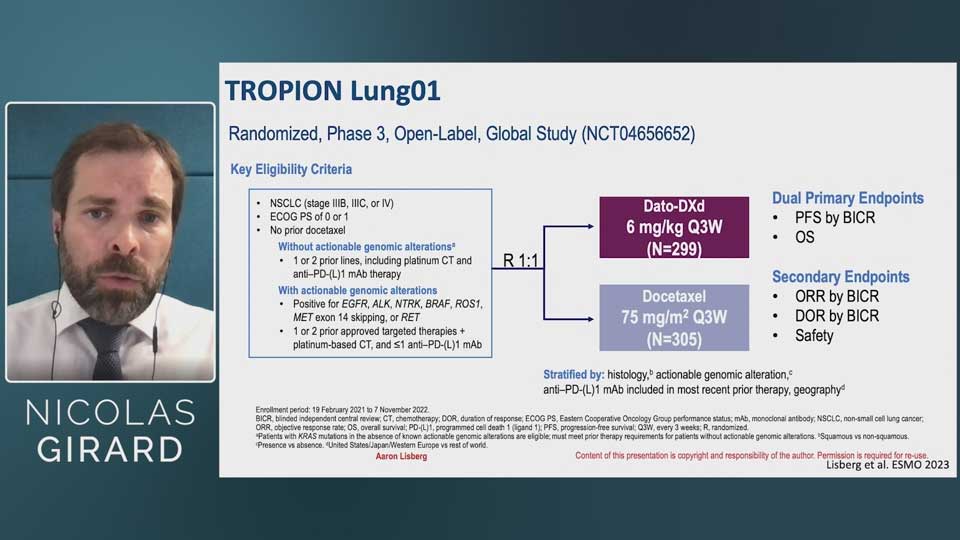
Dr. Rama Balaraman of Ocala Oncology Center in Florida presented updated overall survival from Stage 1 of PRESERVE-003 (NCT05671510), a two-stage, international phase 3 trial of the anti-CTLA-4 antibody gotistobart in metastatic NSCLC that has progressed after a PD-(L)1 inhibitor and platinum chemotherapy. Stage 1 randomised 217 patients between gotistobart and docetaxel; this report concerns the 87 with squamous histology, 45 and 42 respectively. At the slides’ 17 July 2026 cut-off (median follow-up 25.4 months), median overall survival was 18.5 months (95% CI 9.3–not evaluable) with gotistobart and 10.0 months (95% CI 6.2–12.0) with docetaxel (HR 0.56, 95% CI 0.33–0.95; nominal p=0.0295). The abstract, written to a 16 March 2026 cut-off, gave the same medians with an HR of 0.572, which the release quotes as a 43% reduction in the risk of death. Grade 3 or higher treatment-related adverse events occurred in 44.4% and 48.8% of patients, with no treatment-related deaths. In the IASLC release Dr. Balaraman said: “The updated survival findings reinforce the potential of gotistobart to provide a meaningful new treatment option for patients with metastatic squamous NSCLC whose disease has progressed following PD-(L)1 therapy.” Stage 1 is the exploratory part of the trial and its p-value is nominal; response rates and progression-free survival were not given in the material presented, and the 414-patient confirmatory Stage 2 is ongoing.
Consolidative cranial radiotherapy alongside osimertinib prolonged survival; concurrent radiotherapy did not
Dr. Zhengfei Zhu of Fudan University Shanghai Cancer Center presented a retrospective analysis, from three academic centres in China, of early cranial stereotactic radiotherapy (SRT) in EGFR-mutant NSCLC with limited brain metastases at baseline treated with first-line osimertinib. According to the abstract, 148 of 403 patients (36.7%) received early SRT, given concurrently (within one month of starting osimertinib) or as consolidation (after the first month, before progression). After propensity score matching, early SRT was associated with longer overall survival (P=0.027), longer intracranial progression-free survival (48.5 versus 20.0 months, P<0.001) and longer progression-free survival (29.0 versus 15.0 months, P<0.001). Against osimertinib alone, consolidative SRT was associated with improved overall survival (P=0.020) but concurrent SRT was not (P=0.288). Among 255 patients on osimertinib alone, 60 (23.5%) reached an intracranial complete response; those who did not appeared to gain the most from early SRT, particularly consolidative, whereas no clear survival benefit was seen in those who did. The cumulative incidence of symptomatic radiation necrosis was 9.3%, 24.0% and 28.2% at one, two and three years. Overall survival medians and hazard ratios were not stated, and the comparison was not randomised; the authors report an ongoing randomised trial of consolidative SRT (NCT06020066).
A mobile CT unit screened 2,018 high-risk people in Northeast Brazil and found 19 lung cancers
Prof. Ricardo Sales Santos of the ProPulmão Institute in Salvador presented the first results of the Third Brazilian Early Lung Cancer Trial (BRELT3), a prospective, single-arm observational study in which a mobile low-dose CT unit screened current and former smokers aged 50 to 80 across four cities in Northeast Brazil between 2023 and 2025. Of 5,223 people identified, 2,018 met the criteria and were screened: mean age 62, 53% women, 87% self-identified as non-White, 64% educated to primary level, 58.8% current smokers, and 70.7% with high or very high nicotine dependence. Lung-RADS category 3 or 4 findings were seen in 283 (12%); biopsy was indicated in 46 and performed in 34, and lung cancer was diagnosed in 19 (0.94% of those screened), seven at an advanced stage and seven treated surgically. Trained community health workers recruited 894 participants (44.3%), and nearly 60% of the rural participants. In the IASLC release Prof. Sales Santos said: “These initial findings demonstrate that mobile low-dose CT screening can be successfully implemented in resource-limited settings and can reach people who may otherwise face substantial barriers to lung cancer screening.” There was no comparator arm; mortality, false-positive rates and follow-up were not reported, and the reason 12 of the 46 indicated biopsies were not performed was not stated.
Sources
- Hong TH, et al. The 2025 IASLC tumor budding grade identifies high-risk patients and predicts adjuvant chemotherapy benefit in resected lung SqCC. IASLC 2026 World Conference on Lung Cancer, Seoul, 12–15 September 2026; abstract 3102 (session MO05.05).
- Di Federico A, et al. Characteristics and outcomes to immunotherapy in patients with NSCLC harboring class II and III BRAF alterations. IASLC 2026 World Conference on Lung Cancer, Seoul, 12–15 September 2026; abstract 3125 (session MO07.02).
- Balaraman R, et al. Gotistobart vs docetaxel in metastatic squamous NSCLC after PD-(L)1 progression: updated overall survival of the Stage 1 of PRESERVE-003. IASLC 2026 World Conference on Lung Cancer, Seoul, 12–15 September 2026; abstract 627 (session MO07.04).
- Yu S, Peng L, Zhu X, et al.; presented by Zhu Z. Concurrent or consolidative cranial stereotactic radiotherapy in osimertinib-treated NSCLC with limited brain metastases. IASLC 2026 World Conference on Lung Cancer, Seoul, 12–15 September 2026; abstract 1889 (session MO09.01).
- Sales Santos R, et al. Third Brazilian Early Lung Cancer Trial (BRELT3): initial results of mobile lung CT screening in low resources setting. IASLC 2026 World Conference on Lung Cancer, Seoul, 12–15 September 2026; abstract 3182 (session MO14.03).
- IASLC news release, Seoul, 15 September 2026: “IASLC Tumor Budding Grade Identifies High-Risk Patients With Resected Lung Squamous Cell Carcinoma”.
- IASLC news release, Seoul, 15 September 2026: “Study Identifies Distinct Outcomes and Genomic Features in NSCLC With Class II and III BRAF Alterations”.
- IASLC news release, Seoul, 15 September 2026: “Investigational Immunotherapy Nearly Doubles Overall Survival Compared with Docetaxel in Advanced Squamous NSCLC”.
- IASLC news release, Seoul, 15 September 2026: “Mobile CT Lung Cancer Screening Expands Access for Underserved Populations in Brazil”.
ILCS 2026
The International Lung Cancer Summit (ILCS 2026) takes place on Friday 13 November 2026 in Lausanne and live online. Faculty will discuss the WCLC 2026 data in the context of daily practice. Register for ILCS 2026 →
Written by the Lung Summit editorial team.
This article was produced independently by the Lung Summit editorial team, without industry funding or input.