SELECT FROM MENU

Therapy Areas
Drug Classes

       Therapy Areas

All Sessions

All Sessions

Resectable NSCLC

Resectable NSCLC

Advanced NSCLC

Advanced NSCLC

SCLC

SCLC

Biomarkers

Biomarkers

       Drug Classes

Targeted Therapies

Targeted Therapies

Immunotherapies

Immunotherapies

ADCs

ADCs

Resectable NSCLCSeptember 28, 2026

AEGEAN’s second interim analysis kept the EFS benefit of perioperative durvalumab, on an OS reading that crosses 1

AEGEAN established perioperative durvalumab in resectable non-small cell lung cancer on a significant event-free survival benefit and a higher rate of pathological complete response. An updated analysis in the Journal of Clinical Oncology reports where those curves stand once all patients have completed or discontinued study treatment: event-free survival remained consistent at a hazard ratio of 0.69, disease-free survival in resected patients at 0.66, and overall survival at 0.89 on a confidence interval that includes no difference.
Share

In brief

  • At a second planned interim analysis, event-free survival continued to favour perioperative durvalumab, with a hazard ratio of 0.69 (95% CI 0.55 to 0.88) in the 740-patient modified intention-to-treat population.
  • Interim disease-free survival in the resected subpopulation gave a hazard ratio of 0.66 (95% CI 0.47 to 0.92), reported as a numerical improvement.
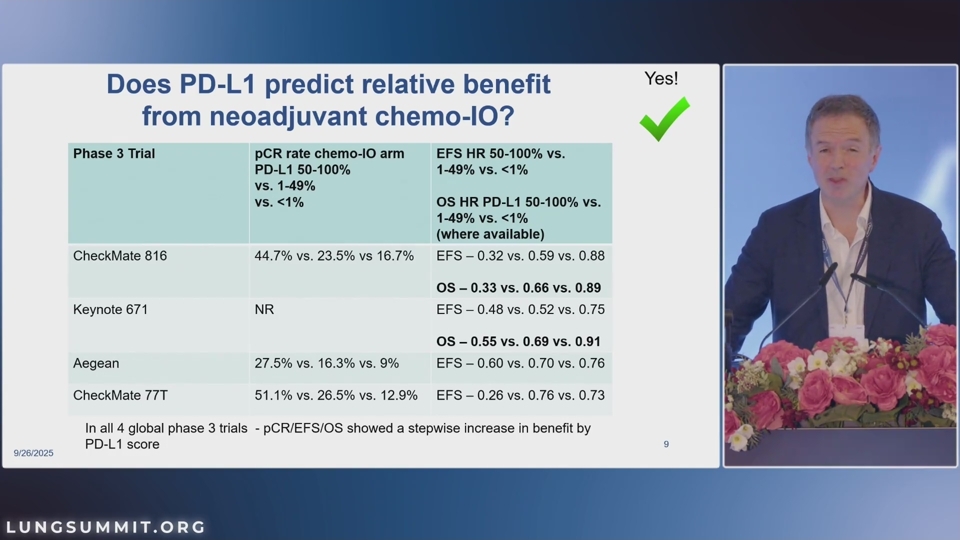
  • Interim overall survival gave a hazard ratio of 0.89 (95% CI 0.70 to 1.14), favouring durvalumab numerically on a confidence interval that crosses 1.
  • Maximum grade 3/4 adverse events during adjuvant treatment occurred in 15.4% of the durvalumab arm and 10.6% of the placebo arm.
  • The data cut-off was 10 May 2024, at a median follow-up of 25.9 months in censored patients, after all patients had completed or discontinued treatment.

Study at a glance

  • Trial: AEGEAN, phase III, double-blind, placebo-controlled, randomised 1:1
  • Population: treatment-naïve resectable NSCLC, stage II to IIIB (N2), with documented EGFR or ALK aberrations excluded from the efficacy analysis
  • Cohort analysed: modified intention-to-treat population, n = 740, and its resected subpopulation for disease-free survival
  • Treatment: neoadjuvant platinum-based chemotherapy with durvalumab or placebo every 3 weeks for four cycles before surgery, then durvalumab or placebo every 4 weeks for 12 cycles after it
  • Follow-up: data cut-off 10 May 2024, median 25.9 months in censored patients
  • Event-free survival: HR 0.69 (95% CI 0.55 to 0.88), second planned interim analysis
  • Disease-free survival: HR 0.66 (95% CI 0.47 to 0.92), interim
  • Overall survival: HR 0.89 (95% CI 0.70 to 1.14), interim
  • Not reported: the abstract gives no median event-free, disease-free or overall survival in months, no pathological complete response figures at this cut-off, and no size for the resected subpopulation

An event-free survival hazard ratio of 0.69 at the second planned interim analysis

The reading was taken after all patients had completed or discontinued study treatment, in the modified intention-to-treat population of 740, and the confidence interval ran from 0.55 to 0.88.

The comparison behind that figure is perioperative durvalumab against neoadjuvant chemotherapy alone, and event-free survival is one of the two endpoints on which AEGEAN was first reported, alongside pathological complete response. Event-free survival counts events from randomisation, which means it captures the patient whose disease progressed before an operation could happen as well as the patient who relapsed after one. The efficacy population excludes patients with documented EGFR or ALK aberrations, so the hazard ratio describes a population from which documented EGFR-driven and ALK-driven disease has been removed.

Disease-free survival in the resected subpopulation gave a hazard ratio of 0.66

That analysis covers only the patients who reached surgery, a group selected after randomisation rather than by it, and the authors report the result as interim and as a numerical improvement.

The distinction between the two endpoints matters, because disease-free survival is measured in a subset of the population event-free survival is measured in, and membership of that subset is decided after randomisation by whether surgery happened. A patient whose disease progressed beforehand contributes an event to event-free survival and never enters the resected subpopulation at all. The two numbers sit close to each other here, 0.69 and 0.66, and they are answering different questions.

An overall survival hazard ratio of 0.89, on a confidence interval that crosses 1

Interim overall survival favoured the durvalumab arm numerically, and at 0.70 to 1.14 the interval is compatible with a moderate survival benefit and with a small disadvantage alike.

A median follow-up of 25.9 months is short for survival in resectable disease. Patients in both arms may live for years after treatment, and the curves need time before they can separate. The authors present the figure as interim, which is the right weight for it, and an interim reading at this cut-off is a checkpoint rather than an answer.

“These results further support perioperative durvalumab plus neoadjuvant chemotherapy as a new treatment option.”Heymach et al., Journal of Clinical Oncology (2026)

Maximum grade 3/4 adverse events in the adjuvant phase, 15.4% against 10.6%

That comparison is confined to the period after surgery, when one arm receives durvalumab, the other receives placebo, and the platinum chemotherapy is behind both of them, so neither rate includes a patient on concurrent chemotherapy.

The gap is just under five percentage points. It is the figure that speaks most directly to what the perioperative design asks of somebody who has already had a lung resection and four cycles of platinum chemotherapy, which is twelve further cycles at four-weekly intervals, running close to a year. Earlier AEGEAN reporting described the safety profile as consistent with the individual agents, and these adjuvant-phase rates are what this update adds to that picture.

Sources

  1. Journal of Clinical Oncology. Perioperative Durvalumab for Resectable Non–Small Cell Lung Cancer: Updated Outcomes From the Phase III AEGEAN Trial (2026-08-28). doi.org

Featuring Lung Summit faculty

This study was co-authored by Lung Summit faculty Martin Reck and Maximilian Hochmair.

This article was produced independently by the Lung Summit editorial team, without industry funding or input.
i 3 On This Page

Share

       Continue With

Related Topics

Videos
Prof. Alessandra Curioni-Fontecedro discussing approaches in metastatic PD-L1 negative NSCLC

May 04 2026
SPONSORED INTERVIEW
Advanced NSCLCImmunotherapies

Approaches in Metastatic PD-L1 Negative NSCLC: An Interview with Prof. Alessandra Curioni-Fontecedro

Prof. Alessandra Curioni-Fontecedro discusses treatment approaches in metastatic PD-L1 negative non-small cell lung cancer in this on-demand expert interview.

A. Curioni-Fontecedro
Lung Cancer Review by Solange Peters, Martin Reck, Charles Rudin
Dec 18 2025
VIRTUAL ROUNDTABLE
Advanced NSCLCSCLCADCs

2025 Approvals & Highlights

} 1 h 49 min

S. PetersC. RudinM. Reck
Sep 26 2025
ILCS 2025
Immunotherapies

The Role of IO Added to Chemoradiation in Unresectable Stage III NSCLC

} 28 min

A. Filippi
Sep 26 2025
ILCS 2025
Immunotherapies

Tailoring IO in Res. NSCLC: Personalized Approaches for Improved Outcomes

} 36 min

P. Forde
IO in NSCLC by Solange Peters, Jordi Remon, Patrick Forde
Jun 25 2025
VIRTUAL ROUNDTABLE
Advanced NSCLCImmunotherapies

Immunotherapies in NSCLC

} 1h 47 min

P. FordeJ. RemonS. Peters
SCLC by Solange Peters, Giannis Mountzios, Jacob Sands
Jun 17 2025
VIRTUAL ROUNDTABLE
SCLCImmunotherapies

Small Cell Lung Cancer

} 1h 35 min

G. MountziosJ. SandsS. Peters
Patient Cases
Oct 04 2024
ILCS 2024
Advanced NSCLCResectable NSCLC

Patient Cases & Open Questions

} 32 min

Jordi Remon
Oct 04 2024
ILCS 2024
Immunotherapies

Tailoring IO in Resectable NSCLC: Personalized Approaches for Improved Outcomes

} 25 min

J. Remon
Nuria Maria Novoa
Oct 04 2024
ILCS 2024
Resectable NSCLC

Surgical Dilemmas: Defining Resectability for Optimal Patient Outcomes in the IO Era

} 27 min

N. Novoa
Oliver Gautschi on EGFR+ NSCLC
Jul 20 2026
SPONSORED INTERVIEW
Advanced NSCLCTargeted Therapies

Advances in EGFR+ NSCLC: An Interview with Prof. Oliver Gautschi

Prof. Oliver Gautschi discusses recent advances in the treatment of EGFR-mutant non-small cell lung cancer in this on-demand expert interview.

O. Gautschi
Nov132026
ILCS 2026

The International Lung Cancer Summit 2026

Learn more about the event

S. PetersA. AddeoM. DasH. HorinouchiT. SequeiraC. LovlyD. PlanchardS. PatelA. CortelliniL. ByersG. MountziosA. Dingemans
Oct252026
ESMO 2026 SYMPOSIUM
SCLC

SCLC Symposium at ESMO 2026: From IO-Standards to the TCE Era

Learn more about the event

M. ReckS. PetersG. MountziosN. Reguart
Sep 26 2025
ILCS 2025
SCLC

Reshaping Approaches in SCLC with the Latest Advances in LS- and ES-Disease

} 34 min

R. Manochakian
Sep 26 2025
ILCS 2025
Advanced NSCLC

Latest Options for Non-Oncogene Addicted Advanced NSCLC in Frontline and Beyond

} 32 min

A. Curioni-Fontecedro
Sep 26 2025
SPONSORED INTERVIEW
Advanced NSCLCTargeted Therapies

Latest Advances in Frontline EGFR+ NSCLC

} 14 min

A. Curioni-Fontecedro
Sep 26 2025
INDUSTRY SYMPOSIUM
Advanced NSCLCTargeted Therapies

Unlocking New Potentials in EGFR-Mutant NSCLC

} 30 min

A. Passaro
Sep 26 2025
ILCS 2025
ADCs

The ADC Revolution in Lung Cancer: New Targets, New Opportunities

} 27 min

N. Reguart
Sep 26 2025
ILCS 2025
Targeted Therapies

DEBATE: Which Is the Better Choice in EGFR+ Advanced NSCLC?

} 31 min

T. Newsom-DavisX. Le
Sep 26 2025
ILCS 2025
Targeted Therapies

Actionable Genomic Alterations – Including HER2 and MET

} 26 min

S. Saw
Sep 26 2025
ILCS 2025
Targeted Therapies

Targeting EGFR and ALK in NSCLC

} 26 min

T. John
Articles
Sep 26 2026
RESEARCH
Advanced NSCLCImmunotherapies

Incidental thymic radiation dose was independently associated with metastasis and death in 1107 patients with NSCLC

B. Ricciuti
Sep 25 2026
RESEARCH
Resectable NSCLCTargeted Therapies

Multi-omic profiling separated recurrence risk within pathological stage in resected EGFR-mutant lung adenocarcinoma

S. Saw
Sep 24 2026
RESEARCH
Resectable NSCLC

Spread through air spaces carried an HR of 2.32 for DFS in stage 1 lung adenocarcinoma

S. Saw
Sep 17 2026
CONGRESS
Resectable NSCLCTargeted Therapies

Adjuvant osimertinib reduced the risk of death by 47% at eight years in ADAURA

Sep 15 2026
CONGRESS
Advanced NSCLCImmunotherapies

HARMONi-2: ivonescimab extends overall survival over pembrolizumab in China

Sep 15 2026
CONGRESS
Advanced NSCLCBiomarkersResectable NSCLC

WCLC 2026, day 4: tumour budding, BRAF class II and III, brain radiotherapy timing, and mobile CT screening

Sep 14 2026
CONGRESS
Advanced NSCLCResectable NSCLCADCs

WCLC 2026, day 3: EGFR exon 20, ROS1 and HER2 in advanced NSCLC, and 79% alive at eight years after surgery

Sep 14 2026
CONGRESS
Resectable NSCLCTargeted Therapies

ADAURA at eight years: adjuvant osimertinib keeps a 15-point overall survival lead

Sep 13 2026
CONGRESS
Advanced NSCLCSCLCADCs

WCLC 2026, day 2: MRI surveillance without prophylactic cranial irradiation, and two relapse trials at 13.3 and 18.5 months

Giannis Mountzios
Sep 13 2026
CONGRESS
Advanced NSCLCADCsImmunotherapies

EVOKE-03: sacituzumab govitecan plus pembrolizumab misses both primary endpoints

G. Mountzios
Sep 12 2026
CONGRESS
Advanced NSCLCResectable NSCLCSCLC

WCLC 2026, day 1: extended-interval and subcutaneous dosing in SCLC, and a 70% early response

Sep 10 2026
INDUSTRY NEWS
SCLCImmunotherapies

Tarlatamab added to durvalumab maintenance improved OS in extensive-stage SCLC

Sep 09 2026
INDUSTRY NEWS
Advanced NSCLCImmunotherapies

HARMONi: ivonescimab plus chemotherapy gave 6.8 against 4.4 months PFS after EGFR TKI progression

Sep 08 2026
RESEARCH
Advanced NSCLCImmunotherapies

Pleural metastases carried worse two-year survival than contralateral lung metastases in stage M1a NSCLC

L. Hendriks
Sep 03 2026
INDUSTRY NEWS
Advanced NSCLCImmunotherapies

Akeso reports an OS benefit for ivonescimab over pembrolizumab in PD-L1-positive NSCLC

Sep 02 2026
RESEARCH
Advanced NSCLCImmunotherapies

AI-HOPE registry recruits 920 patients to build machine-learning models for metastatic NSCLC outcomes

R. FerraraL. Hendriks
Aug 31 2026
RESEARCH
Resectable NSCLCTargeted Therapies

Adjuvant alectinib held its advantage in ALINA’s Asia subgroup, on 31 events and immature survival data

H. Horinouchi
Aug 27 2026
RESEARCH
Advanced NSCLCADCsImmunotherapies

Two EORTC questionnaires cover the common side effects in NSCLC labels, and miss 62 rarer ones

J. RemonR. Ferrara
Aug 25 2026
RESEARCH
Resectable NSCLCTargeted Therapies

ALINA: fewer patients stopped adjuvant alectinib than chemotherapy; quality-of-life gains held to two years

M. HochmairH. HorinouchiD. Planchard
Aug 25 2026
RESEARCH
Advanced NSCLCBiomarkersImmunotherapies

Cleared ctDNA within weeks predicted longer survival on immunotherapy in a 109-patient study

P. Forde