In brief
- At eight years, adjuvant osimertinib reduced the risk of death by 47% against placebo in the Stage II–IIIA primary population (hazard ratio 0.53; 95% CI 0.38–0.75) and by 48% in the Stage IB–IIIA overall population (HR 0.52; 95% CI 0.39–0.71).
- An estimated 74% of patients treated with osimertinib were alive at eight years against 58% of those given placebo in the primary population, and 79% against 64% in the overall population.
- The analysis is exploratory. Extended survival data were obtained for approximately 77% of the patients still alive at the planned final overall survival analysis; 127 patients had none and remained censored at their earlier survival time.
- No median overall survival was released for either arm, and no figure was given for the percentage of placebo patients who received osimertinib after recurrence, which the principal investigator described as high.
- In a separate retrospective cohort of US patients, stopping osimertinib before the three-year course was complete more than doubled the risk of recurrence or death, with no hazard ratio, cohort size or follow-up period released.
Study at a glance
- Cohort: 682 patients, randomised at more than 200 centres in more than 20 countries
- Population: Stage IB, II and IIIA EGFR-mutated NSCLC after complete tumour resection, with adjuvant chemotherapy given at the physician’s and the patient’s discretion
- Treatment: osimertinib 80 mg once daily by mouth, or placebo, for three years or until disease recurrence
- Primary endpoint: disease-free survival in Stage II and IIIA patients
- Survival, primary population: HR 0.53 (95% CI 0.38–0.75), with 74% against 58% alive at eight years
- Survival, overall population: HR 0.52 (95% CI 0.39–0.71), with 79% against 64% alive at eight years
- Data cut-off: 4 May 2026, in an exploratory analysis of all randomised patients
- What was not reported: median overall survival in either arm, the crossover percentage after recurrence, and the hazard ratio, cohort size and follow-up period for the real-world discontinuation cohort
- Safety: final safety data were collected at the planned final overall survival analysis and were consistent with the established profile, with no new concerns identified
Hazard ratios of 0.53 and 0.52 across the two analysis populations
In the Stage II–IIIA primary population, osimertinib reduced the risk of death by 47% against placebo, on a hazard ratio of 0.53 (95% CI 0.38–0.75). In the Stage IB–IIIA overall population the reduction was 48%, on a hazard ratio of 0.52 (95% CI 0.39–0.71). AstraZeneca reported that the survival benefit was observed across all predefined subgroups.
Both figures come from one randomised trial of 682 patients, treated at more than 200 centres in more than 20 countries across the US, Europe, South America, Asia and the Middle East. Patients received osimertinib 80 mg once daily or placebo for three years, or until their disease recurred. Disease-free survival in Stage II and IIIA patients was the primary endpoint; disease-free survival in the wider Stage IB–IIIA group and overall survival in both populations were secondary endpoints. The eight-year overall survival result is therefore a long look at an endpoint the trial was designed to measure.
An estimated 74% alive at eight years, against 58% on placebo
In the primary population, an estimated 74% of patients given osimertinib were alive at eight years, against 58% of those given placebo. In the overall population the estimates were 79% and 64%. The separation between the arms is therefore about 16 percentage points in the primary population and about 15 points in the overall population.
AstraZeneca describes these as estimated percentages, and the release carries no median overall survival for either arm. It also gives no number for how many placebo patients went on to receive osimertinib after their disease recurred, although the trial’s principal investigator described those rates as high. Without that figure, the extent to which crossover narrowed the difference between the arms cannot be read from the results.
Extended follow-up for 77% of survivors, and 127 patients left where they stood
The eight-year analysis was exploratory and was conducted in all randomised patients. It drew complete or partial extended survival data from approximately 77% of the patients who were still alive at the data cut-off for the planned final overall survival analysis. That additional information came either from follow-up to the 4 May 2026 cut-off or from accessible medical records and last contact dates.
A further 127 patients contributed no new information and remained censored, with their survival time unchanged from the planned final analysis. The eight-year percentages therefore rest partly on records gathered outside the trial’s own follow-up schedule, and AstraZeneca presented the result as exploratory rather than as a new confirmatory analysis.
“These ADAURA findings show patients continue to experience meaningful, long-term benefit following early intervention with adjuvant osimertinib, with a 16 per cent point improvement in overall survival at eight years versus placebo. This is especially impressive given high rates of crossover to osimertinib following disease recurrence. This durable overall survival benefit reinforces the importance of prioritising EGFR testing at diagnosis so as many patients as possible can benefit from this transformative therapy.”Roy S. Herbst, MD, PhD, Director at Dartmouth Cancer Center and principal investigator in the ADAURA Phase III trial
Stopping before the three years were complete more than doubled the risk of recurrence or death
A separate retrospective cohort study of US patients with early-stage, Stage I–IIIA, EGFR-mutated NSCLC was presented at the same conference (abstract P1.142). It reported that discontinuing osimertinib before the three-year course was complete more than doubled the risk of disease recurrence or death.
No hazard ratio, cohort size or follow-up period accompanied that summary, and a retrospective cohort cannot separate the effect of stopping treatment from the reasons patients stop. The observation still bears on how the ADAURA result is applied, since the survival percentages above describe a population assigned to three years of treatment rather than a shorter course.
Safety closed at the final analysis, with no new concerns reported
Final safety data for ADAURA were collected at the planned final overall survival analysis. AstraZeneca reported that the safety and tolerability of osimertinib were consistent with its established profile and that no new safety concerns were identified. No adverse event rates, discontinuation rates or dose reductions were released alongside that statement.
TP53 co-mutation status did not change the direction of the FLAURA2 comparison
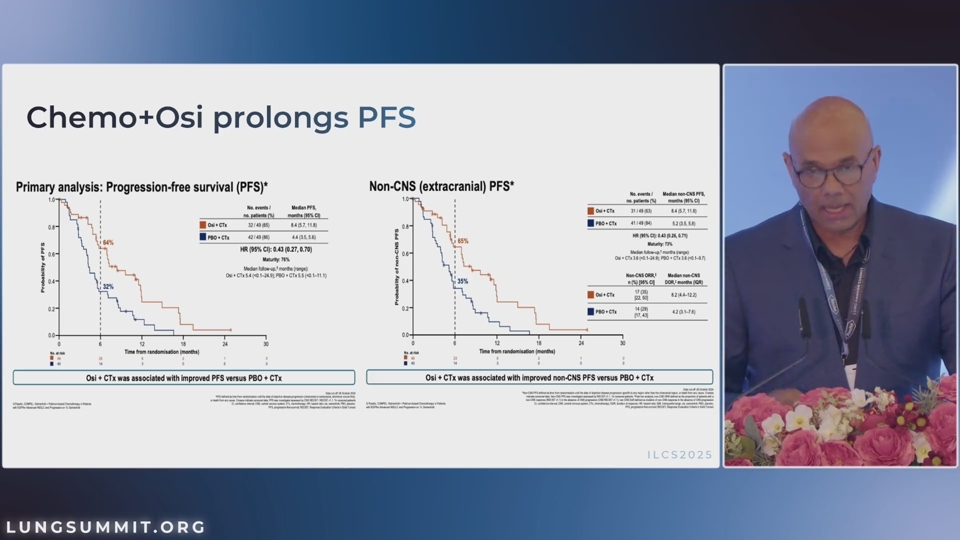
Two analyses from the FLAURA2 trial in advanced disease were presented at the same meeting. A safety analysis at a median follow-up of 42.6 months (abstract PT2.03.03) reported that the tolerability of osimertinib with platinum and pemetrexed remained consistent with the known profiles of those medicines, with reductions in the onset of new adverse events after the initial induction period.
An exploratory analysis (abstract P2.237) reported that progression-free survival and overall survival hazard ratios numerically favoured osimertinib with platinum and pemetrexed over osimertinib alone, regardless of baseline TP53 co-mutation status. No hazard ratios, confidence intervals or subgroup sizes were given for that comparison, so it records the direction of the effect without its size.
Sources
- AstraZeneca. Tagrisso demonstrated unprecedented eight-year landmark survival in early-stage EGFR-mutated lung cancer in ADAURA Phase III trial (2026-09-14). astrazeneca.com
This article was produced independently by the Lung Summit editorial team, without industry funding or input.