SELECT FROM MENU

Therapy Areas
Drug Classes

       Therapy Areas

All Sessions

All Sessions

Resectable NSCLC

Resectable NSCLC

Advanced NSCLC

Advanced NSCLC

SCLC

SCLC

Biomarkers

Biomarkers

       Drug Classes

Targeted Therapies

Targeted Therapies

Immunotherapies

Immunotherapies

ADCs

ADCs

BiomarkersAugust 23, 2026

SLFN11 expression across lung neuroendocrine neoplasms: highest in SCLC, and prognostic only there

SLFN11, a marker already reported to predict sensitivity to DNA-damaging agents in small cell lung cancer (SCLC), has now been measured across the wider family of lung neuroendocrine neoplasms (NENs) for the first time, in a multicentre series of 361 tumours. The results were published in Lung Cancer.
Share

In brief

  • A multicentre study measured SLFN11 by immunohistochemistry in 361 lung neuroendocrine tumours across four histologies and found expression rising from typical and atypical carcinoids, through large cell neuroendocrine carcinoma (LCNEC), to small cell lung cancer (SCLC).
  • SLFN11 expression correlated with Ki67 across all histologies (R² = 0.187), and tracked with ASCL1-high status in carcinoids and LCNEC, with the same direction in SCLC falling short of significance.
  • Expression carried no prognostic value in carcinoids or LCNEC.
  • In SCLC, expression at or above the median was associated with just over double the median overall survival: 13.9 months versus 6.8 months (hazard ratio 0.48, 95% CI 0.26 to 0.90; p = 0.020).
  • The authors said SLFN11’s role in carcinoids and LCNEC remains undefined, so its value as a treatment-selection marker outside SCLC is still an open question.

Study at a glance

  • Cohort: 361 lung neuroendocrine tumours (127 typical carcinoid, 35 atypical carcinoid, 152 LCNEC, 47 SCLC)
  • Design: multicentre, correlative study (immunohistochemistry associated with clinicopathologic data and survival, not a treatment trial)
  • Method: SLFN11 scored by IHC (H-score 0–300), integrated with Ki67, pRb, cMYC, DLL3, ASCL1, HNF1a, OTP and the NEUROD1/ASCL1/POU2F3/YAP1 (NAPY) panel
  • Median SLFN11 H-score: 0 (typical carcinoid) · 0 (atypical carcinoid) · 2.49 (LCNEC) · 35 (SCLC)
  • Correlation with Ki67: R² = 0.187 across all histologies
  • Prognostic value: none in carcinoids or LCNEC; positive in SCLC only
  • SCLC survival: 13.9 vs 6.8 months overall survival for expression ≥ vs < median (HR 0.48, 95% CI 0.26–0.90; p = 0.020)

A chemosensitivity marker in SCLC, untested in its neuroendocrine relatives

SLFN11 is highly expressed in SCLC, and its expression has been reported to predict sensitivity to DNA-damaging agents there. Whether it carries the same meaning in the other lung NENs was not known. The authors stated that its role in typical and atypical carcinoids (TC and AC) and in LCNEC is unknown, and set out to measure it across those histologies alongside SCLC in one series.

This is a correlative survey rather than a treatment trial, and the published abstract reports no therapy-response or treatment-outcome data. What it measured instead was where SLFN11 sits across the neuroendocrine spectrum, and whether that expression tracks with the clinicopathologic and molecular features already used to classify these tumours.

361 tumours scored by IHC against a seven-marker panel

The investigators measured SLFN11 by immunohistochemistry, reported as an H-score from 0 to 300, in 361 tumours: 127 typical carcinoids, 35 atypical carcinoids, 152 LCNEC and 47 SCLC. SLFN11 staining was integrated with Ki67, pRb, cMYC, DLL3, ASCL1, HNF1a and OTP, and with the NEUROD1, ASCL1, POU2F3 and YAP1 (NAPY) transcription-factor panel, in which an H-score above 50 defined the dominant subgroup for each tumour.

Clinicopathologic data and survival were analysed alongside the staining, with the median SLFN11 expression used as the cut-off for the survival analysis. The published abstract does not report whether this panel or cut-off was tested against an independent cohort, so the associations below describe this one series.

Expression climbs steeply from carcinoids through LCNEC to SCLC

SLFN11 expression differed across histologies (p < 0.001). The median H-score was 0 in typical carcinoids (range 0 to 20) and 0 in atypical carcinoids (range 0 to 40), rising to 2.49 in LCNEC (range 0 to 250) and 35 in SCLC (range 0 to 240), a gradient that follows the same order these tumours are already ranked in by proliferative grade.

Across all four histologies, SLFN11 correlated positively with Ki67, the standard proliferation marker (R² = 0.187). The abstract reports this correlation across the whole cohort rather than broken out separately within each histology.

ASCL1-high tumours carry more SLFN11 in carcinoids and LCNEC, a trend in SCLC

In typical and atypical carcinoids, SLFN11 expression was enriched in A1 subgroup tumours, which are known for ASCL1 expression (p = 0.035), and was not correlated with OTP, HNF1A, CD44 or SSTR2A expression. In LCNEC, expression was higher in ASCL1-high tumours (median 17.2, range 0 to 162.5, versus lower expression outside that subgroup; p = 0.003) and correlated with cMYC expression (p = 0.024), but not with pRb or DLL3 status.

In SCLC, the authors reported a trend toward higher expression in ASCL1-high tumours without reaching statistical significance. This is the same direction seen in carcinoids and LCNEC, but the weakest of the three, despite SCLC being the histology in which SLFN11 is already best established.

Above-median expression nearly halved the risk of death, in SCLC only

SLFN11 expression was not prognostic in typical or atypical carcinoids, nor in LCNEC: in those three histologies, tumours with higher and lower expression showed no difference in survival.

In SCLC, expression at or above the median value was associated with longer overall survival: 13.9 months compared with 6.8 months (hazard ratio 0.48, 95% CI 0.26 to 0.90; p = 0.020). The SCLC subgroup numbered only 47 tumours, and the confidence interval on that hazard ratio is correspondingly wide; the finding is a prognostic association in one cohort, not yet a validated predictor of benefit from any specific treatment.

“SLFN11 exp was associated with ASCL1 exp in all lung NENs.”Scattolin et al., Lung Cancer (2026)

A marker still without a defined role outside small cell lung cancer

The authors concluded that SLFN11 expression in lung neuroendocrine neoplasms follows the order SCLC, then LCNEC, then typical and atypical carcinoids, and that it correlates with Ki67 and with ASCL1 expression throughout. No treatment-response or outcome data tied to SLFN11 status were reported outside the SCLC survival analysis, and the abstract does not say whether the cut-offs were confirmed in an independent cohort.

They also stated that the role of SLFN11 in carcinoids and LCNEC remains to be defined, so its value as a treatment-selection marker outside SCLC is still an open question. In SCLC, SLFN11 expression is already reported to predict sensitivity to DNA-damaging agents; this series adds a prognostic association to that picture, without addressing whether SLFN11 status should change which treatment a patient receives.

Sources

  1. Lung Cancer. Analysis of SLFN11 expression in small cell lung cancer, carcinoids and large cell neuroendocrine carcinoma: insights into lung neuroendocrine neoplasms (2026-07-13). doi.org

Featuring Lung Summit faculty

This study was co-authored by Lung Summit faculty Anne-Marie Dingemans.

This article was produced independently by the Lung Summit editorial team, without industry funding or input.

i 3 On This Page

Share

       Continue With

Related Topics

Videos
Oct252026
ESMO 2026 SYMPOSIUM
SCLC

SCLC Symposium at ESMO 2026: From IO-Standards to the TCE Era

Learn more about the event

M. ReckS. PetersG. MountziosN. Reguart

Lung Cancer Review by Solange Peters, Martin Reck, Charles Rudin
Dec 18 2025
VIRTUAL ROUNDTABLE
Advanced NSCLCSCLCADCs

2025 Approvals & Highlights

} 1 h 49 min

S. PetersC. RudinM. Reck
Sep 26 2025
ILCS 2025
SCLC

Reshaping Approaches in SCLC with the Latest Advances in LS- and ES-Disease

} 34 min

R. Manochakian
Sep 26 2025
ILCS 2025
Biomarkers

Cutting-Edge Diagnostic Techniques and Emerging Biomarkers

} 24 min

M. Ilié
SCLC by Solange Peters, Giannis Mountzios, Jacob Sands
Jun 17 2025
VIRTUAL ROUNDTABLE
SCLCImmunotherapies

Small Cell Lung Cancer

} 1h 35 min

G. MountziosJ. SandsS. Peters
Stephen Liu
Oct 04 2024
ILCS 2024
SCLC

Reshaping Our Approaches in SCLC: Latest Therapeutic Options and Future Strategies

} 25 min

S. Liu
Anne Schultheis
Oct 04 2024
ILCS 2024
Biomarkers

Advancements in Diagnostics: Current Guidelines and Emerging Tests

} 20 min

A. Schultheis
Oliver Gautschi on EGFR+ NSCLC
Jul 20 2026
SPONSORED INTERVIEW
Advanced NSCLCTargeted Therapies

Advances in EGFR+ NSCLC: An Interview with Prof. Oliver Gautschi

Prof. Oliver Gautschi discusses recent advances in the treatment of EGFR-mutant non-small cell lung cancer in this on-demand expert interview.

O. Gautschi
Nov132026
ILCS 2026

The International Lung Cancer Summit 2026

Learn more about the event

S. PetersA. AddeoM. DasH. HorinouchiT. SequeiraC. LovlyD. PlanchardS. PatelA. CortelliniN. FrostG. MountziosA. Dingemans
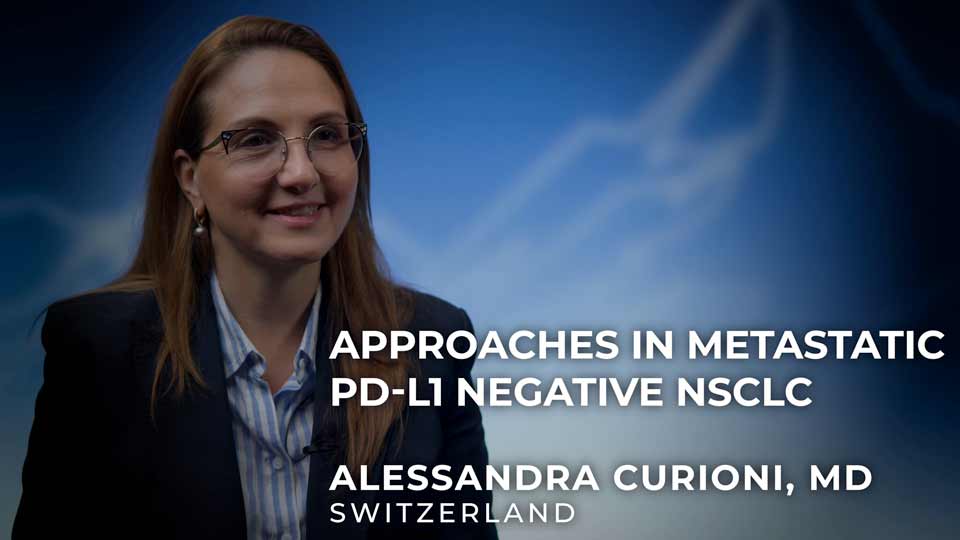
Prof. Alessandra Curioni-Fontecedro discussing approaches in metastatic PD-L1 negative NSCLC
May 04 2026
SPONSORED INTERVIEW
Advanced NSCLCImmunotherapies

Approaches in Metastatic PD-L1 Negative NSCLC: An Interview with Prof. Alessandra Curioni-Fontecedro

Prof. Alessandra Curioni-Fontecedro discusses treatment approaches in metastatic PD-L1 negative non-small cell lung cancer in this on-demand expert interview.

A. Curioni-Fontecedro
Sep 26 2025
ILCS 2025
Advanced NSCLC

Latest Options for Non-Oncogene Addicted Advanced NSCLC in Frontline and Beyond

} 32 min

A. Curioni-Fontecedro
Sep 26 2025
ILCS 2025
Immunotherapies

The Role of IO Added to Chemoradiation in Unresectable Stage III NSCLC

} 28 min

A. Filippi
Sep 26 2025
ILCS 2025
Immunotherapies

Tailoring IO in Res. NSCLC: Personalized Approaches for Improved Outcomes

} 36 min

P. Forde
Sep 26 2025
SPONSORED INTERVIEW
Advanced NSCLCTargeted Therapies

Latest Advances in Frontline EGFR+ NSCLC

} 14 min

A. Curioni-Fontecedro
Sep 26 2025
INDUSTRY SYMPOSIUM
Advanced NSCLCTargeted Therapies

Unlocking New Potentials in EGFR-Mutant NSCLC

} 30 min

A. Passaro
Sep 26 2025
ILCS 2025
ADCs

The ADC Revolution in Lung Cancer: New Targets, New Opportunities

} 27 min

N. Reguart
Sep 26 2025
ILCS 2025
Targeted Therapies

DEBATE: Which Is the Better Choice in EGFR+ Advanced NSCLC?

} 31 min

T. Newsom-DavisX. Le
Sep 26 2025
ILCS 2025
Targeted Therapies

Actionable Genomic Alterations – Including HER2 and MET

} 26 min

S. Saw
Sep 26 2025
ILCS 2025
Targeted Therapies

Targeting EGFR and ALK in NSCLC

} 26 min

T. John
Sep 26 2025
ILCS 2025
Advanced NSCLC

Open Discussion on Patient Cases

} 22 min

Articles
Oct 23 2026
RESEARCH
SCLCImmunotherapies

KEYVIBE-008 tested vibostolimab coformulated with pembrolizumab plus chemotherapy in first-line ES-SCLC

J. SandsM. Reck
Oct 21 2026
RESEARCH
Advanced NSCLCBiomarkersResectable NSCLC

ctDNA on immunotherapy is prognostic across NSCLC stages, but ctDNA-guided treatment remains investigational

U. Malapelle
Oct 07 2026
RESEARCH
BiomarkersSCLC

IASLC pathologists propose a grade 3 category for lung carcinoids with more than 10 mitoses

P. Hofman
Oct 05 2026
RESEARCH
SCLCImmunotherapies

Second-line therapy in ES-SCLC gave a median OS of 7.1 months in the Austrian LALUCA registry

M. Hochmair
Nikolaj Frost
Oct 04 2026
RESEARCH
Advanced NSCLCSCLCTargeted Therapies

Checkpoint inhibitors were associated with longer survival in NSCLC after allogeneic stem cell transplantation

N. FrostM. ReckA. Cortellini
Oct 04 2026
RESEARCH
SCLCImmunotherapies

Longer OS in Asian than non-Asian patients given atezolizumab plus chemotherapy for extensive-stage SCLC

S. LiuM. ReckC. Rudin
Oct 02 2026
RESEARCH
Advanced NSCLCBiomarkersImmunotherapies

High tumour mutational burden was associated with more frequent and earlier immune-related adverse events in advanced NSCLC

B. Ricciuti
Sep 30 2026
RESEARCH
Advanced NSCLCSCLCADCs

Pulmonary adverse events affected almost a third of lung cancer patients treated with ADCs in a 24-study meta-analysis

C. Rolfo
Sep 18 2026
CONGRESS
SCLCADCs

Ris-Rez improved OS against topotecan in relapsed SCLC in China

Sep 16 2026
CONGRESS
SCLCTargeted Therapies

Tam-Peli extended median OS to 13.3 months in relapsed SCLC, against 9.4 months with topotecan

Sep 15 2026
CONGRESS
Advanced NSCLCBiomarkersResectable NSCLC

WCLC 2026, day 4: tumour budding, BRAF class II and III, brain radiotherapy timing, and mobile CT screening

Sep 13 2026
CONGRESS
Advanced NSCLCSCLCADCs

WCLC 2026, day 2: MRI surveillance without prophylactic cranial irradiation, and two relapse trials at 13.3 and 18.5 months

Sep 13 2026
CONGRESS
SCLCADCs

Tam-Peli extends overall survival over topotecan in relapsed SCLC: TAISHAN-302

Sep 13 2026
CONGRESS
SCLCADCs

ARTEMIS-008: risvutatug rezetecan lifts relapsed-SCLC survival to 18.5 months

Sep 13 2026
CONGRESS
SCLC

MAVERICK: MRI surveillance without PCI improves cognitive failure-free survival in SCLC

Sep 12 2026
CONGRESS
Advanced NSCLCResectable NSCLCSCLC

WCLC 2026, day 1: extended-interval and subcutaneous dosing in SCLC, and a 70% early response

Sep 10 2026
INDUSTRY NEWS
SCLCImmunotherapies

Tarlatamab added to durvalumab maintenance improved OS in extensive-stage SCLC

Aug 25 2026
RESEARCH
Advanced NSCLCBiomarkersImmunotherapies

Cleared ctDNA within weeks predicted longer survival on immunotherapy in a 109-patient study

P. Forde
Aug 21 2026
RESEARCH
Advanced NSCLCBiomarkersImmunotherapies

A ctDNA tumour fraction of 5% or more marks who benefits from adding chemotherapy to checkpoint blockade

D. Planchard
Antonio Passaro
Aug 19 2026
RESEARCH
BiomarkersResectable NSCLCImmunotherapies

AIOT expert panel endorses chemo-immunotherapy as a new standard in resectable stage II-III NSCLC

T. CasconeP. FordeA. Passaro