In brief
- In the TKI-naive cohort of the phase 1/2 ARROS-1 trial, zidesamtinib 100 mg once daily produced an objective response by blinded central review in 88 of 94 patients (94%), or 87 of 94 (93%) counting confirmed responses only.
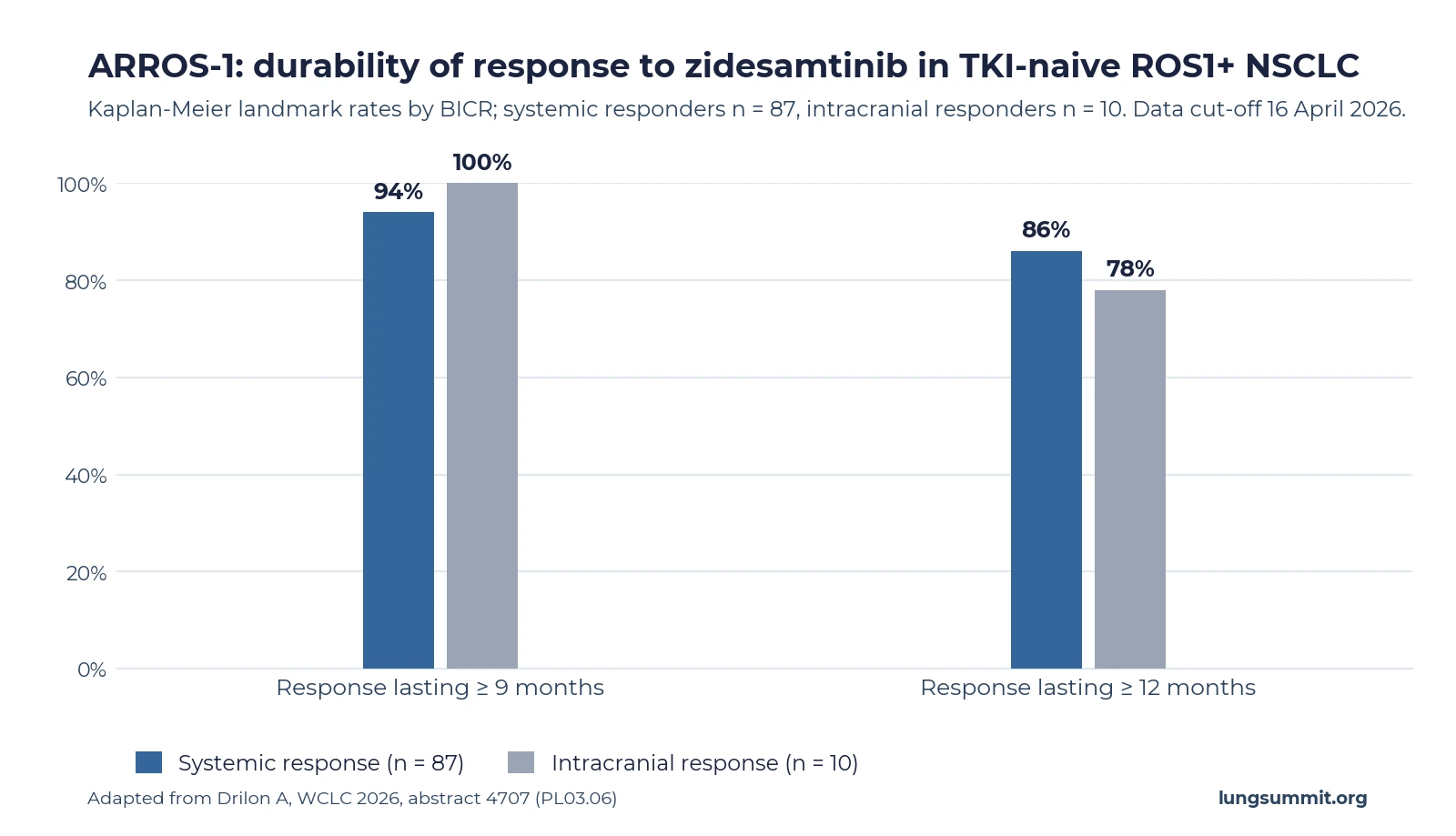
- Responses were durable: 94% were still ongoing at 9 months and 86% at 12 months. Median duration of response and median progression-free survival were not reached; 90% of patients were progression-free at 12 months.
- All 10 patients with measurable brain metastases responded intracranially, 7 of them with a complete intracranial response, and no CNS progression was seen in the 78 patients without brain metastases at baseline.
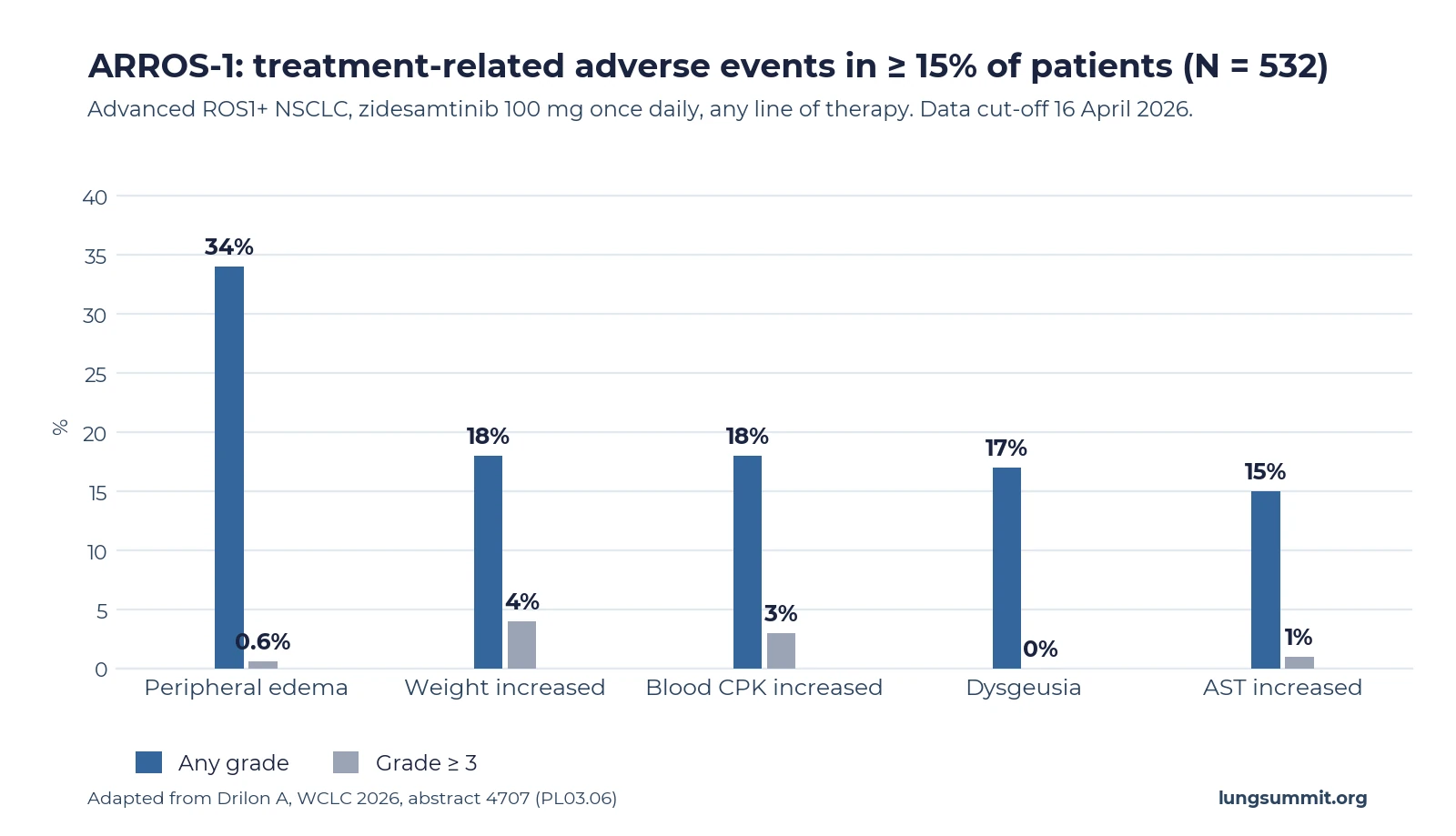
- Across 532 patients treated at 100 mg, treatment-related adverse events led to dose reduction in 11% and to discontinuation in 1%; peripheral edema (34%, any grade) was the most frequent treatment-related event.
Study at a glance
- Trial: ARROS-1 (NCT05118789), sponsored by Nuvalent
- Design: global, single-arm, first-in-human phase 1/2 trial of zidesamtinib in advanced ROS1-positive NSCLC and other solid tumours; phase 1 dose escalation (25–150 mg once daily) in TKI-pretreated patients, phase 2 cohorts at the recommended dose of 100 mg once daily; sites in the Asia-Pacific region, Europe and North America
- Population reported here: TKI-naive patients with locally advanced or metastatic ROS1-positive NSCLC, up to one prior line of chemotherapy with or without immunotherapy; 183 TKI-naive patients treated, 94 in the efficacy population (measurable disease by BICR, first dose by 15 June 2025); safety population 532 patients at 100 mg across all lines
- Arms: none; single-arm, all patients received zidesamtinib 100 mg once daily
- Primary endpoint of phase 2: objective response rate by blinded independent central review (BICR), RECIST 1.1. Secondary: duration of response, time to response, PFS, OS, intracranial activity, safety, pharmacokinetics, patient-reported outcomes. No formal statistical test was reported
- Data cut-off 16 April 2026; median follow-up 15.2 months (range 1.1–30.5) in the efficacy population
Four design goals: ROS1 potency, resistance-mutation coverage, brain penetration and sparing TRK
Zidesamtinib is a ROS1 TKI designed to spare TRK. It is approved by the FDA for adults with locally advanced or metastatic ROS1-positive NSCLC who have already received a ROS1 kinase inhibitor, and it remains investigational in the first-line, TKI-naive setting. In his background slides, Dr. Drilon listed the limitations of the FDA-approved frontline ROS1 TKIs that the drug was designed to address: suboptimal activity in the central nervous system, and frequent, dose-limiting CNS adverse events with agents that inhibit TRK as well as ROS1. The four stated design goals for zidesamtinib were activity against ROS1, activity against ROS1 resistance mutations, brain penetrance and minimal TRK inhibition.
Earlier reports from ARROS-1 covered TKI-pretreated patients, including those with ROS1 resistance mutations, CNS disease, and prior repotrectinib or taletrectinib. The Seoul presentation reports the trial’s registrational-intent TKI-naive cohort.
Who was treated: 94 efficacy-evaluable patients out of 629 enrolled
ARROS-1 enrolled 629 patients with any ROS1-positive solid tumour at any dose across its phase 1 and phase 2 parts. Of these, 532 patients with advanced ROS1-positive NSCLC received the phase 2 dose of 100 mg once daily in any line of therapy and form the safety population. The abstract describes this group as 35% from the Asia-Pacific region, 33% from Europe and 32% from North America. Within it, 183 patients were TKI-naive. The efficacy analysis was restricted to the 94 TKI-naive patients with measurable disease by BICR who had started treatment by 15 June 2025, which gave at least nine months of follow-up for duration of response.
In this efficacy population the median age was 59 years (range 26–87), 59% were women and 59% had never smoked. By region, 40% were treated in North America, 31% in the Asia-Pacific region and 29% in Europe. ECOG performance status was 0 in 60% and 1 in 40%; 93% had stage IV disease at study entry. Baseline CNS metastases by BICR, measurable or non-measurable, were present in 16 patients (17%). Prior platinum-based chemotherapy, with or without immunotherapy, had been given to 25 patients (27%); 16 of the 25 had also received immunotherapy, which is the 17% prior-immunotherapy figure in the abstract.
Responses in 93–94% of patients, most lasting beyond a year
The objective response rate by BICR was reported as 94% (88 of 94; 95% CI 87–98) in the presentation and as 93% (87 of 94) in the abstract. The one-patient difference is explained by the presentation’s footnote: its count includes a single-timepoint partial response that was pending confirmation in a patient still on treatment. The confirmed response rate is therefore 93%. Complete responses were recorded in 14 patients (15%), one of them a single-timepoint complete response pending confirmation in a patient with a prior confirmed partial response.
Among the 87 responders, Kaplan-Meier estimates put 96% still in response at 6 months, 94% (95% CI 86–97) at 9 months and 86% (95% CI 75–92) at 12 months. Median duration of response was not reached (95% CI 20 months to not estimable). Progression-free survival in the full efficacy population of 94 was 95% (95% CI 87–98) at both 6 and 9 months and 90% (95% CI 81–95) at 12 months; the median was not reached. No overall survival data were presented.
Complete intracranial responses in seven of ten patients with measurable brain metastases
Intracranial activity was assessed in a CNS response-evaluable population of 10 TKI-naive patients, defined as those with measurable CNS lesions of at least 5 mm at baseline by BICR and no brain radiation within two months of the first dose. All 10 responded intracranially (intracranial ORR 100%, 95% CI 69–100), and 7 of the 10 (70%) had a complete intracranial response. By Kaplan-Meier estimate, every intracranial response was still ongoing at 6 and 9 months, and 78% (95% CI 36–94) were ongoing at 12 months; the median intracranial duration of response was not reached (95% CI 9 months to not estimable). The wide confidence intervals reflect the size of this group.
A separate observation concerned patients who entered the study without brain metastases. Among the 78 TKI-naive patients with no CNS disease at baseline by BICR, no CNS progression events were observed at the data cut-off.
Peripheral edema leads the adverse-event list; 1% stopped for a treatment-related event
Safety was reported for all 532 patients with advanced ROS1-positive NSCLC who received zidesamtinib 100 mg once daily, whether TKI-naive or pretreated. Treatment-related adverse events occurring in at least 15% of patients were peripheral edema (34% any grade; 0.6% grade 3 or higher), weight increased (18%; 4%), blood creatine phosphokinase increased (18%; 3%), dysgeusia (17%; 0%) and aspartate aminotransferase increased (15%; 1%). Treatment-emergent adverse events of any cause in at least 15% of patients additionally included constipation (23%), alanine aminotransferase increased (18%), dyspnea (17%; 4% grade 3 or higher), arthralgia (17%), peripheral sensory neuropathy (17%), hypertriglyceridemia (16%) and headache (15%). Peripheral edema of any cause was seen in 42% of patients, with 1% at grade 3 or higher.
Dose reductions were made for a treatment-emergent adverse event in 12% of patients and for a treatment-related event in 11%; the events most often responsible were peripheral edema (2.4%), peripheral sensory neuropathy (1.5%), blood CPK increased (1.1%) and weight increased (1.1%). Treatment was discontinued for a treatment-emergent adverse event in 4% of patients and for a treatment-related event in 1%. The events leading to discontinuation in two or more patients were pneumonia (3), pneumonitis (3) and weight increased (2). The presenter described the profile as consistent with the earlier ARROS-1 reports and with the prescribing information.
The IASLC news release carried Dr. Drilon’s summary of the cohort and of what should follow.
“Zidesamtinib demonstrated clinically meaningful activity in TKI-naive patients with ROS1-positive NSCLC, with a safety profile consistent with previous reports and low rates of dose reduction and discontinuation. The findings support continued investigation of zidesamtinib in earlier lines of therapy.”
Dr. Alexander Drilon, Memorial Sloan Kettering Cancer Center and Weill Cornell Medical Center, New York, USA
Several limits of the dataset should be kept in view. ARROS-1 is a single-arm trial, so there is no randomised comparison with crizotinib, entrectinib or the other ROS1 TKIs; the response and PFS figures stand on their own. The intracranial analysis rests on 10 patients. Median duration of response and median PFS had not been reached at a median follow-up of 15.2 months, and no survival data were shown. The presentation closed by stating that the data support continued investigation of zidesamtinib as frontline therapy in TKI-naive patients; the drug is not approved in that setting.
Sources
- Drilon A, de Langen AJ, Besse B, et al. Zidesamtinib in TKI-naive patients with advanced/metastatic ROS1+ NSCLC: ARROS-1 efficacy and safety data. IASLC 2026 World Conference on Lung Cancer, Seoul, 12–15 September 2026; late-breaking abstract 4707 (session PL03.06).
- IASLC news release, Seoul, 14 September 2026: “Zidesamtinib Demonstrates 93% Response Rate in TKI-Naive Patients With Advanced ROS1-Positive NSCLC”.
ILCS 2026
The International Lung Cancer Summit (ILCS 2026) takes place on Friday 13 November 2026 in Lausanne and live online. Faculty will discuss the WCLC 2026 data in the context of daily practice. Register for ILCS 2026 →
Written by the Lung Summit editorial team.
This article was produced independently by the Lung Summit editorial team, without industry funding or input.