SELECT FROM MENU

Therapy Areas
Drug Classes

       Therapy Areas

All Sessions

All Sessions

Resectable NSCLC

Resectable NSCLC

Advanced NSCLC

Advanced NSCLC

SCLC

SCLC

Biomarkers

Biomarkers

       Drug Classes

Targeted Therapies

Targeted Therapies

Immunotherapies

Immunotherapies

ADCs

ADCs

SCLCNovember 25, 2026

Patient-reported quality of life was similar with lurbinectedin plus atezolizumab maintenance in IMforte

Patient-reported outcomes (PROs) from the phase 3 IMforte study (NCT05091567), published in Lung Cancer by Stephen V. Liu and colleagues, show no meaningful difference in functioning or health-related quality of life (HRQoL) when lurbinectedin is added to atezolizumab as first-line maintenance in extensive-stage small cell lung cancer (ES-SCLC). IMforte had already reported that the combination improved survival outcomes compared with atezolizumab maintenance alone.
Share

In brief

  • In the lurbinectedin plus atezolizumab arm of IMforte, more than 80% of patients reported “little” or “no” trouble with treatment adverse events between baseline and Cycle 6 on the EORTC Item Library 46 (IL46).
  • On PRO-CTCAE, the percentage of patients free of a given symptom did not change for 6 of 12 symptomatic adverse events and decreased transiently, with a difference of more than 10%, for the remaining 6.
  • Functioning, global health status/quality of life and lung cancer symptoms showed no meaningful difference between the combination and atezolizumab alone.
  • Median unconfirmed time to deterioration in physical functioning and global health status/quality of life did not differ between arms.

Study at a glance

  • Trial: IMforte, phase 3 (NCT05091567)
  • Population: Patients with ES-SCLC receiving first-line maintenance treatment
  • Treatment: Lurbinectedin plus atezolizumab versus atezolizumab
  • Instruments: EORTC IL46, PRO-CTCAE, EORTC QLQ-C30 and EORTC QLQ-LC13
  • Tolerability: More than 80% reported “little” or “no” trouble with treatment adverse events, baseline to Cycle 6 (combination arm)
  • Symptomatic adverse events: Symptom-free percentage unchanged for 6 of 12, transiently lower for 6
  • Functioning and HRQoL: No meaningful difference between arms
  • Not reported: Number of patients completing the questionnaires, completion rates, and which six symptomatic adverse events declined

More than 80% reported little or no trouble from treatment adverse events

Tolerability was measured with EORTC IL46 in the lurbinectedin plus atezolizumab arm, across the period from baseline to Cycle 6. Over that window, more than four in five patients described their trouble with treatment adverse events as “little” or “no”.

Symptomatic adverse events were measured separately with the PRO-Common Terminology Criteria for Adverse Events (PRO-CTCAE). Of the 12 symptoms tracked, the percentage of patients reporting themselves free of the symptom stayed the same for six. For the other six it fell, with a difference of more than 10%, and the authors describe this fall as transient. Both measures are given for the combination arm, and the abstract offers no direct comparison with atezolizumab alone on either of them.

Functioning, quality of life and lung cancer symptoms similar in both arms

On the EORTC QLQ-Core 30 (QLQ-C30), the Physical, Emotional, Role, Social and Cognitive functioning scales and the global health status/quality of life score showed no meaningful difference between the two maintenance regimens. Lung cancer symptoms, measured with the QLQ-Lung Cancer Module 13 (QLQ-LC13), were also similar between arms.

Censoring limited the confirmed time-to-deterioration analysis

For physical functioning and global health status/quality of life, the investigators measured time to deterioration in two ways, confirmed (TTCD) and unconfirmed (TTD). The authors state that interpretation of median TTCD was limited by high, early and unbalanced censoring between the arms.

The unconfirmed analysis showed no difference in median TTD between arms for either scale.

The authors conclude:

“PRO results support the favourable benefit–risk profile of maintenance lurbinectedin + atezolizumab as a new treatment option for ES-SCLC.”Liu et al., Lung Cancer (2026)

Sources

  1. Lung Cancer. Patient-reported outcomes from the phase 3 IMforte study of first-line maintenance treatment with lurbinectedin + atezolizumab versus atezolizumab in patients with extensive-stage small cell lung cancer (2026-11-01). doi.org

Featuring Lung Summit faculty

This study was co-authored by Lung Summit faculty Solange Peters, Stephen Liu, Martin Reck, Hossein Borghaei and Giannis Mountzios.

This article was produced independently by the Lung Summit editorial team, without industry funding or input.

i 3 On This Page

Share

       Continue With

Related Topics

Videos
Jacob Sands, Solange Peters and Martin Reck
Dec102026
VIRTUAL ROUNDTABLE
Advanced NSCLCSCLCADCs

2026 Year in Review

Learn more about the event

S. PetersJ. SandsM. Reck
Nov 13 2026
ILCS 2026
Advanced NSCLCResectable NSCLCSCLC

Panel: open questions & patient cases

Nov 13 2026
ILCS 2026
SCLC

Debate: which is the better choice in 1L ES-SCLC?

G. MountziosA. Dingemans
Nov 13 2026
ILCS 2026
SCLC

The emerging role of T-cell engagers and ADCs in SCLC

N. Frost
Nov 13 2026
ILCS 2026
Resectable NSCLCImmunotherapies

Latest options in early-stage NSCLC: novel IO approaches for improved outcomes

S. Patel
Prof. Martin Reck
Nov 04 2026
SPONSORED EXPERT TALK
Resectable NSCLCImmunotherapies

MDT-BRIDGE in Resectable and Borderline Resectable NSCLC

Prof. Martin Reck presents and discusses the phase 2 MDT-BRIDGE trial in resectable and borderline resectable non-small cell lung cancer in this on-demand expert talk.

M. Reck
Dr. Jacob Sands
Nov 04 2026
SPONSORED INTERVIEW
SCLCImmunotherapies

New Therapy Options in SCLC and AE Management

Dr. Jacob Sands discusses new treatment options in small cell lung cancer and the management of their adverse events in this on-demand expert interview.

J. Sands
Oct252026
ESMO 2026 SYMPOSIUM
SCLCImmunotherapies

SCLC Symposium at ESMO 2026: From IO-Standards to the TCE Era

A symposium at ESMO Congress 2026 on small-cell lung cancer, from immunotherapy standards to the emerging era of DLL3 T-cell engagers. Recording to follow.

M. ReckS. PetersG. MountziosN. Reguart
Prof. Alessandra Curioni-Fontecedro discussing approaches in metastatic PD-L1 negative NSCLC
May 04 2026
SPONSORED INTERVIEW
Advanced NSCLCImmunotherapies

Approaches in Metastatic PD-L1 Negative NSCLC: An Interview with Prof. Alessandra Curioni-Fontecedro

Prof. Alessandra Curioni-Fontecedro discusses treatment approaches in metastatic PD-L1 negative non-small cell lung cancer in this on-demand expert interview.

A. Curioni-Fontecedro
Lung Cancer Review by Solange Peters, Martin Reck, Charles Rudin
Dec 18 2025
VIRTUAL ROUNDTABLE
Advanced NSCLCSCLCADCs

2025 Approvals & Highlights

} 1 h 49 min

S. PetersC. RudinM. Reck
Sep 26 2025
ILCS 2025
SCLC

Reshaping Approaches in SCLC with the Latest Advances in LS- and ES-Disease

} 34 min

R. Manochakian
Sep 26 2025
ILCS 2025
Immunotherapies

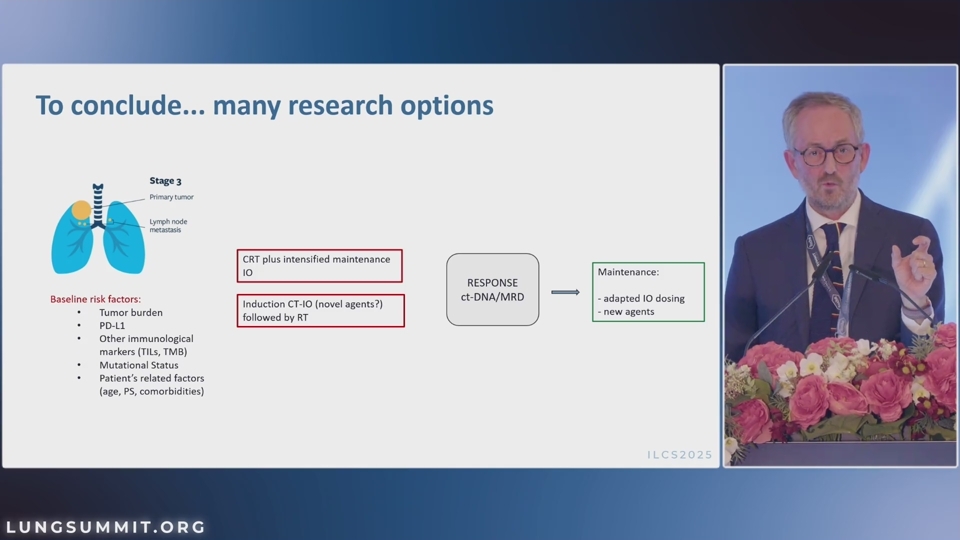
The Role of IO Added to Chemoradiation in Unresectable Stage III NSCLC

} 28 min

A. Filippi
Sep 26 2025
ILCS 2025
Immunotherapies

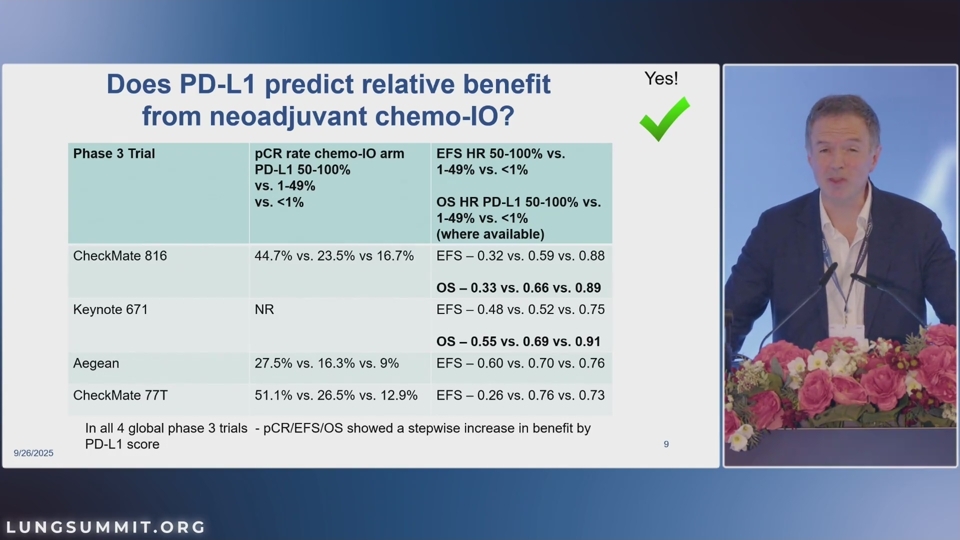
Tailoring IO in Res. NSCLC: Personalized Approaches for Improved Outcomes

} 36 min

P. Forde
IO in NSCLC by Solange Peters, Jordi Remon, Patrick Forde
Jun 25 2025
VIRTUAL ROUNDTABLE
Advanced NSCLCImmunotherapies

Immunotherapies in NSCLC

} 1h 47 min

P. FordeJ. RemonS. Peters
SCLC by Solange Peters, Giannis Mountzios, Jacob Sands
Jun 17 2025
VIRTUAL ROUNDTABLE
SCLCImmunotherapies

Small Cell Lung Cancer

} 1h 35 min

G. MountziosJ. SandsS. Peters
Stephen Liu
Oct 04 2024
ILCS 2024
SCLC

Reshaping Our Approaches in SCLC: Latest Therapeutic Options and Future Strategies

} 25 min

S. Liu
Jordi Remon
Oct 04 2024
ILCS 2024
Immunotherapies

Tailoring IO in Resectable NSCLC: Personalized Approaches for Improved Outcomes

} 25 min

J. Remon
Nov 13 2026
ILCS 2026
Advanced NSCLC

New compounds and combinations for non-oncogene-addicted advanced NSCLC

A. Cortellini
Nov 13 2026
INDUSTRY SYMPOSIUM
Advanced NSCLCResectable NSCLCTargeted Therapies

One Backbone, Many Opportunities: Osimertinib Across the EGFRm NSCLC Journey

M. Hochmair
Nov 13 2026
ILCS 2026
Advanced NSCLCADCs

The ADC wave: integrating new agents in NSCLC

D. Planchard
Articles
Nov 24 2026
RESEARCH
Immunotherapies

Second-line treatment order made no significant survival difference in a UK real-world mesothelioma cohort

G. Banna
Nov 16 2026
RESEARCH
Immunotherapies

Lenvatinib plus pembrolizumab gave a median PFS of 22.1 months in pretreated thymic carcinoma and B3 thymoma

J. RemonN. GirardN. Reguart
Charles Rudin
Nov 14 2026
RESEARCH
Advanced NSCLCSCLCTargeted Therapies

SCLC transformation in 5 of 11 patients given first-line osimertinib with platinum and etoposide

C. Rudin
Nov 04 2026
RESEARCH
Advanced NSCLCImmunotherapies

Local ablative therapy alone after durvalumab was followed by an mOS of 18.7 months in oligoprogressive NSCLC

A. FilippiL. Hendriks
Nikolaj Frost
Oct 31 2026
RESEARCH
Resectable NSCLCImmunotherapies

KEYNOTE-867 tested pembrolizumab with SBRT in unresected stage I or II NSCLC

N. Frost
Charles Rudin
Oct 30 2026
RESEARCH
SCLCImmunotherapies

Tarlatamab gave an mOS of 13.6 months against 8.4 with chemotherapy in SCLC at extended DeLLphi-304 follow-up

C. RudinG. Mountzios
Martin Reck
Oct 30 2026
RESEARCH
Advanced NSCLCResectable NSCLCImmunotherapies

Neoadjuvant durvalumab plus chemotherapy led to resection in 74.6% of patients in the MDT-BRIDGE trial

M. ReckN. GirardA. Filippi
Oct 29 2026
RESEARCH
BiomarkersResectable NSCLCImmunotherapies

Early ctDNA clearance was associated with longer event-free survival in resectable NSCLC in NeoCOAST-2

T. CasconeP. Forde
Oct 29 2026
RESEARCH
Advanced NSCLCImmunotherapies

Adding chemotherapy to pembrolizumab lengthened PFS in PD-L1-high advanced NSCLC in PERSEE

M. Pérol
Oct 27 2026
RESEARCH
SCLCImmunotherapies

Tarlatamab added to durvalumab maintenance extended OS in extensive-stage SCLC

J. SandsM. PérolA. Dingemans
Oct 23 2026
RESEARCH
SCLCImmunotherapies

KEYVIBE-008 tested vibostolimab coformulated with pembrolizumab plus chemotherapy in first-line ES-SCLC

J. SandsM. Reck
Oct 21 2026
SPONSORED
Advanced NSCLCImmunotherapies

The “tail of the curve” is real: long-term survival in PD-L1–negative metastatic NSCLC

A. Curioni-Fontecedro
Oct 21 2026
RESEARCH
Advanced NSCLCBiomarkersResectable NSCLC

ctDNA on immunotherapy is prognostic across NSCLC stages, but ctDNA-guided treatment remains investigational

U. Malapelle
Oct 19 2026
RESEARCH
Advanced NSCLCImmunotherapies

Nivolumab plus ipilimumab in 545 Japanese patients with metastatic NSCLC: the LIGHT-NING 2.5-year update

H. Horinouchi
Oct 07 2026
RESEARCH
BiomarkersSCLC

IASLC pathologists propose a grade 3 category for lung carcinoids with more than 10 mitoses

P. Hofman
Oct 06 2026
RESEARCH
Advanced NSCLCImmunotherapies

Two-thirds of patients with PD-L1-high NSCLC received first-line immunotherapy alone in a real-world survey

D. Rodríguez-Abreu
Oct 05 2026
RESEARCH
SCLCImmunotherapies

Second-line therapy in ES-SCLC gave a median OS of 7.1 months in the Austrian LALUCA registry

M. Hochmair
Nikolaj Frost
Oct 04 2026
RESEARCH
Advanced NSCLCSCLCTargeted Therapies

Checkpoint inhibitors were associated with longer survival in NSCLC after allogeneic stem cell transplantation

N. FrostM. ReckA. Cortellini
Oct 04 2026
RESEARCH
SCLCImmunotherapies

Longer OS in Asian than non-Asian patients given atezolizumab plus chemotherapy for extensive-stage SCLC

S. LiuM. ReckC. Rudin
Oct 02 2026
RESEARCH
Advanced NSCLCBiomarkersImmunotherapies

High tumour mutational burden was associated with more frequent and earlier immune-related adverse events in advanced NSCLC

B. Ricciuti