In brief
- An international, multidisciplinary steering committee has published 55 consensus statements on preventing, monitoring, and managing adverse events associated with datopotamab deruxtecan (Dato-DXd) in advanced or metastatic NSCLC.
- The recommendations focus on five adverse events: oral mucositis/stomatitis, interstitial lung disease (ILD)/pneumonitis, ocular surface events, nausea, and vomiting.
- All 55 statements reached consensus using Delphi methodology, with more than 75% expert agreement required.
- Key recommendations include proactive patient and caregiver communication, regular clinical examinations, multidisciplinary collaboration, and adjusting treatment dosage and care planning based on the severity of each adverse event.
- The committee also flags real-world differences in how these adverse events are managed across regions and healthcare systems, including differences in access to examinations and treatment options.
Consensus at a glance
- Panel: International steering committee of medical oncologists, ophthalmologists and pulmonologists
- Method: Delphi methodology, more than 75% expert agreement required per statement
- Statements produced: 55, all reaching consensus
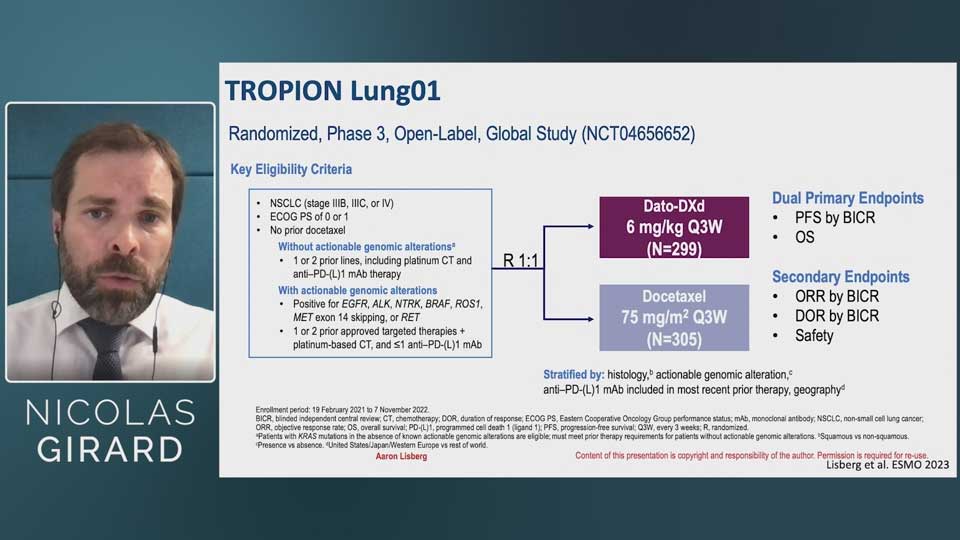
- Drug covered: Datopotamab deruxtecan (Dato-DXd), an antibody-drug conjugate
- Setting: Advanced/metastatic NSCLC
- Adverse events addressed: Oral mucositis/stomatitis, ILD/pneumonitis, ocular surface events, nausea and vomiting
- Basis for recommendations: Existing guidelines, clinical trial data and real-world experience
- Source: Therapeutic Advances in Medical Oncology (2026)
Five adverse events, one multidisciplinary panel
Dato-DXd is under investigation in clinical trials across a range of solid tumors, and its use in advanced or metastatic NSCLC brings with it a specific adverse event profile that spans more than one specialty. The steering committee behind these recommendations was deliberately built to match that profile, drawing together medical oncologists, ophthalmologists and pulmonologists rather than oncologists alone, and focusing its recommendations on five adverse events: oral mucositis and stomatitis, interstitial lung disease and pneumonitis, ocular surface events, nausea, and vomiting.
Reaching agreement across three specialties on a shared set of practical recommendations is itself part of the paper’s contribution: an ophthalmologist and a pulmonologist are not typically co-authors on an oncology adverse-event guidance document, and the panel’s structure reflects how many different kinds of clinician a patient on Dato-DXd may need to see.
55 statements, each requiring more than 75% agreement
The committee used Delphi methodology, a structured process for building consensus among experts through iterative rounds of anonymous feedback, to develop and refine its recommendations. In total, 55 statements were produced, and every one of them reached the panel’s consensus threshold of more than 75% expert agreement, drawing on available clinical guidelines, clinical trial data, and real-world experience with the drug.
What the recommendations actually tell a clinician to do
The key recommendations split into prevention and monitoring measures. On prevention, the panel calls for proactive communication between patients and caregivers, regular clinical examinations, and collaboration across the relevant multidisciplinary specialties before problems escalate. On monitoring, the recommendations tie treatment dosage decisions and care planning directly to the severity of whichever adverse event has occurred, rather than applying a single fixed approach regardless of how serious the reaction is.
The paper does not give a table of specific dose-modification thresholds or grading criteria within the available summary; the recommendations are described at the level of principle (proactive communication, severity-based dosing decisions) rather than as a fully reproduced dosing algorithm.
Real-world management already varies by region
Beyond the recommendations themselves, the committee reports that real-world challenges and local differences already shape how these adverse events are managed in practice, and it offers guidance on implementing regional strategies through multidisciplinary collaboration. Access to examinations and treatment possibilities is one of the factors the authors cite as varying by healthcare system.
“Dato-DXd AEs awareness, understanding, and proper management via a well-established multidisciplinary collaboration is crucial to guarantee patients’ quality of life.”William et al., Therapeutic Advances in Medical Oncology (2026)
Practical guidance built for the multidisciplinary reality of the drug
What this consensus adds is not new trial data on Dato-DXd’s safety profile, but a shared, cross-specialty reference for handling the adverse events that profile already includes. For clinicians managing patients on Dato-DXd in advanced or metastatic NSCLC, the recommendations set out what proactive prevention and severity-based management look like in practice, while acknowledging that how those recommendations translate locally will still depend on what specialist resources are available where the patient is being treated.
Sources
- Therapeutic Advances in Medical Oncology. Consensus recommendations for the management of Dato-DXd-associated adverse events in patients with advanced/metastatic NSCLC: insights from a multiregional steering committee (2026-08-01). doi.org
Featuring Lung Summit faculty
This study was co-authored by Lung Summit faculty Stephanie Saw.
This article was produced independently by the Lung Summit editorial team, without industry funding or input.