SELECT FROM MENU

Therapy Areas
Drug Classes

       Therapy Areas

All Sessions

All Sessions

Resectable NSCLC

Resectable NSCLC

Advanced NSCLC

Advanced NSCLC

SCLC

SCLC

Biomarkers

Biomarkers

       Drug Classes

Targeted Therapies

Targeted Therapies

Immunotherapies

Immunotherapies

ADCs

ADCs

Advanced NSCLCJuly 15, 2026

Proton pump inhibitors and antibiotics linked to reduced durvalumab benefit in unresectable stage III NSCLC

A new analysis of the phase 3 PACIFIC trial has found that patients with unresectable stage III non-small-cell lung cancer (NSCLC) who were taking proton pump inhibitors or antibiotics at baseline derived markedly less benefit from durvalumab after chemoradiotherapy than patients who were not. The pattern, published in The Lancet Oncology, was absent in the trial's placebo group, pointing to an interaction with the drug rather than a general marker of sicker patients.
Share

In brief

  • In a post-hoc analysis of the phase 3 PACIFIC trial, patients with unresectable stage III NSCLC taking proton pump inhibitors at baseline had shorter progression-free survival (9.4 vs 17.2 months) and overall survival (33.0 vs 57.9 months) on durvalumab than patients who were not.
  • Baseline antibiotic use was likewise associated with shorter progression-free survival (9.2 vs 15.6 months), although the difference in overall survival did not reach statistical significance.
  • No such associations appeared in the placebo group, pointing to an interaction with durvalumab rather than a general marker of sicker patients.
  • The analysis is observational and cannot show that the medications caused the poorer outcomes; the authors call for prospective studies with standardised exposure definitions and integrated microbiome profiling.

Read the full paper in The Lancet Oncology →

Already linked to weaker immunotherapy response in advanced disease

Durvalumab, a PD-L1 immune checkpoint inhibitor, is given as consolidation treatment after concurrent chemoradiotherapy in unresectable stage III NSCLC, the approach established by the original PACIFIC trial. Earlier work in advanced and metastatic cancers had linked two commonly prescribed classes of medication, proton pump inhibitors and systemic antibiotics, to weaker responses to checkpoint inhibitors, an effect attributed to disruption of the gut microbiome. Whether the same held in earlier-stage disease treated with curative intent had not been established. The investigators examined the question using the completed PACIFIC dataset at its final five-year cutoff.

Study at a glance

  • Source trial: PACIFIC (NCT02125461), phase 3, randomised, double-blind, placebo-controlled; this is a post-hoc analysis at the final 5-year data cutoff
  • Population: 660 of 713 randomised patients with unresectable stage III NSCLC (449 durvalumab, 211 placebo)
  • Exposures examined: baseline proton pump inhibitors (263 patients, 40%) and systemic antibiotics (69 patients, 10%)
  • Endpoints: progression-free survival and overall survival, compared by exposure
  • Median follow-up: 62.4 months

Worse survival on durvalumab, absent on placebo

Among patients treated with durvalumab, baseline proton pump inhibitor use was associated with shorter progression-free survival, a median of 9.4 months versus 17.2 months without exposure (hazard ratio 1.57; 95% CI 1.28–1.93; p<0.0001), and shorter overall survival, 33.0 months versus 57.9 months (hazard ratio 1.66; 95% CI 1.30–2.13; p<0.0001). Baseline antibiotic use was likewise associated with shorter progression-free survival, 9.2 months versus 15.6 months (hazard ratio 1.50; 95% CI 1.08–2.10; p=0.016), although the difference in overall survival did not reach statistical significance (hazard ratio 1.33; 95% CI 0.90–1.97; p=0.16).

No such associations appeared in the placebo group, where neither medication class was linked to progression-free or overall survival. The interaction between treatment and proton pump inhibitor exposure was statistically significant for both progression-free survival (p=0.023) and overall survival (p<0.0001); the interaction with antibiotics was not. The authors note that the analysis is observational and cannot show that the medications caused the poorer outcomes.

A possible interaction with the drug, not just sicker patients

Because the association was present with durvalumab but not with placebo, the investigators described the medications as potentially attenuating the drug’s benefit rather than simply marking patients with worse prognosis. They set the finding against the curative intent of treatment at this stage of disease:

“Given the curative intent of treatment in this setting, these results underscore the importance of careful evaluation of concomitant medications when clinically appropriate.”Brunetti et al., The Lancet Oncology (2026)

The authors call for prospective studies with standardised exposure definitions and integrated microbiome profiling to test whether the association is causal and to inform antibiotic stewardship in this setting.

Sources

  1. The Lancet Oncology. Proton pump inhibitors and antibiotics linked to reduced durvalumab benefit in unresectable stage III NSCLC (2026-07-03). thelancet.com

Featuring Lung Summit faculty

This study was co-authored by Lung Summit faculty Alessio Cortellini, David Planchard, Jarushka Naidoo, Jordi Remon and Biagio Ricciuti.

This article was produced independently by the Lung Summit editorial team, without industry funding or input.

i 3 On This Page

Share

       Continue With

Related Topics

Charles Rudin
Aug 07 2026
IMMUNOTHERAPIES
Advanced NSCLCImmunotherapies

Radiation plus durvalumab without chemotherapy cleared its survival target in frail LA-NSCLC patients

Read the article

C. Rudin
Aug 07 2026
TARGETED THERAPIES
Advanced NSCLCBiomarkersTargeted Therapies

EGFR amplification at baseline marks shorter time on first-line osimertinib, in exon 19 deletions but not L858R

Read the article

B. Ricciuti
Aug 07 2026
ADCs
Advanced NSCLCBiomarkersADCs

EVOKE-01 biomarker analysis: Trop-2 staining did not pick out who does better on sacituzumab govitecan than docetaxel

Read the article

G. Mountzios
Aug 07 2026
TARGETED THERAPIES
Advanced NSCLCTargeted Therapies

ORCHARD final data: osimertinib plus gefitinib gives modest benefit in EGFR C797X, and the authors advise against further study

Read the article

X. LeZ. Piotrowska
Jul 23 2026
TARGETED THERAPIES
Advanced NSCLCTargeted Therapies

Zidesamtinib approved in the US for previously treated ROS1-positive non-small cell lung cancer

Read the article

Jul 20 2026
ADCs
Advanced NSCLCADCs

Sac-TMT plus pembrolizumab improves PFS in PD-L1-negative NSCLC

Read the article

Oliver Gautschi on EGFR+ NSCLC
Jul 20 2026
SPONSORED INTERVIEW
Advanced NSCLCTargeted Therapies

Advances in EGFR+ NSCLC: An Interview with Prof. Oliver Gautschi

Prof. Oliver Gautschi discusses recent advances in the treatment of EGFR-mutant non-small cell lung cancer in this on-demand expert interview.

O. Gautschi
Jul 14 2026
ADCs
Advanced NSCLCADCs

Trastuzumab deruxtecan in HER2-mutant NSCLC: evidence from the largest real-world cohort to date

Read the article

M. HochmairG. MountziosA. AddeoM. Reck
Jul 14 2026
ADCs
Advanced NSCLCSCLCADCs

Antibody-drug conjugates across solid tumours: an ETOP/IBCSG expert group sets the research priorities

Read the article

R. StahelS. PetersG. MountziosA. PassaroN. ReguartJ. Remon
Jul 13 2026
TARGETED THERAPIES
Advanced NSCLCTargeted Therapies

Roche Reports Positive Phase 3 Results for Divarasib in Previously Treated KRAS G12C NSCLC

Read the article

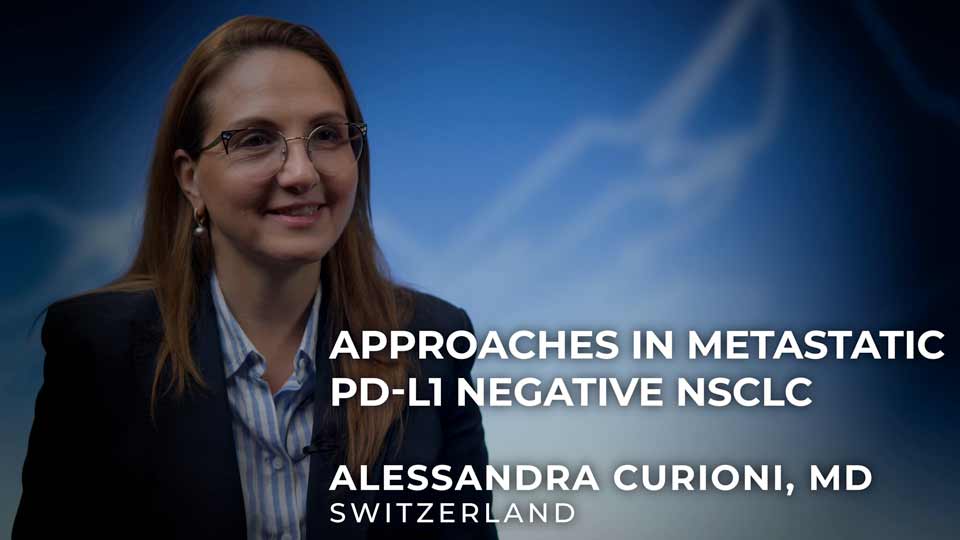
Prof. Alessandra Curioni-Fontecedro discussing approaches in metastatic PD-L1 negative NSCLC
May 04 2026
SPONSORED INTERVIEW
Advanced NSCLCImmunotherapies

Approaches in Metastatic PD-L1 Negative NSCLC: An Interview with Prof. Alessandra Curioni-Fontecedro

Prof. Alessandra Curioni-Fontecedro discusses treatment approaches in metastatic PD-L1 negative non-small cell lung cancer in this on-demand expert interview.

A. Curioni-Fontecedro
Lung Cancer Review by Solange Peters, Martin Reck, Charles Rudin
Dec 18 2025
VIRTUAL ROUNDTABLE
Advanced NSCLCSCLCADCs

2025 Approvals & Highlights

} 1 h 49 min

S. PetersC. RudinM. Reck
Sep 26 2025
ILCS 2025
Advanced NSCLC

Latest Options for Non-Oncogene Addicted Advanced NSCLC in Frontline and Beyond

} 32 min

A. Curioni-Fontecedro
Sep 26 2025
ILCS 2025
Immunotherapies

The Role of IO Added to Chemoradiation in Unresectable Stage III NSCLC

} 28 min

A. Filippi
Sep 26 2025
ILCS 2025
Immunotherapies

Tailoring IO in Res. NSCLC: Personalized Approaches for Improved Outcomes

} 36 min

P. Forde
Sep 26 2025
SPONSORED INTERVIEW
Advanced NSCLCTargeted Therapies

Latest Advances in Frontline EGFR+ NSCLC

} 14 min

A. Curioni-Fontecedro
Sep 26 2025
INDUSTRY SYMPOSIUM
Advanced NSCLCTargeted Therapies

Unlocking New Potentials in EGFR-Mutant NSCLC

} 30 min

A. Passaro
Sep 26 2025
ILCS 2025
Advanced NSCLC

Open Discussion on Patient Cases

} 22 min

Targeted Therapies by Oliver Gautschi, Jarushka Naidoo, Nicolas Girard
Jul 10 2025
VIRTUAL ROUNDTABLE
Advanced NSCLCTargeted Therapies

Targeted Therapies in NSCLC

} 1h 30 min

O. GautschiJ. NaidooN. Girard
IO in NSCLC by Solange Peters, Jordi Remon, Patrick Forde
Jun 25 2025
VIRTUAL ROUNDTABLE
Advanced NSCLCImmunotherapies

Immunotherapies in NSCLC

} 1h 47 min

P. FordeJ. RemonS. Peters