SELECT FROM MENU

Therapy Areas
Drug Classes

       Therapy Areas

All Sessions

All Sessions

Resectable NSCLC

Resectable NSCLC

Advanced NSCLC

Advanced NSCLC

SCLC

SCLC

Biomarkers

Biomarkers

       Drug Classes

Targeted Therapies

Targeted Therapies

Immunotherapies

Immunotherapies

ADCs

ADCs

Advanced NSCLCNovember 29, 2026

CD8+ T-cell exclusion was associated with poorer response to checkpoint blockade in NSCLC

A study by Guégan and colleagues in Signal Transduction and Targeted Therapy links the immune-excluded phenotype in ICB-treated NSCLC to poorer outcomes, and describes the tumour-intrinsic and stromal programs that accompany it.
Share

In brief

  • In patients with NSCLC treated with immune checkpoint blockade (ICB), spatial exclusion of CD8+ T cells from tumour nests was associated with lower objective response rates and shorter progression-free survival.
  • The analysis drew on a discovery cohort and a non-overlapping internal validation cohort.
  • Immune-excluded tumours expressed less antigen-presentation machinery in the tumour compartment, including HLA class I genes and TAP1.
  • Their stroma was enriched for myofibroblastic cancer-associated fibroblast programs and a peri-epithelial, collagen-rich architecture.
  • CD8-enriched regions in excluded tumours showed reduced metabolic activation and lower TCR-probe expression diversity, without a marked rise in canonical exhaustion markers.

Study at a glance

  • Cohorts: a discovery cohort and a non-overlapping internal validation cohort
  • Population: patients with NSCLC treated with ICB
  • Phenotype studied: CD8+ T cells gathered in stroma that fail to penetrate tumour nests (immune exclusion), against infiltrated tumours
  • Outcomes: objective response rate and progression-free survival
  • Methods: GeoMx spatial transcriptomics, bulk transcriptomics, TCR-probe expression, multiplex immunohistofluorescence, single-cell spatial neighbourhood analysis
  • Not reported: cohort sizes, response rates, survival figures

Exclusion of CD8+ T cells went with fewer responses and earlier progression

Immune exclusion is one recognised pattern of resistance to checkpoint blockade: CD8+ T cells collect in the stromal regions of the tumour but fail to penetrate the tumour nests. Using the discovery and validation cohorts, the authors found that spatial CD8+ T-cell exclusion was associated with lower objective response rates and shorter progression-free survival.

The validation cohort is described as internal. The abstract mentions no external validation cohort.

Lower HLA class I and TAP1 expression inside excluded tumours

In the tumour compartment, excluded tumours carried reduced expression of genes encoding antigen-presentation machinery, among them the HLA class I genes and TAP1. The relationship between IFN-γ-associated transcriptional signals and antigen-presentation gene expression also differed from that in infiltrated tumours.

Myofibroblastic fibroblasts and collagen around the epithelium

The stroma of excluded tumours was enriched for myofibroblastic cancer-associated fibroblast programs and showed a peri-epithelial, collagen-rich architecture. Infiltrated tumours instead displayed stromal signatures the authors describe as immune-supportive.

Lower metabolic activation and TCR diversity, without a marked rise in exhaustion markers

CD8-enriched regions taken from excluded tumours showed reduced metabolic activation and lower TCR-probe expression diversity. Canonical exhaustion markers in those regions were not markedly increased.

“These findings provide an integrated, compartment-resolved description of tumor-intrinsic and stromal features associated with immune exclusion in NSCLC and support further evaluation of spatial immune contexture as a complementary biomarker in ICB-treated patients.”Guégan et al., Signal Transduction and Targeted Therapy (2026)

Sources

  1. Signal Transduction and Targeted Therapy. Spatial transcriptomics identifies tumor-intrinsic and stromal programs associated with immune exclusion in NSCLC (2026-10-26). doi.org

Featuring Lung Summit faculty

This study was co-authored by Lung Summit faculty David Planchard.

This article was produced independently by the Lung Summit editorial team, without industry funding or input.

i 3 On This Page

Share

       Continue With

Related Topics

Videos
Jacob Sands, Solange Peters and Martin Reck
Dec102026
VIRTUAL ROUNDTABLE
Advanced NSCLCSCLCADCs

2026 Year in Review

Learn more about the event

S. PetersJ. SandsM. Reck
Nov 13 2026
ILCS 2026
Advanced NSCLCResectable NSCLCSCLC

Panel: open questions & patient cases

Nov 13 2026
ILCS 2026
Advanced NSCLC

New compounds and combinations for non-oncogene-addicted advanced NSCLC

A. Cortellini
Nov 13 2026
ILCS 2026
Resectable NSCLCImmunotherapies

Latest options in early-stage NSCLC: novel IO approaches for improved outcomes

S. Patel
Nov 13 2026
INDUSTRY SYMPOSIUM
Advanced NSCLCResectable NSCLCTargeted Therapies

One Backbone, Many Opportunities: Osimertinib Across the EGFRm NSCLC Journey

M. Hochmair
Nov 13 2026
ILCS 2026
Advanced NSCLCADCs

The ADC wave: integrating new agents in NSCLC

D. Planchard
Nov 13 2026
ILCS 2026
Advanced NSCLCTargeted Therapies

Targeting (K)RAS with new compounds

C. Lovly
Nov 13 2026
ILCS 2026
Advanced NSCLCTargeted Therapies

Other actionable genomic alterations, incl. HER2 and ROS1

T. Sequeira
Nov 13 2026
ILCS 2026
Advanced NSCLCTargeted Therapies

New standards in EGFR- and ALK-positive NSCLC

H. Horinouchi
Nov 13 2026
ILCS 2026
Biomarkers

ctDNA-guided decisions in lung cancer: ready or not?

M. Das
Prof. Martin Reck
Nov 04 2026
SPONSORED EXPERT TALK
Resectable NSCLCImmunotherapies

MDT-BRIDGE in Resectable and Borderline Resectable NSCLC

Prof. Martin Reck presents and discusses the phase 2 MDT-BRIDGE trial in resectable and borderline resectable non-small cell lung cancer in this on-demand expert talk.

M. Reck
Dr. Jacob Sands
Nov 04 2026
SPONSORED INTERVIEW
SCLCImmunotherapies

New Therapy Options in SCLC and AE Management

Dr. Jacob Sands discusses new treatment options in small cell lung cancer and the management of their adverse events in this on-demand expert interview.

J. Sands
Oct252026
ESMO 2026 SYMPOSIUM
SCLCImmunotherapies

SCLC Symposium at ESMO 2026: From IO-Standards to the TCE Era

A symposium at ESMO Congress 2026 on small-cell lung cancer, from immunotherapy standards to the emerging era of DLL3 T-cell engagers. Recording to follow.

M. ReckS. PetersG. MountziosN. Reguart
Oliver Gautschi on EGFR+ NSCLC
Jul 20 2026
SPONSORED INTERVIEW
Advanced NSCLCTargeted Therapies

Advances in EGFR+ NSCLC: An Interview with Prof. Oliver Gautschi

Prof. Oliver Gautschi discusses recent advances in the treatment of EGFR-mutant non-small cell lung cancer in this on-demand expert interview.

O. Gautschi
Prof. Alessandra Curioni-Fontecedro discussing approaches in metastatic PD-L1 negative NSCLC
May 04 2026
SPONSORED INTERVIEW
Advanced NSCLCImmunotherapies

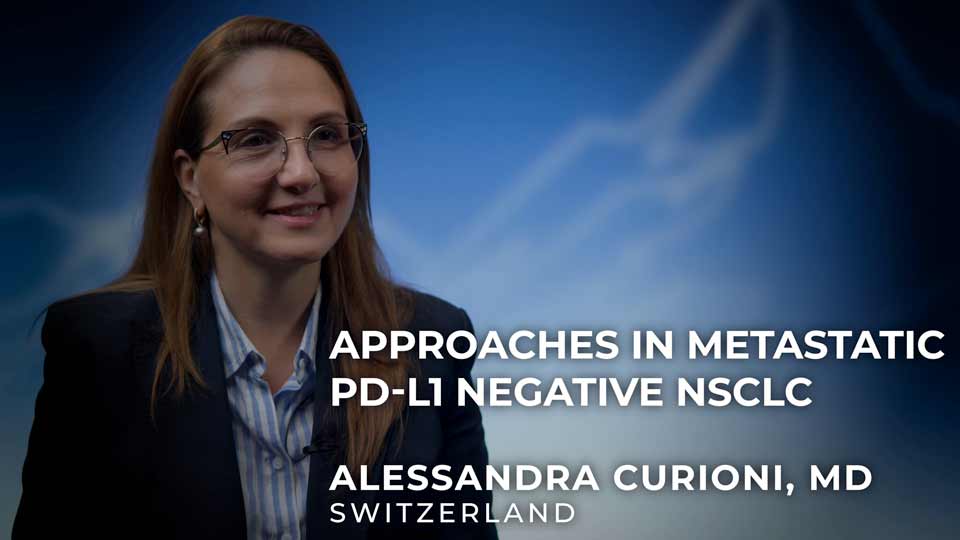
Approaches in Metastatic PD-L1 Negative NSCLC: An Interview with Prof. Alessandra Curioni-Fontecedro

Prof. Alessandra Curioni-Fontecedro discusses treatment approaches in metastatic PD-L1 negative non-small cell lung cancer in this on-demand expert interview.

A. Curioni-Fontecedro
Lung Cancer Review by Solange Peters, Martin Reck, Charles Rudin
Dec 18 2025
VIRTUAL ROUNDTABLE
Advanced NSCLCSCLCADCs

2025 Approvals & Highlights

} 1 h 49 min

S. PetersC. RudinM. Reck
Sep 26 2025
ILCS 2025
Advanced NSCLC

Latest Options for Non-Oncogene Addicted Advanced NSCLC in Frontline and Beyond

} 32 min

A. Curioni-Fontecedro
Sep 26 2025
ILCS 2025
Immunotherapies

The Role of IO Added to Chemoradiation in Unresectable Stage III NSCLC

} 28 min

A. Filippi
Sep 26 2025
ILCS 2025
Immunotherapies

Tailoring IO in Res. NSCLC: Personalized Approaches for Improved Outcomes

} 36 min

P. Forde
Sep 26 2025
SPONSORED INTERVIEW
Advanced NSCLCTargeted Therapies

Latest Advances in Frontline EGFR+ NSCLC

} 14 min

A. Curioni-Fontecedro
Articles
Nov 28 2026
RESEARCH
Advanced NSCLCBiomarkersTargeted Therapies

PD-L1, TP53 and tumour suppressor gene mutations predicted early progression on first-line osimertinib

B. RicciutiD. PlanchardA. CortelliniR. Ferrara
Martin Reck
Nov 28 2026
RESEARCH
Advanced NSCLCImmunotherapies

Nivolumab plus ipilimumab held its survival advantage over chemotherapy at 7.5 years in CheckMate 227

M. ReckH. BorghaeiS. Peters
Nov 27 2026
RESEARCH
SCLCImmunotherapies

Tarlatamab controlled disease in about half of evaluable patients in a 265-patient U.S. real-world SCLC cohort

J. Sands
Nov 27 2026
RESEARCH
Advanced NSCLCBiomarkersImmunotherapies

RELATIVITY-104 tested relatlimab added to nivolumab and chemotherapy in first-line stage IV NSCLC

N. GirardJ. NaidooM. Reck
Solange Peters
Nov 25 2026
RESEARCH
SCLCImmunotherapies

Patient-reported quality of life was similar with lurbinectedin plus atezolizumab maintenance in IMforte

S. PetersS. LiuM. ReckH. BorghaeiG. Mountzios
Nov 24 2026
RESEARCH
Immunotherapies

Second-line treatment order made no significant survival difference in a UK real-world mesothelioma cohort

G. Banna
Nov 23 2026
RESEARCH
Advanced NSCLCTargeted Therapies

First-treatment checkpoint inhibition was associated with fewer CNS metastases in advanced NSCLC

N. GirardM. Pérol
Nov 16 2026
RESEARCH
Advanced NSCLCResectable NSCLC

South Asian experts agree consensus recommendations for NSCLC, with low-cost options built in

V. Noronha
Nov 16 2026
RESEARCH
Immunotherapies

Lenvatinib plus pembrolizumab gave a median PFS of 22.1 months in pretreated thymic carcinoma and B3 thymoma

J. RemonN. GirardN. Reguart
Nikolaj Frost
Nov 15 2026
RESEARCH
Advanced NSCLCResectable NSCLC

A 454-patient single-cell atlas links NSCLC tumour cell states to metastasis and survival

N. Frost
Charles Rudin
Nov 14 2026
RESEARCH
Advanced NSCLCSCLCTargeted Therapies

SCLC transformation in 5 of 11 patients given first-line osimertinib with platinum and etoposide

C. Rudin
Nov 14 2026
RESEARCH
Advanced NSCLCBiomarkersADCs

Membrane share of TROP2 identified longer PFS on Dato-DXd in nonsquamous NSCLC

J. SandsM. PérolN. Girard
Nov 12 2026
RESEARCH
BiomarkersResectable NSCLCTargeted Therapies

MTAP loss seen in 17% of NSCLC by immunohistochemistry, with PRMT5 inhibitors active in TKI-resistant cells

Z. Piotrowska
Nov 04 2026
RESEARCH
Advanced NSCLCImmunotherapies

Local ablative therapy alone after durvalumab was followed by an mOS of 18.7 months in oligoprogressive NSCLC

A. FilippiL. Hendriks
Nov 01 2026
RESEARCH
Advanced NSCLCBiomarkersTargeted Therapies

Secondary ALK resistance mutations found in 8% of ALK-positive NSCLC samples on genomic profiling

P. Hofman
Nikolaj Frost
Oct 31 2026
RESEARCH
Resectable NSCLCImmunotherapies

KEYNOTE-867 tested pembrolizumab with SBRT in unresected stage I or II NSCLC

N. Frost
Oct 31 2026
RESEARCH
Advanced NSCLCTargeted Therapies

VTE reporting in fusion-positive NSCLC trials is fragmented across publications and registries

A. Cortellini
Charles Rudin
Oct 30 2026
RESEARCH
SCLCImmunotherapies

Tarlatamab gave an mOS of 13.6 months against 8.4 with chemotherapy in SCLC at extended DeLLphi-304 follow-up

C. RudinG. Mountzios
Martin Reck
Oct 30 2026
RESEARCH
Advanced NSCLCResectable NSCLCImmunotherapies

Neoadjuvant durvalumab plus chemotherapy led to resection in 74.6% of patients in the MDT-BRIDGE trial

M. ReckN. GirardA. Filippi
Oct 29 2026
RESEARCH
BiomarkersResectable NSCLCImmunotherapies

Early ctDNA clearance was associated with longer event-free survival in resectable NSCLC in NeoCOAST-2

T. CasconeP. Forde