SELECT FROM MENU

Therapy Areas
Drug Classes

       Therapy Areas

All Sessions

All Sessions

Resectable NSCLC

Resectable NSCLC

Advanced NSCLC

Advanced NSCLC

SCLC

SCLC

Biomarkers

Biomarkers

       Drug Classes

Targeted Therapies

Targeted Therapies

Immunotherapies

Immunotherapies

ADCs

ADCs

Advanced NSCLCOctober 16, 2026

Fixation protocol determined immunocytochemistry performance on lung cancer cytology slides in an IASLC study

The fixation protocol applied to a cytology specimen has a significant effect on how well it stains for the markers used to subtype non-small cell lung cancer (NSCLC) and to screen for ALK and ROS1 rearrangements, according to a multicentre study from the International Association for the Study of Lung Cancer (IASLC) Cytology Working Group published in Cancer Cytopathology, with Deepali Jain as first author.
Share

In brief

  • An IASLC Cytology Working Group study compared immunocytochemistry (ICC) for TTF-1, p40, ALK and ROS1 on cytology slides stained in seven laboratories representing commonly used fixation protocols.
  • The seven laboratories were selected after an exploratory global survey of 63 institutions, and 105 stained slides from 17 study runs were scored on digitised images.
  • Delaunay-fixed, Papanicolaou-stained and methanol-fixed polyethylene glycol-coated preparations performed consistently better than the other fixation protocols evaluated.
  • Staining was suboptimal in 81.8% of PreservCyt-fixed preparations and in 58.8% of air-dried preparations.
  • The authors call for harmonised pre-analytical practice, robust local validation and external quality assessment for ICC on material without a cell block.

Study at a glance

  • Laboratories: Seven, selected after an exploratory global survey of 63 institutions
  • Material: Direct smears, cytospins and cells in PreservCyt, prepared by two central laboratories from specimens with confirmed marker expression
  • Markers: TTF-1, p40, ALK and ROS1, each stained to the laboratory’s local protocol
  • Scoring: Digitised slides, evaluated independently against standardised four-tier criteria
  • Slides assessed: 105, from 17 study runs
  • Suboptimal staining: 81.8% with PreservCyt fixation; 58.8% with air-dried preparations
  • Not reported: In the abstract, results for each marker separately, the number of slides per protocol and agreement between the evaluators

Seven laboratories chosen after a survey of 63 institutions

Immunohistochemistry on a biopsy or a cell block is the usual basis for TTF-1 and p40 subtyping and for ALK and ROS1 testing in NSCLC. When the only material available is cytological and there is neither a concurrent biopsy nor a cell block, the stain may have to be done on slides prepared with whatever fixation the laboratory uses.

The working group surveyed 63 institutions and then selected seven laboratories whose fixation protocols were in common use. Two central laboratories prepared direct smears and cytospins, and supplied cells in PreservCyt, from specimens already known to express the markers. Each participating laboratory then stained the material according to its own local protocol.

Delaunay-fixed Pap-stained and PEG-coated methanol preparations stained most reliably

All slides were digitised and evaluated independently against a standardised four-tier scale, and 105 slides from 17 study runs went into the comparison. The preparations that gave consistently superior ICC performance were Delaunay-fixed, Papanicolaou-stained, and methanol-fixed polyethylene glycol (PEG)-coated preparations.

Because every specimen had confirmed expression of the marker being tested, the design measures whether a protocol can show a marker that is present. It does not estimate how often each protocol would miss expression in an unselected series of patient samples.

Suboptimal staining in 81.8% of PreservCyt and 58.8% of air-dried preparations

PreservCyt, a methanol-based liquid medium used to collect cells for liquid-based cytology, gave suboptimal staining in 81.8% of preparations. Air-dried preparations, which are commonly made for rapid on-site evaluation, were suboptimal in 58.8%.

A call for harmonised fixation, local validation and external quality assessment

The authors conclude that the fixation-dependent differences point to a need for change in laboratory practice.

“This study demonstrates that fixation protocol significantly impacts ICC performance on non-cell block cytological preparations.”Jain et al., Cancer Cytopathology (2026)

They recommend harmonised pre-analytical practices, robust local validation of each protocol used for ICC, and participation in external quality assessment.

Sources

  1. Cancer Cytopathology. Evaluating immunocytochemistry performance in lung cancer cytology: An IASLC Cytology Working Group study (2026-10-12). doi.org

Featuring Lung Summit faculty

This study was co-authored by Lung Summit faculty Lukas Bubendorf.

This article was produced independently by the Lung Summit editorial team, without industry funding or input.

i 3 On This Page

Share

       Continue With

Related Topics

Videos
Oliver Gautschi on EGFR+ NSCLC
Jul 20 2026
SPONSORED INTERVIEW
Advanced NSCLCTargeted Therapies

Advances in EGFR+ NSCLC: An Interview with Prof. Oliver Gautschi

Prof. Oliver Gautschi discusses recent advances in the treatment of EGFR-mutant non-small cell lung cancer in this on-demand expert interview.

O. Gautschi
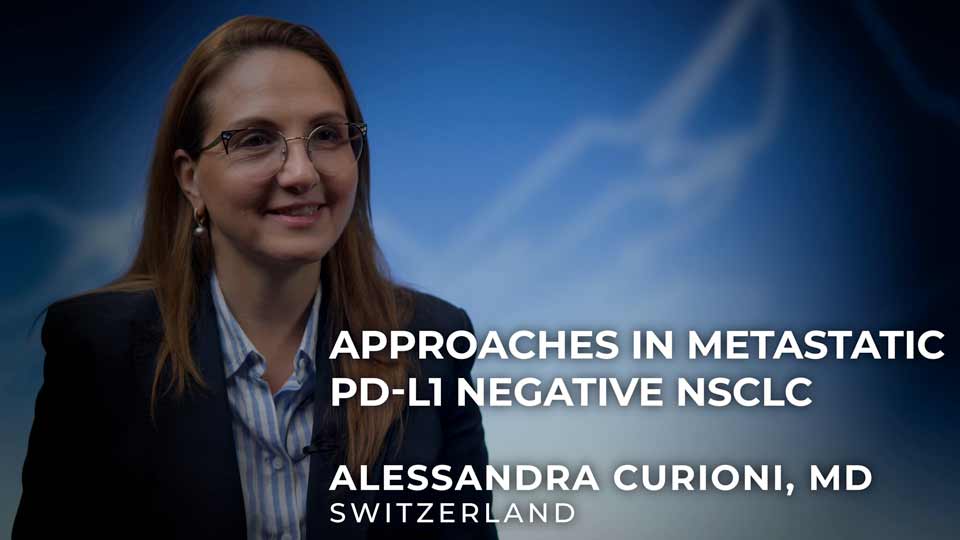
Prof. Alessandra Curioni-Fontecedro discussing approaches in metastatic PD-L1 negative NSCLC
May 04 2026
SPONSORED INTERVIEW
Advanced NSCLCImmunotherapies

Approaches in Metastatic PD-L1 Negative NSCLC: An Interview with Prof. Alessandra Curioni-Fontecedro

Prof. Alessandra Curioni-Fontecedro discusses treatment approaches in metastatic PD-L1 negative non-small cell lung cancer in this on-demand expert interview.

A. Curioni-Fontecedro
Lung Cancer Review by Solange Peters, Martin Reck, Charles Rudin
Dec 18 2025
VIRTUAL ROUNDTABLE
Advanced NSCLCSCLCADCs

2025 Approvals & Highlights

} 1 h 49 min

S. PetersC. RudinM. Reck
Sep 26 2025
ILCS 2025
Advanced NSCLC

Latest Options for Non-Oncogene Addicted Advanced NSCLC in Frontline and Beyond

} 32 min

A. Curioni-Fontecedro
Sep 26 2025
SPONSORED INTERVIEW
Advanced NSCLCTargeted Therapies

Latest Advances in Frontline EGFR+ NSCLC

} 14 min

A. Curioni-Fontecedro
Sep 26 2025
INDUSTRY SYMPOSIUM
Advanced NSCLCTargeted Therapies

Unlocking New Potentials in EGFR-Mutant NSCLC

} 30 min

A. Passaro
Sep 26 2025
ILCS 2025
Advanced NSCLC

Open Discussion on Patient Cases

} 22 min

Targeted Therapies by Oliver Gautschi, Jarushka Naidoo, Nicolas Girard
Jul 10 2025
VIRTUAL ROUNDTABLE
Advanced NSCLCTargeted Therapies

Targeted Therapies in NSCLC

} 1h 30 min

O. GautschiJ. NaidooN. Girard
IO in NSCLC by Solange Peters, Jordi Remon, Patrick Forde
Jun 25 2025
VIRTUAL ROUNDTABLE
Advanced NSCLCImmunotherapies

Immunotherapies in NSCLC

} 1h 47 min

P. FordeJ. RemonS. Peters
Girard ADCs
Oct 05 2024
INDUSTRY SYMPOSIUM
Advanced NSCLCADCs

Best Practices in Managing Adverse Events with ADCs in NSCLC

} 18 min

N. Girard
Patient Cases
Oct 04 2024
ILCS 2024
Advanced NSCLCResectable NSCLC

Patient Cases & Open Questions

} 32 min

Sandip Patel & Giannis Mountzios
Oct 04 2024
ILCS 2024
Advanced NSCLC

DEBATE: Balancing Efficacy, Toxicity, and Patient-Centered Care For IO Duration in NSCLC

} 33 min

G. MountziosS. Patel
Nov132026
ILCS 2026

The International Lung Cancer Summit 2026

Learn more about the event

S. PetersA. AddeoM. DasH. HorinouchiT. SequeiraC. LovlyD. PlanchardS. PatelA. CortelliniN. FrostG. MountziosA. Dingemans
Oct252026
ESMO 2026 SYMPOSIUM
SCLC

SCLC Symposium at ESMO 2026: From IO-Standards to the TCE Era

Learn more about the event

M. ReckS. PetersG. MountziosN. Reguart
Sep 26 2025
ILCS 2025
SCLC

Reshaping Approaches in SCLC with the Latest Advances in LS- and ES-Disease

} 34 min

R. Manochakian
Sep 26 2025
ILCS 2025
Immunotherapies

The Role of IO Added to Chemoradiation in Unresectable Stage III NSCLC

} 28 min

A. Filippi
Sep 26 2025
ILCS 2025
Immunotherapies

Tailoring IO in Res. NSCLC: Personalized Approaches for Improved Outcomes

} 36 min

P. Forde
Sep 26 2025
ILCS 2025
ADCs

The ADC Revolution in Lung Cancer: New Targets, New Opportunities

} 27 min

N. Reguart
Sep 26 2025
ILCS 2025
Targeted Therapies

DEBATE: Which Is the Better Choice in EGFR+ Advanced NSCLC?

} 31 min

T. Newsom-DavisX. Le
Sep 26 2025
ILCS 2025
Targeted Therapies

Actionable Genomic Alterations – Including HER2 and MET

} 26 min

S. Saw
Articles
Oct 16 2026
RESEARCH
Advanced NSCLCTargeted Therapies

Platinum-pemetrexed after selective RET inhibitor failure gave a median real-world PFS of 6.1 months

A. CallesJ. RemonA. CortelliniD. PlanchardB. Ricciuti
Oct 14 2026
RESEARCH
Advanced NSCLCTargeted Therapies

Durable responders to immunotherapy for NSCLC or melanoma mostly reported good health, but frequent fatigue

N. Girard
Oct 08 2026
RESEARCH
Advanced NSCLCTargeted Therapies

Amivantamab, lazertinib and bevacizumab gave a 33% response rate after osimertinib in AMAZE-lung

R. StahelM. PérolA. AddeoS. Peters
Oct 06 2026
RESEARCH
Advanced NSCLCImmunotherapies

Two-thirds of patients with PD-L1-high NSCLC received first-line immunotherapy alone in a real-world survey

D. Rodríguez-Abreu
Alfredo Addeo
Oct 05 2026
RESEARCH
Advanced NSCLCTargeted Therapies

A JCO review sets PACC mutations and exon 20 insertions apart from classical EGFR mutations in NSCLC

A. AddeoX. Le
Nikolaj Frost
Oct 04 2026
RESEARCH
Advanced NSCLCSCLCTargeted Therapies

Checkpoint inhibitors were associated with longer survival in NSCLC after allogeneic stem cell transplantation

N. FrostM. ReckA. Cortellini
Oct 03 2026
RESEARCH
Advanced NSCLCResectable NSCLCTargeted Therapies

AI-extracted records describe stage I–III NSCLC care at four Spanish hospitals before immunotherapy

A. Calles
Oct 03 2026
RESEARCH
Advanced NSCLCTargeted Therapies

KRAS inhibitors in NSCLC: modest survival gains, inevitable resistance and combinations in early trials

V. Noronha
Oct 02 2026
RESEARCH
Advanced NSCLCTargeted Therapies

Sutetinib produced responses in 71% of patients with uncommon EGFR mutations in a phase IIb trial

X. Le
Oct 02 2026
RESEARCH
Advanced NSCLCBiomarkersImmunotherapies

High tumour mutational burden was associated with more frequent and earlier immune-related adverse events in advanced NSCLC

B. Ricciuti
Oct 01 2026
RESEARCH
Advanced NSCLCTargeted Therapies

Uncommon EGFR exon 19 deletions were associated with shorter PFS on osimertinib in a 111-patient study

H. Horinouchi
Sep 30 2026
RESEARCH
Advanced NSCLCSCLCADCs

Pulmonary adverse events affected almost a third of lung cancer patients treated with ADCs in a 24-study meta-analysis

C. Rolfo
Sep 26 2026
RESEARCH
Advanced NSCLCImmunotherapies

Incidental thymic radiation dose was independently associated with metastasis and death in 1107 patients with NSCLC

B. Ricciuti
Portrait of Dr. Alexander Drilon
Sep 23 2026
CONGRESS
Advanced NSCLCTargeted Therapies

Zidesamtinib produced responses in 94% of ROS1 TKI-naive patients in ARROS-1

Sep 18 2026
INDUSTRY NEWS
Advanced NSCLCTargeted Therapies

Sevabertinib approved in the US for untreated HER2-mutant NSCLC

Sep 17 2026
RESEARCH
Advanced NSCLCTargeted Therapies

Grade 3 adverse events on the FLAURA2 combination fell from 43% during induction to 14% on osimertinib alone

D. Planchard
Sep 16 2026
CONGRESS
Advanced NSCLCADCs

First-line trastuzumab deruxtecan extended median PFS to 14.3 months in HER2-mutant NSCLC

Sep 15 2026
CONGRESS
Advanced NSCLCImmunotherapies

HARMONi-2: ivonescimab extends overall survival over pembrolizumab in China

Sep 15 2026
CONGRESS
Advanced NSCLCBiomarkersResectable NSCLC

WCLC 2026, day 4: tumour budding, BRAF class II and III, brain radiotherapy timing, and mobile CT screening

Sep 14 2026
CONGRESS
Advanced NSCLCResectable NSCLCADCs

WCLC 2026, day 3: EGFR exon 20, ROS1 and HER2 in advanced NSCLC, and 79% alive at eight years after surgery