SELECT FROM MENU

Therapy Areas
Drug Classes

       Therapy Areas

All Sessions

All Sessions

Resectable NSCLC

Resectable NSCLC

Advanced NSCLC

Advanced NSCLC

SCLC

SCLC

Biomarkers

Biomarkers

       Drug Classes

Targeted Therapies

Targeted Therapies

Immunotherapies

Immunotherapies

ADCs

ADCs

UncategorizedNovember 23, 2026

A standardised cleaning protocol left a clean EBUS-TBNA needle rinse in 92.2% of malignant cases

After a standardised needle-cleaning protocol, the TBNA needle rinse was free of malignant cells in 92.2% of malignant cases during endobronchial and transoesophageal ultrasound sampling, and positive or suspicious in 7.8%, according to a prospective European multicentre study published in Pulmonology.
Share

In brief

  • A prospective European multicentre study tested a standardised cleaning protocol for transbronchial needle aspiration (TBNA) needles reused between targets during EBUS and EUS-B.
  • Among malignant cases, needle rinse samples taken after cleaning were negative for malignant cells in 92.2% and positive or suspicious in 7.8%.
  • Cleaning took a mean of 148.8 seconds per target, and no complications were observed.
  • The needle looked clean in 89.3% of cases, but visual assessment did not correlate with the cytology of the rinse.
  • No clinical or procedural variable predicted which cleanings would fail.

Study at a glance

  • Design: prospective, multicentre, European
  • Population: 162 of 164 enrolled patients undergoing EBUS and/or EUS-B for diagnosis or staging of lung cancer or metastatic disease
  • Targets sampled: 270; malignancy confirmed in 76.3%
  • Intervention: standardised TBNA needle-cleaning protocol between targets
  • Primary endpoint: no malignant cells in the post-cleaning needle rinse
  • Main result: rinse negative in 92.2% of malignant cases, positive or suspicious in 7.8%
  • Safety: no complications observed
  • Not reported: in the abstract, the number of centres and the steps of the protocol

Needle reuse between N2 stations as the open question

EBUS and EUS-B are standard tools for mediastinal staging, and the 9th edition of the TNM classification gives weight to station-by-station nodal assessment. In principle, when the same needle samples more than one N2 station, malignant cells carried over from a positive node could make a negative node read as positive and upstage the patient. The authors describe the best sampling strategy, and needle reuse in particular, as unresolved.

A clean rinse in 92.2% of malignant cases

Of 164 patients enrolled, 162 entered the final analysis, contributing 270 sampled targets. The needle was cleaned with the standardised protocol, and post-cleaning rinse samples were assessed cytologically. In malignant cases this rinse was free of malignant cells 92.2% of the time, while 7.8% of rinses came back positive or suspicious.

Cleaning took 148.8 ± 40.9 seconds per target on average. No complications were observed.

A needle that looks clean is not a reliable guide

The needle was visually assessed as clean in 89.3% of cases, and that assessment did not correlate with the rinse cytology. No clinical or procedural variable was associated with a failed cleaning either, so the study offers no way to pick out in advance the cases in which carry-over persists.

“However, residual contamination persists in a minority of cases, indicating that needle reuse may carry a small risk of cross-contamination between targets.”Bugalho et al., Pulmonology (2026)

An alternative to routine needle exchange, with a residual risk

The authors conclude that the protocol is safe and effective in reducing contamination, and that it may be a pragmatic alternative to exchanging the needle as a matter of routine. The rinse endpoint measures cells left on the needle after cleaning; it does not measure how often those cells reached the next node and altered the staging result.

The figures set roughly two and a half minutes of cleaning per target against a positive or suspicious rinse in about one malignant case in thirteen.

Sources

  1. Pulmonology. Effectiveness of a standardised cleaning protocol to prevent malignant cell contamination during EBUS-TBNA: Results from a European multicentre study (2026-11-18). doi.org

Featuring Lung Summit faculty

This study was co-authored by Lung Summit faculty Telma Sequeira.

This article was produced independently by the Lung Summit editorial team, without industry funding or input.

i 3 On This Page

Tags
Share

       Continue With

Related Topics

Videos
Jacob Sands, Solange Peters and Martin Reck
Dec102026
VIRTUAL ROUNDTABLE
Advanced NSCLCSCLCADCs

2026 Year in Review

Learn more about the event

S. PetersJ. SandsM. Reck
Nov 13 2026
ILCS 2026
Advanced NSCLCResectable NSCLCSCLC

Panel: open questions & patient cases

Nov 13 2026
ILCS 2026
SCLC

Debate: which is the better choice in 1L ES-SCLC?

G. MountziosA. Dingemans
Nov 13 2026
ILCS 2026
SCLC

The emerging role of T-cell engagers and ADCs in SCLC

N. Frost
Nov 13 2026
ILCS 2026
Advanced NSCLC

New compounds and combinations for non-oncogene-addicted advanced NSCLC

A. Cortellini
Nov 13 2026
ILCS 2026
Resectable NSCLCImmunotherapies

Latest options in early-stage NSCLC: novel IO approaches for improved outcomes

S. Patel
Nov 13 2026
INDUSTRY SYMPOSIUM
Advanced NSCLCResectable NSCLCTargeted Therapies

One Backbone, Many Opportunities: Osimertinib Across the EGFRm NSCLC Journey

M. Hochmair
Nov 13 2026
INDUSTRY SYMPOSIUM
Advanced NSCLCTargeted Therapies

First-Line NSCLC in Transition: Opportunities and Challenges for KRAS G12C

A. Curioni-Fontecedro
Nov 13 2026
ILCS 2026
Advanced NSCLCADCs

The ADC wave: integrating new agents in NSCLC

D. Planchard
Nov 13 2026
ILCS 2026
Advanced NSCLCTargeted Therapies

Targeting (K)RAS with new compounds

C. Lovly
Nov 13 2026
ILCS 2026
Advanced NSCLCTargeted Therapies

Other actionable genomic alterations, incl. HER2 and ROS1

T. Sequeira
Nov 13 2026
ILCS 2026
Advanced NSCLCTargeted Therapies

New standards in EGFR- and ALK-positive NSCLC

H. Horinouchi
Nov 13 2026
ILCS 2026
Biomarkers

ctDNA-guided decisions in lung cancer: ready or not?

M. Das
Nov 13 2026
ILCS 2026

Welcome & introduction

S. PetersA. Addeo
Prof. Martin Reck
Nov 04 2026
SPONSORED EXPERT TALK
Resectable NSCLCImmunotherapies

MDT-BRIDGE in Resectable and Borderline Resectable NSCLC

Prof. Martin Reck presents and discusses the phase 2 MDT-BRIDGE trial in resectable and borderline resectable non-small cell lung cancer in this on-demand expert talk.

M. Reck
Dr. Jacob Sands
Nov 04 2026
SPONSORED INTERVIEW
SCLCImmunotherapies

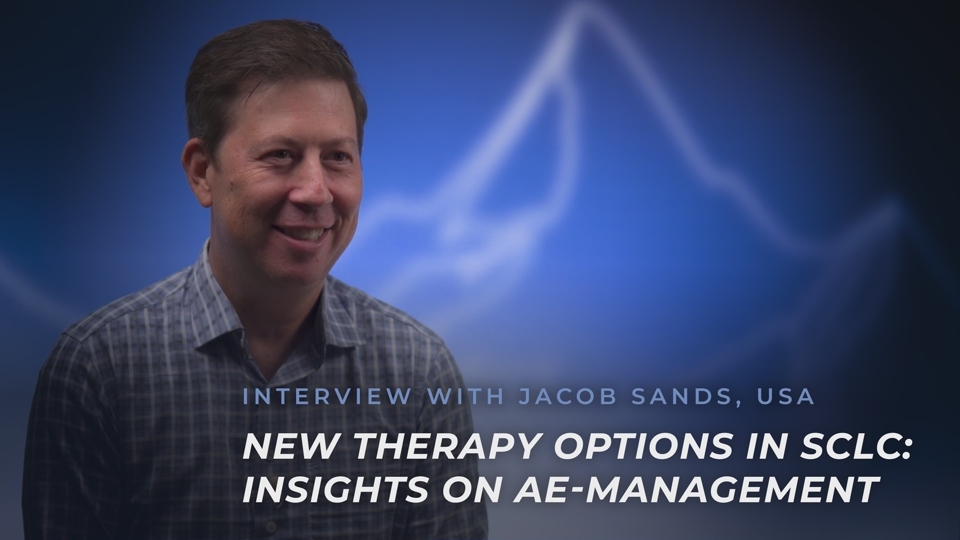
New Therapy Options in SCLC and AE Management

Dr. Jacob Sands discusses new treatment options in small cell lung cancer and the management of their adverse events in this on-demand expert interview.

J. Sands
Oct252026
ESMO 2026 SYMPOSIUM
SCLCImmunotherapies

SCLC Symposium at ESMO 2026: From IO-Standards to the TCE Era

A symposium at ESMO Congress 2026 on small-cell lung cancer, from immunotherapy standards to the emerging era of DLL3 T-cell engagers. Recording to follow.

M. ReckS. PetersG. MountziosN. Reguart
Oliver Gautschi on EGFR+ NSCLC
Jul 20 2026
SPONSORED INTERVIEW
Advanced NSCLCTargeted Therapies

Advances in EGFR+ NSCLC: An Interview with Prof. Oliver Gautschi

Prof. Oliver Gautschi discusses recent advances in the treatment of EGFR-mutant non-small cell lung cancer in this on-demand expert interview.

O. Gautschi
Nov132026
ILCS 2026

The International Lung Cancer Summit 2026

The International Lung Cancer Summit returns on 13 November 2026 – on site in Lausanne and streamed online. A one-day programme of practice-changing lung cancer debates, chaired by Solange Peters and Alfredo ...

S. PetersA. AddeoM. DasH. HorinouchiT. SequeiraC. LovlyD. PlanchardS. PatelA. CortelliniN. FrostG. MountziosA. Dingemans
Prof. Alessandra Curioni-Fontecedro discussing approaches in metastatic PD-L1 negative NSCLC
May 04 2026
SPONSORED INTERVIEW
Advanced NSCLCImmunotherapies

Approaches in Metastatic PD-L1 Negative NSCLC: An Interview with Prof. Alessandra Curioni-Fontecedro

Prof. Alessandra Curioni-Fontecedro discusses treatment approaches in metastatic PD-L1 negative non-small cell lung cancer in this on-demand expert interview.

A. Curioni-Fontecedro
Articles
Nov 23 2026
RESEARCH
Advanced NSCLCTargeted Therapies

First-treatment checkpoint inhibition was associated with fewer CNS metastases in advanced NSCLC

N. GirardM. Pérol
Nov 16 2026
RESEARCH
Advanced NSCLCResectable NSCLC

South Asian experts agree consensus recommendations for NSCLC, with low-cost options built in

V. Noronha
Nov 16 2026
RESEARCH
Immunotherapies

Lenvatinib plus pembrolizumab gave a median PFS of 22.1 months in pretreated thymic carcinoma and B3 thymoma

J. RemonN. GirardN. Reguart
Nikolaj Frost
Nov 15 2026
RESEARCH
Advanced NSCLCResectable NSCLC

A 454-patient single-cell atlas links NSCLC tumour cell states to metastasis and survival

N. Frost
Charles Rudin
Nov 14 2026
RESEARCH
Advanced NSCLCSCLCTargeted Therapies

SCLC transformation in 5 of 11 patients given first-line osimertinib with platinum and etoposide

C. Rudin
Nov 14 2026
RESEARCH
Advanced NSCLCBiomarkersADCs

Membrane share of TROP2 identified longer PFS on Dato-DXd in nonsquamous NSCLC

J. SandsM. PérolN. Girard
Nov 12 2026
RESEARCH
BiomarkersResectable NSCLCTargeted Therapies

MTAP loss seen in 17% of NSCLC by immunohistochemistry, with PRMT5 inhibitors active in TKI-resistant cells

Z. Piotrowska
Nov 04 2026
RESEARCH
Advanced NSCLCImmunotherapies

Local ablative therapy alone after durvalumab was followed by an mOS of 18.7 months in oligoprogressive NSCLC

A. FilippiL. Hendriks
Nov 01 2026
RESEARCH
Advanced NSCLCBiomarkersTargeted Therapies

Secondary ALK resistance mutations found in 8% of ALK-positive NSCLC samples on genomic profiling

P. Hofman
Nikolaj Frost
Oct 31 2026
RESEARCH
Resectable NSCLCImmunotherapies

KEYNOTE-867 tested pembrolizumab with SBRT in unresected stage I or II NSCLC

N. Frost
Oct 31 2026
RESEARCH
Advanced NSCLCTargeted Therapies

VTE reporting in fusion-positive NSCLC trials is fragmented across publications and registries

A. Cortellini
Charles Rudin
Oct 30 2026
RESEARCH
SCLCImmunotherapies

Tarlatamab gave an mOS of 13.6 months against 8.4 with chemotherapy in SCLC at extended DeLLphi-304 follow-up

C. RudinG. Mountzios
Martin Reck
Oct 30 2026
RESEARCH
Advanced NSCLCResectable NSCLCImmunotherapies

Neoadjuvant durvalumab plus chemotherapy led to resection in 74.6% of patients in the MDT-BRIDGE trial

M. ReckN. GirardA. Filippi
Oct 29 2026
RESEARCH
BiomarkersResectable NSCLCImmunotherapies

Early ctDNA clearance was associated with longer event-free survival in resectable NSCLC in NeoCOAST-2

T. CasconeP. Forde
Oct 29 2026
RESEARCH
Advanced NSCLCImmunotherapies

Adding chemotherapy to pembrolizumab lengthened PFS in PD-L1-high advanced NSCLC in PERSEE

M. Pérol
Oct 27 2026
RESEARCH
SCLCImmunotherapies

Tarlatamab added to durvalumab maintenance extended OS in extensive-stage SCLC

J. SandsM. PérolA. Dingemans
Oct 26 2026
INDUSTRY NEWS
Advanced NSCLCResectable NSCLCTargeted Therapies

Divarasib extended OS over sotorasib or adagrasib in previously treated KRAS G12C-mutated NSCLC

Oct 23 2026
RESEARCH
SCLCImmunotherapies

KEYVIBE-008 tested vibostolimab coformulated with pembrolizumab plus chemotherapy in first-line ES-SCLC

J. SandsM. Reck
Oct 22 2026
RESEARCH
Advanced NSCLC

TP53 Y220C occurs in 0.7% of NSCLC and more often in EGFR-mutant tumours, in an ETOP study of 28,244 patients

R. StahelL. BubendorfL. HendriksS. PetersS. Finn
Oct 21 2026
SPONSORED
Advanced NSCLCImmunotherapies

The “tail of the curve” is real: long-term survival in PD-L1–negative metastatic NSCLC

A. Curioni-Fontecedro